

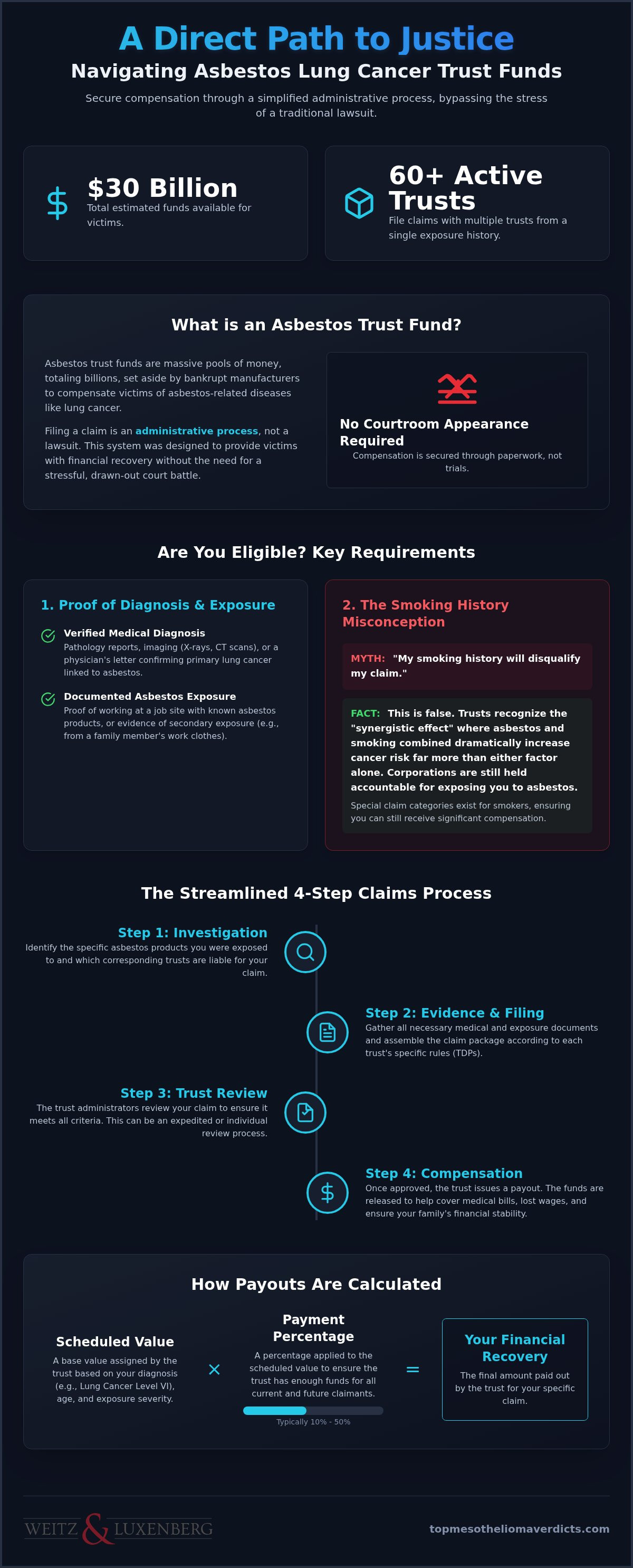
You don't have to step foot in a courtroom to hold a multibillion-dollar corporation accountable for your illness. While the idea of a traditional lawsuit feels exhausting when you're focusing on your health, there's a quieter, more direct path to justice. Currently, over 60 active trusts hold approximately $30 billion specifically set aside for victims. Accessing an asbestos lung cancer trust fund allows you to secure compensation through a simplified administrative process, bypassing the stress of a trial entirely.
It's natural to feel hesitant, especially if you're worried that a history of smoking might disqualify you or if the companies you worked for decades ago have since declared bankruptcy. We understand those anxieties, and we know that your diagnosis is the result of corporate negligence, regardless of your personal habits. You deserve financial stability for your medical bills and your family's future without the burden of a high-stakes legal fight.
This article will show you exactly how to navigate these funds in 2026. We'll cover how to identify the companies responsible for your exposure, the specific steps to file a successful claim, and how to maximize your recovery through expert guidance.
Key Takeaways
- Learn how an asbestos lung cancer trust fund provides a path to recovery without the stress of a traditional lawsuit.
- Discover the specific medical and occupational evidence required to qualify for compensation from bankrupt asbestos manufacturers.
- Understand the streamlined administrative process that allows you to secure funds without ever having to step foot in a courtroom.
- Gain insight into how payout amounts are calculated using scheduled values and payment percentages based on your unique history.
- See how a national leader in asbestos law handles the complex paperwork so your family can focus entirely on health and recovery.
What is an Asbestos Lung Cancer Trust Fund?
For decades, corporations prioritized profits over the safety of the workers who handled their asbestos products. When the resulting health crisis led to a wave of litigation, many of these manufacturers sought protection in the bankruptcy courts. This led to the creation of Asbestos bankruptcy trusts. These are massive, court-ordered pools of capital reserved specifically for victims. Unlike a traditional court case, an asbestos lung cancer trust fund claim is an administrative request. You aren't entering a legal battle against a company; you're filing for compensation from a fund that's already been established for your benefit.
There are currently more than 60 active trusts in operation across the country. Collectively, these funds hold an estimated $30 billion in remaining assets as of 2026. These trusts were established under Section 524(g) of the U.S. Bankruptcy Code, which ensures the money is legally shielded from other corporate creditors. It's dedicated entirely to providing financial recovery for those diagnosed with asbestos-related illnesses.
The Purpose of Trust Funds for Lung Cancer Victims
Trust funds offer a vital safety net when a responsible company no longer exists in its original form. Even if a manufacturer has been defunct for years, their trust remains available to pay out valid claims. One of the most significant benefits is the ability to file multiple claims. Because most industrial workers were exposed to products from various manufacturers, you can often recover money from several different trusts at once. This administrative path is designed to be much faster than a trial, helping you secure funds for medical bills and family stability without a long, drawn-out court fight.
Why These Funds Exist: Corporate Responsibility and Bankruptcy
The creation of these trusts was a mandatory condition for companies trying to reorganize under bankruptcy law. They weren't allowed to simply walk away from their debts to sick workers. Instead, they were forced to provide the funding necessary to compensate victims for years to come. This structure protects your right to financial recovery regardless of a company's current financial health. It also creates a predictable, standardized system for valuing an asbestos lung cancer trust fund claim. Each trust uses specific criteria to evaluate the severity of your diagnosis and the extent of your exposure, ensuring that every claimant receives a fair portion of the available assets.
Eligibility Criteria for Asbestos Lung Cancer Trust Fund Claims
Qualifying for an asbestos lung cancer trust fund requires meeting specific criteria detailed in a document called the Trust Distribution Procedures (TDP). These procedures serve as the legal rulebooks for each individual fund. They define exactly what medical and exposure evidence you must submit to receive a payout. While each trust is managed independently, the core requirements remain consistent: a verified medical diagnosis and documented proof of exposure. You can file these claims as a patient or as a family member representing a loved one in a wrongful death case.
Required Medical Evidence and Documentation
You'll need imaging reports like X-rays or CT scans that show asbestos-related markers, such as pleural plaques or asbestosis. Pathology reports or a formal letter from a physician are also essential to link the illness to asbestos exposure. A "Level VI" lung cancer claim typically requires a diagnosis of primary lung cancer combined with evidence of an underlying asbestos-related disease or a significant history of asbestos exposure. These medical records provide the foundation for your claim and ensure the trust administrators can validate your health status quickly.
Addressing the Smoking History Misconception
Many people believe that a history of smoking automatically disqualifies them from compensation. This is simply not true. Scientific research shows that asbestos and smoking have a "synergistic effect," meaning the combination increases cancer risk far more than either factor alone. Trusts recognize this reality and have established specific categories for smokers that still result in significant financial payouts. A U.S. Government Accountability Office report highlights how these trusts have been structured to handle a wide range of claimant histories fairly. Your past habits don't excuse a corporation's decision to expose you to a known carcinogen.
Proving Occupational or Secondary Exposure
Proving you were around asbestos decades ago can seem like a massive hurdle. We simplify this by using employment records, union logs, and Social Security statements to reconstruct your work history. Witness affidavits from former co-workers are also powerful tools to confirm the presence of specific asbestos-containing products on job sites. We also assist families with secondary exposure claims. These cases involve family members who were exposed to "take-home" dust brought back on a worker's clothes, which is a recognized path to recovery under most trust rules. If you're unsure if your work history qualifies, you can review recent results to see how others in similar trades secured their recovery.
The Administrative Claims Process: Compensation Without Going to Court
Securing financial recovery from an asbestos lung cancer trust fund doesn't require you to step foot in a courtroom. Unlike a traditional lawsuit against an active company, this process is entirely administrative. There is no judge, no jury, and no stressful cross-examination. This path is significantly less adversarial, allowing you to seek justice from the comfort of your home. Your legal team manages the complexities, acting as your advocate while you focus on your health and family. The legal framework for these funds is established under the U.S. Bankruptcy Code for asbestos trusts, ensuring a structured and fair way for victims to access compensation without the volatility of a trial.
Step 1: The Exposure and Medical Review
Your legal team begins by identifying every bankrupt company whose products you likely encountered during your career. We use extensive databases to match your work history with known asbestos manufacturers. Simultaneously, medical experts review your records to ensure they meet the specific medical criteria set by each trust. It's often possible to pursue multiple avenues for recovery, including filing both asbestos trust fund and lawsuit claims simultaneously if you were exposed to products from both bankrupt and active companies. This dual approach helps maximize your total financial recovery.
Step 2: Filing the Claim Package
Once the evidence is gathered, your attorney submits a formal claim package to the trust's processing facility. This package includes your medical diagnosis, work history, and supporting affidavits. The trust then reviews the claim for completeness and validity based on their established rules. If the trust administrators issue a deficiency notice or request more evidence, your legal team handles these requests directly. This keeps the burden off you and ensures the claim moves forward efficiently. Most of this work happens behind the scenes, allowing you to avoid the logistical headaches of a typical court case.
Step 3: Offer, Acceptance, and Payment
After the review is complete, the trust issues a settlement offer. This amount is calculated based on the trust's current asbestos trust fund payout percentages, which are adjusted periodically to ensure the fund remains available for future victims. Once you accept the offer, the trust issues payment. These payments are sometimes distributed in installments to preserve the fund's longevity, providing a steady source of financial support for medical expenses and your family's legacy. This administrative process is designed to be faster and more predictable than litigation, putting money in your hands when you need it most.
Factors That Influence Asbestos Trust Fund Payout Amounts
Payouts from an asbestos lung cancer trust fund are never "one size fits all." Instead, they are meticulously calculated based on the severity of your diagnosis and the documented extent of your exposure. Each individual trust establishes what is known as a "Scheduled Value" for lung cancer, which serves as a baseline for compensation. However, the actual check you receive is a percentage of that value. Trusts utilize payment percentages to ensure that their assets are managed responsibly and remain available for future claimants who may not be diagnosed for many years. The number of trusts you can file against is the most significant factor in your total cumulative recovery.
Expedited Review vs. Individual Review
Expedited Review is the most common path for claimants. It provides a fixed, pre-determined payout amount for claims that meet standard medical and exposure criteria. This route is designed for speed, allowing families to access funds without a lengthy evaluation process. In contrast, Individual Review is reserved for unique cases that may deserve higher compensation than the standard scheduled value. This might include younger victims or those with exceptionally high medical expenses. An experienced attorney determines the best strategy by weighing the immediate need for funds against the potential for a larger recovery through the more detailed individual review process.
The Synergistic Effect and Valuation
Trusts also weigh the combination of asbestos exposure and other risk factors, such as smoking. This is often referred to as the synergistic effect, where the presence of asbestos drastically multiplies the dangers of other carcinogens. Your medical classification also plays a role in the final dollar amount. A "Level VI" lung cancer claim, which requires evidence of an underlying asbestos-related disease like asbestosis, typically receives a higher valuation than a "Level V" claim. Navigating these categories requires a deep understanding of medical documentation. For many families, this is just one part of a larger legal strategy, which may also involve looking at a mesothelioma litigation guide for families to understand how different asbestos diseases are treated in the legal system.
To find out which trusts you qualify for and what your claim might be worth, you can request a comprehensive case review at no upfront cost.
How Weitz & Luxenberg Navigates the Asbestos Trust System
Choosing the right legal partner is the most critical decision you'll make in your recovery journey. Weitz & Luxenberg has been a national leader in this field for 40 years, standing as a formidable ally for families facing the realities of an asbestos-related diagnosis. We've secured over $13 billion in total compensation for our clients, a figure that reflects our deep experience and relentless pursuit of justice. In the first half of 2026, our firm was recognized as the #1 filer of asbestos injury cases in the United States. This massive scale of operations means we have the resources to handle even the most complex asbestos lung cancer trust fund claims with precision and care.
Success in these administrative claims depends on the quality of the evidence provided. We maintain an extensive internal database of thousands of job sites and asbestos-containing products across the country. This proprietary resource allows us to prove your exposure quickly and accurately, often identifying responsible companies that you might not even remember. We handle every aspect of the paperwork and investigation, allowing you to focus entirely on your health. Because we operate on a contingency fee basis, you'll never face any upfront costs or out-of-pocket expenses. We only receive a fee if we successfully secure compensation for you.
National Reach with Individualized Advocacy
Our firm provides the resources of a national powerhouse while maintaining the personal attention of a dedicated advocate. With a team of over 500 professionals, we have the bandwidth to represent clients in all 50 states. You won't need to travel to secure your recovery; we bring our expertise to you. We're also deeply committed to those who served our country. If your exposure occurred during your time in the armed forces, our 2026 Mesothelioma claims guide for veterans offers specific guidance on navigating both trust funds and VA benefits.
Maximizing Your Recovery Across Multiple Trusts
We don't settle for the easiest path. Our attorneys investigate every possible source of compensation, often filing claims against dozens of different trusts for a single client. This comprehensive approach is designed to maximize your total recovery. Our commitment to high-stakes results is proven by our track record, including a record $117 million verdict in 2025. We're ready to lead you through this process with a steady hand and a clear sense of purpose. Contact us today for a free, no-obligation case review to discover which asbestos lung cancer trust fund options are available to you and your family.
Secure Your Family's Future Without the Stress of Trial
You've worked hard your entire life; you shouldn't have to spend your time fighting in a courtroom now. Accessing an asbestos lung cancer trust fund provides a dignified, administrative path to the financial recovery you deserve. These funds are specifically designed to bypass the adversarial nature of traditional lawsuits, ensuring that corporate negligence is addressed without adding to your physical or emotional burden. By choosing an established ally, you ensure that every responsible party is held accountable while you focus entirely on your health and your family.
Weitz & Luxenberg stands as a national leader in this space. As the #1 filer of asbestos injury cases in the U.S. for the first half of 2026, our firm has recovered over $13 billion for victims. We operate on a contingency basis, meaning there are no fees unless we win your case. You don't have to navigate this complex system alone. Take the first step toward securing your legacy and ensuring your medical needs are met. Help is available, and you deserve a protector who knows how to win.
Get a Free Asbestos Trust Fund Case Review from Weitz & Luxenberg
Frequently Asked Questions
Can I file an asbestos trust fund claim if I was a smoker?
Yes, you can still qualify for compensation from an asbestos lung cancer trust fund even if you have a history of smoking. Corporations often try to blame smoking for your illness, but medical science recognizes that asbestos exposure and tobacco use work together to multiply cancer risks. Most trusts have established specific claim categories and payout levels for smokers, ensuring you aren't unfairly excluded from recovery due to your personal habits or medical history.
How long does it take to get a payout from an asbestos trust fund?
Most claimants receive their first payments within a few months of filing, though the exact timeline depends on the review process you choose. Expedited reviews offer a fixed payout and move much faster through the trust's administrative system. If your case requires an individual review to secure a higher valuation, it may take a year or longer to finalize. Your legal team works to ensure all documentation is complete to prevent unnecessary delays.
Do I need a lawyer to file a claim with an asbestos trust?
While you aren't legally required to hire an attorney, navigating dozens of different trust funds with unique criteria is extremely difficult alone. A specialized firm like Weitz & Luxenberg uses proprietary databases to match your specific work history with bankrupt manufacturers. We handle the complex paperwork and medical evidence required to maximize your recovery. This allows you to focus on your health while we ensure no potential source of compensation is overlooked.
What is the difference between an asbestos lawsuit and a trust fund claim?
An asbestos lawsuit is a legal action filed in court against a company that is still in business, often involving a judge or jury. In contrast, a trust fund claim is an administrative request for money from a pool of funds set aside by a bankrupt company. Trust claims don't require courtroom appearances or depositions. Many victims pursue both paths simultaneously to recover the maximum amount possible from every company responsible for their exposure.
Is there a time limit for filing a trust fund claim?
Yes, every trust fund has a specific deadline for filing, which is usually two to three years from the date of your diagnosis or the passing of a loved one. These deadlines are independent of state laws and can vary between different trusts. It's vital to act quickly after a diagnosis to preserve your right to compensation. We help families identify these critical dates and file the necessary paperwork before these windows of opportunity close forever.
Can family members file a claim if a loved one has already passed away?
Yes, surviving family members have the right to file a claim on behalf of a loved one who passed away from asbestos-related lung cancer. These are often called wrongful death claims and help secure a family's financial legacy. You'll need to provide the same evidence of exposure and medical diagnosis that the patient would have submitted. Our team assists families in gathering these records to ensure their loved one's story is heard and their sacrifices are recognized.
How much money is typically in an asbestos lung cancer trust fund payout?
Payout amounts vary significantly based on your specific exposure history and the number of trusts you can file against. While individual trusts use payment percentages to manage their assets, the average total compensation for victims filing against multiple funds typically ranges between $300,000 and $400,000. Your final recovery depends on factors like the severity of your illness and the specific scheduled value assigned to lung cancer by each individual trust fund administrator.
Will filing a trust fund claim affect my VA benefits or Social Security?
No, filing a claim with an asbestos lung cancer trust fund does not reduce or eliminate your VA benefits or Social Security payments. These trust fund payouts are considered a form of personal injury compensation and are generally separate from government benefit programs. In fact, many veterans successfully pursue both VA disability benefits and trust fund claims at the same time. This allows you to maximize your total monthly and lump-sum financial support without risking your existing coverage.


