

While many families fear the window for compensation is closing, there is still approximately $30 to $35 billion remaining in active asbestos trust funds as we head into 2026. This vast sum is distributed based on specific asbestos trust fund payout percentages, a mechanism that often causes more confusion than clarity. It's frustrating to see a "scheduled value" of $350,000 for a mesothelioma claim only to realize the actual check might be a fraction of that amount. You've already endured a devastating diagnosis; you shouldn't have to decode complex financial formulas to secure your family's future.
We understand this burden and provide the transparency you deserve. This guide will demystify how these percentages work, provide current 2026 trust levels, and show you how to maximize your total recovery. We'll examine why some trusts like NARCO pay 100% while others pay significantly less. You'll learn how a national leader with 40 years of experience can help you navigate these filings on a contingency basis to ensure no available dollar is left on the table. Our goal is to alleviate the stress of the process while projecting the formidable strength needed to secure the results you need.
Key Takeaways
- Learn the critical difference between a claim's "scheduled value" and the actual check you receive to set realistic expectations for your family's recovery.
- View the most recent 2026 asbestos trust fund payout percentages to identify which specific funds currently offer the highest levels of compensation.
- Discover how the "stacked claim" approach allows the average victim to qualify for 15 to 25 different trusts, significantly increasing the total financial award.
- Understand how professional occupational mapping can trace your work history back decades to uncover exposures you didn't know were eligible for filing.
- Find out why working with the nation’s #1 filer provides the formidable strength needed to navigate the complexities of over 60 active trusts with ease.
What Are Asbestos Trust Fund Payout Percentages?
When major corporations faced thousands of lawsuits for asbestos exposure, many sought protection through Chapter 11 reorganization. This legal shift led to the creation of Asbestos bankruptcy trusts, a system now holding over $30 billion to compensate victims. These trusts aren't bottomless reservoirs. To ensure that a person diagnosed in 2026 receives the same fair treatment as someone diagnosed a decade from now, administrators implement asbestos trust fund payout percentages. These rates act as a financial stabilizer, balancing the trust's total assets against the projected volume of future claims.
Each trust operates under a specific set of rules known as Trust Distribution Procedures (TDP). These documents outline how claims are evaluated and how much each specific illness is worth. Because administrators must account for decades of potential liabilities, paying 100% of a claim's value is rare. Instead, they pay a calculated portion to preserve capital for the long term. This ensures the trust remains a viable resource for every family affected by these companies' past negligence.
The Purpose of Payment Percentages
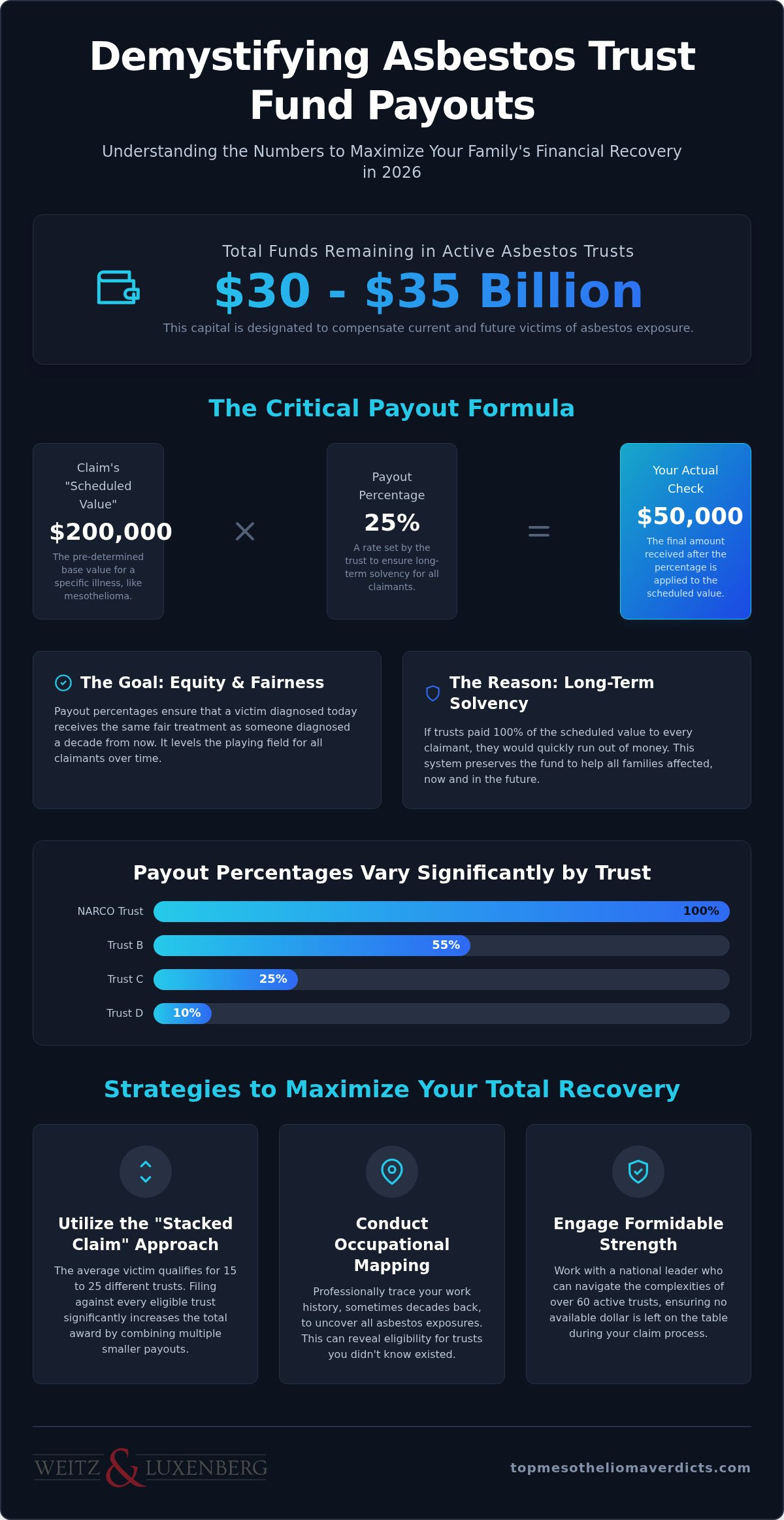
The primary goal of these percentages is equity. If a trust paid every claimant the full value of their claim immediately, the fund would likely run dry within a few years. This would leave future victims with no path to recovery. Administrators periodically review their financial health and the number of new filings to adjust these rates accordingly. A Payment Percentage is the ratio of the liquidated value actually paid to the claimant. By carefully managing this ratio, the trust remains solvent and functional for everyone, regardless of when they file.
Liquidated Value vs. Actual Payout
Understanding your potential recovery requires distinguishing between the "Scheduled Value" and your actual check. The trust assigns a base liquidated value to specific diseases based on their severity. Mesothelioma typically receives the highest scheduled value; asbestos lung cancer and non-malignant conditions are assigned lower base amounts. However, your actual recovery is determined by applying the current asbestos trust fund payout percentages to that base number.
- Scheduled Value: The pre-determined total value of a claim (e.g., $200,000).
- Payout Percentage: The current rate the trust can afford to pay (e.g., 25%).
- Actual Payout: The final amount sent to the claimant ($50,000).
This formula is exactly why it's vital to work with an advocate who can identify every possible trust you're eligible for. While a single payout might seem small, stacking multiple claims across different trusts is the key to a significant total recovery.
Factors Influencing Trust Payout Rates in 2026
The stability of asbestos trust fund payout percentages isn't fixed; it's a living calculation influenced by economic shifts and legal trends. Trust solvency is the most significant factor. If a fund's assets decrease due to market volatility or high payout years, the percentage often drops to preserve the remaining capital. Conversely, a strong investment portfolio can lead to stable or even increased rates. A U.S. Government Accountability Office report highlights how these trusts manage billions in assets, balancing current payouts with the need for long-term survival. As we move through 2026, administrators are also integrating inflation adjustments to ensure that the compensation awarded maintains its real-world value for medical expenses and family support.
Claim volume also plays a pivotal role. When a specific trust sees a surge in new filings, the board must decide if the current payout rate is sustainable. If the volume of claims exceeds the trust's actuarial projections, they may lower the percentage to ensure they don't run out of money before future victims can file. This is why timing and professional guidance are so critical; you want to file while the trust is well-funded and the percentages are favorable.
The Periodic Review Process
Trust boards typically meet annually or semi-annually to re-evaluate their financial position. They apply a "pro-rata" principle, which means they aim to pay every eligible claimant a fair portion of their claim's value without exhausting the fund prematurely. These reviews are methodical and transparent, though they can result in sudden changes to payout levels. If you've already received a payment and the percentage later increases, some trusts offer "supplemental payments" to bridge the gap. However, this isn't guaranteed and depends entirely on the specific trust's rules.
Disease Categorization and Payout Tiers
Most trusts utilize eight standard disease levels to categorize claims. Mesothelioma is consistently placed in the highest tier, receiving priority processing and the largest scheduled values. Other categories include lung cancer, other cancers, and various non-malignant conditions like asbestosis. Eligibility also extends to family members who suffered secondary exposure, such as a spouse who inhaled fibers while washing a worker's clothes. Identifying every tier you qualify for is a complex task that requires deep legal experience. If you're unsure where your diagnosis fits, you can review recent successful outcomes to understand how similar cases were categorized and compensated.
2026 List of Major Asbestos Trusts and Payout Trends
The landscape of available compensation remains robust yet varied as we move through 2026. While many asbestos trust fund payout percentages currently fall within a range of 1% to 35%, specific funds offer significantly higher recovery levels depending on their remaining assets. For example, the W.R. Grace trust currently pays approximately 30.1%, while the Johns-Manville trust sits at roughly 5.1%. These numbers aren't static. The record-breaking verdicts seen throughout 2025 have placed new pressure on trust administrators to ensure their settlement offers reflect the current reality of medical costs and jury expectations. This environment makes it essential to understand which companies have the strongest reserves.
High-Value Trusts to Watch in 2026
Large "anchor" trusts form the foundation of most financial recovery plans. Funds like Halliburton, currently paying 60%, and NARCO, which remarkably remains at 100%, possess significant capital that often exceeds $1 billion. These high-value trusts are critical because they provide a stable source of compensation even when other funds face depletion. A U.S. Government Accountability Office report confirms that these structured funds are designed to provide a reliable path to justice without the long delays of a traditional trial. To see how these trust claims integrate with other legal options, you can read our Mesothelioma Litigation: 2026 Guide for Families for a more comprehensive look at the process.
New and Emerging Bankruptcy Trusts
The 2025 and 2026 period has seen several companies finally emerge from the Chapter 11 process, resulting in the launch of brand-new funds. These emerging trusts often begin their operations with initial "test" percentages that can be more favorable than those of older, more established funds. Filing early with a newly created trust can be a strategic advantage. Administrators sometimes lower their asbestos trust fund payout percentages after the first wave of claims reveals a higher-than-expected volume of victims. We track these emerging funds in real time to ensure your claims are filed at the most opportune moment. This proactive approach helps secure the maximum possible amount from every new source of compensation as it becomes available.
Strategies to Maximize Your Total Trust Fund Recovery
Maximizing your financial recovery isn't about luck; it's about investigative precision. While individual asbestos trust fund payout percentages might seem modest when viewed in isolation, the true path to a significant award lies in the "Stacked Claim" approach. Most victims don't realize they were exposed to products from dozens of different companies throughout their careers. By identifying every liable party, the average claimant can often file against 15 to 25 different trusts. When these individual payments are combined, they form a substantial financial safety net for your family. Our role is to ensure no stone is left unturned and every eligible claim is filed with the formidable strength of the nation's leading advocate.
Tracing Exposure Across Decades
The success of your claim depends on "Occupational Mapping," a process that traces your work history back 40 or 50 years. We maintain a massive, proprietary database of thousands of job sites across the country, from shipyards and power plants to residential construction projects. This resource allows us to identify specific asbestos brands that were present at your job sites, even if you don't remember the product names yourself. We supplement this data with co-worker testimony and product identification records to build an airtight "Exposure Evidence" file. For those who worked in trades, our Asbestos & Lung Cancer Claims: 2026 Construction Guide provides specific examples of how these site-specific histories are reconstructed to justify higher-than-average payouts.
Navigating the 'Individual Review' Option
When you file a claim, you generally choose between two paths: Expedited Review or Individual Review. Expedited Review is the faster route, offering a fixed, standard payout based on the current asbestos trust fund payout percentages. It's designed for efficiency and provides a quick check for families in immediate need. However, in certain circumstances, we may recommend an Individual Review. This path involves a manual evaluation by trust administrators and is often better for claimants who have:
- Extraordinary medical expenses that exceed standard projections.
- A diagnosis at a significantly younger age.
- Unique family circumstances or loss of income that warrant higher compensation.
While an Individual Review takes longer, the potential for a higher net recovery can be worth the wait. We analyze the specific rules of each trust to determine which path offers the best outcome for your unique situation. This strategic decision making is part of our commitment to acting as your professional guide through a complex process. If you are ready to see which trusts might apply to your history, you can request a free case evaluation to begin the mapping process today.
Why Weitz & Luxenberg is the Leader in Trust Fund Advocacy
Securing the maximum compensation from a complex web of bankruptcy trusts requires more than just filling out forms. It demands the formidable strength of a national leader. As the #1 filer of asbestos injury cases in the U.S. as of 2026, Weitz & Luxenberg provides an unmatched level of data-driven advocacy. With over 40 years of specialized experience and $13 billion secured in verdicts and settlements, we possess the resources to track down every possible dollar. Trust administrators respect the claims we submit because they are backed by a reputation for meticulous preparation and established success. When we represent your family, we leverage this authority to ensure your asbestos trust fund payout percentages result in the highest possible financial recovery.
Our commitment to justice is built on a contingency-based promise. We believe that every family deserves elite legal representation regardless of their current financial situation. This means there are no upfront costs and no out-of-pocket expenses for you. We only receive a fee if we successfully secure compensation on your behalf. This low-pressure approach allows you to focus on your health and your loved ones while we handle the high-stakes legal work required to hold negligent corporations accountable.
National Reach, Individual Empathy
We operate as a seasoned protector for families across all 50 states. Our national reach means you don't have to worry about travel or logistical burdens; we handle the entire process from our offices while staying deeply connected to your individual needs. We pride ourselves on being a "gentle ally" for those in distress. While we are aggressive in our pursuit of trust administrators and defendants, we maintain a compassionate and reassuring presence for our clients. During your free, no-obligation case evaluation, you can expect a clear, professional guide who will listen to your story and outline a purposeful path forward without any high-pressure tactics.
Starting Your Claim Today
Time is a critical factor in asbestos litigation. As we move through 2026, the statutes of limitations continue to pose a risk to those who wait too long to file. Each state has specific deadlines that begin the moment a diagnosis is made. Starting the process now ensures that your exposure mapping is completed while evidence and testimony are most accessible. We make it easy to begin by providing a comprehensive "Compensation Packet" that helps us start tracing your work history immediately. Don't let the complexity of asbestos trust fund payout percentages or filing requirements delay your family's security. Contact Weitz & Luxenberg for a Free Case Review to ensure your rights are protected by the nation's premier asbestos law firm.
Take the First Step Toward Financial Security
Managing the complexities of over 60 active trusts requires a partner with the resources to investigate every detail of your work history. By understanding how asbestos trust fund payout percentages function, you can set realistic expectations while working to maximize your total recovery through the stacked claim approach. Timing is essential in 2026. State laws and trust fund rules place strict deadlines on when you can file, making it vital to start your exposure mapping as soon as possible.
As the #1 filer of asbestos cases in the U.S., Weitz & Luxenberg brings 40 years of specialized advocacy and a legacy of $13 billion in total recoveries to your side. We handle the entire process on a contingency basis. This ensures you have access to a national powerhouse without any financial risk. You don't have to face this burden alone. We are here to act as your seasoned protector and guide you toward the justice your family deserves. It's time to secure the compensation that was set aside for you.
Secure Your Family's Future with a Free Trust Fund Case Evaluation
Frequently Asked Questions
Why do asbestos trust funds pay only a percentage of the claim's value?
Trusts implement these rates to ensure long-term solvency for every victim. Administrators must balance current assets against projected future claims that may occur decades from now. If a fund paid 100% of every claim immediately, it would likely run dry within a few years. These percentages allow the trust to provide an equitable distribution of funds for everyone, regardless of when they file.
Can I file a trust fund claim and a lawsuit at the same time?
You can often pursue both trust fund claims and active litigation simultaneously. While trust claims are filed against bankrupt entities, lawsuits target solvent corporations that still exist today. This dual approach is a standard strategy used to maximize your total financial recovery. We evaluate your entire exposure history to identify every possible source of compensation from both bankruptcy trusts and active court cases.
How long does it take to receive a payout from an asbestos trust in 2026?
Many claimants begin receiving payments within 90 days or less of filing a successful claim. The exact timeline depends on whether you choose an expedited review or an individual review. Expedited reviews are typically faster because they use fixed asbestos trust fund payout percentages and standard values. Individual reviews take longer but allow for a manual evaluation of unique medical costs or family circumstances.
Do payout percentages ever go up, or do they only decrease?
Payout percentages can fluctuate in both directions based on periodic financial reviews. While percentages often decrease if a trust sees a surge in new filings, they can increase if the trust's investment portfolio performs well. Some trusts even offer supplemental payments to those who were previously paid if the percentage increases significantly after their initial check was issued. These reviews happen at least annually.
What is the average total payout for a mesothelioma trust fund claim?
The average total payout from asbestos trust funds is between $300,000 and $400,000 per claimant. This total is achieved because most victims were exposed to products from multiple companies and qualify for 15 to 25 different trusts. While an individual claim might have a lower value on its own, "stacking" multiple filings is the most effective way to secure a substantial recovery for your family.
Are asbestos trust fund payouts taxable as income?
Generally, these payouts are not considered taxable income by the IRS. Compensation for personal physical injuries or physical sickness is typically exempt from federal taxes. This exemption usually covers payments for medical expenses, pain and suffering, and lost wages directly related to your asbestos diagnosis. It's always a good idea to consult with a qualified tax professional regarding the specifics of your individual award and state laws.
Can I file a claim if my loved one has already passed away?
Family members can file "wrongful death" claims on behalf of a deceased loved one to secure their legacy. These claims follow the same evaluation process as those filed by living victims and rely on the same asbestos trust fund payout percentages. The resulting compensation can help cover remaining medical bills, funeral expenses, and the loss of financial support for surviving spouses, children, or other legal heirs.
Do I need a lawyer to file an asbestos trust fund claim?
While you aren't legally required to have a lawyer, navigating over 60 active trusts is an incredibly complex task. A national firm like Weitz & Luxenberg uses proprietary databases to map your work history to dozens of specific asbestos brands. This expertise ensures that you don't miss any eligible trusts and that your evidence is strong enough to justify the highest possible award from every available fund.


