

What if the legal deadline to hold a company accountable didn't start when you were first exposed to asbestos forty years ago, but rather the moment you received your diagnosis? It's a heavy burden to carry the weight of a life-altering illness while fearing that the clock has already run out on your family's future. Many people feel overwhelmed by the complex and often conflicting rules surrounding the asbestos lawsuit statute of limitations, especially when their work history spans multiple states.
You deserve a clear path forward without the stress of managing legal jargon alone. We're here to show you that your legal rights are likely more secure than you think. In this 2026 guide, you'll learn how to determine which state’s laws apply to your specific situation, the critical differences between personal injury and wrongful death deadlines, and how to fast-track your claim to ensure your medical bills and family are covered.
Key Takeaways
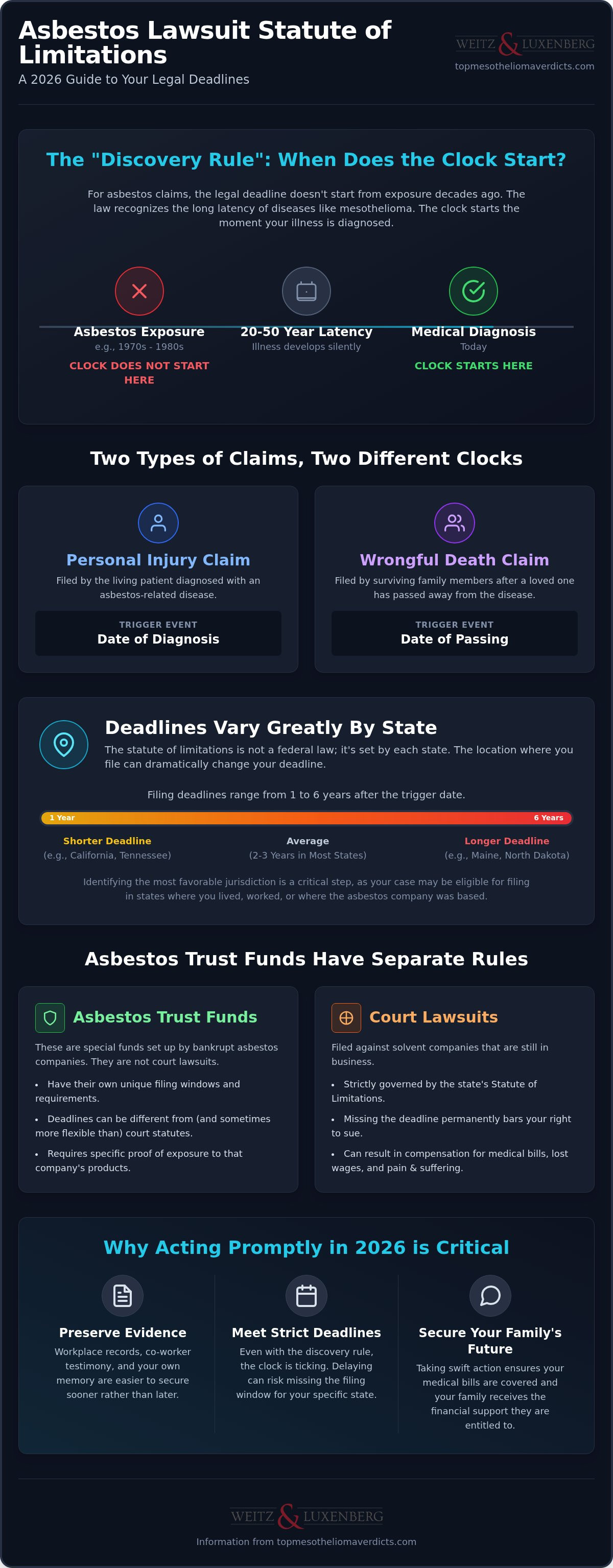
- The clock for an asbestos claim typically begins at the moment of medical diagnosis rather than the date of exposure, thanks to the legal "discovery rule."
- Navigating the asbestos lawsuit statute of limitations requires identifying the most favorable jurisdiction, as deadlines vary from one to six years depending on the state.
- Personal injury and wrongful death claims operate on separate timelines, with triggers based on either the date of diagnosis or the date of a loved one's passing.
- Asbestos trust funds maintain their own unique filing windows and requirements that often differ from standard court-ordered statutory deadlines.
- Taking action in 2026 is vital for preserving workplace evidence and securing your place within trust fund reserves that may shift over time.
What is the Asbestos Lawsuit Statute of Limitations?
Think of the statute of limitations as a legal expiration date. It is a strict deadline set by state legislatures that dictates exactly how long you have to file a claim after an injury occurs. In standard personal injury cases, this clock usually starts the moment an accident happens. However, Asbestos law and litigation recognizes that these diseases don't follow standard rules. Because mesothelioma and lung cancer can take 20 to 50 years to develop, the law provides specific protections for victims whose injuries remained hidden for decades.
The asbestos lawsuit statute of limitations varies significantly by state, ranging from as little as one year in California to six years in Maine. If this window closes, your right to seek financial support for medical bills and lost wages is permanently lost. It's a high-stakes timeline that requires precise navigation to protect your family's future, especially when exposure happened across multiple jurisdictions.
The Discovery Rule: Why Decades of Latency Don’t Bar Your Claim
If the law required you to file a lawsuit when you were first exposed on a job site in the 1970s, no one would ever receive compensation. The Discovery Rule solves this problem. It ensures that the clock doesn't start ticking until you actually know you're sick. The Discovery Rule is the legal principle that pauses the statute of limitations until an injury is known. This means "discovery" occurs on the date of your formal medical diagnosis or when your symptoms became so apparent that a reasonable person would have sought medical attention.
How Courts Determine the "Start Date" for Your Case
Courts look at concrete evidence to find the exact moment the clock began. Your medical records, pathology reports, and physician notes are the primary tools used to establish this timeline. A definitive diagnosis of mesothelioma or asbestos-related lung cancer is usually the clearest trigger for the court's calendar.
Legal teams also have to account for "constructive notice." This is a nuance where a court might argue you should have known you were injured before the official diagnosis. If you had severe respiratory symptoms and a known history of exposure but waited several years to see a doctor, a defendant might try to use that delay to claim the statute has expired. We work to ensure your medical history is presented accurately so your right to file remains protected under the asbestos lawsuit statute of limitations.
Personal Injury vs. Wrongful Death: Two Different Clocks
Understanding your legal options requires a clear distinction between two separate paths. Each path has its own "trigger event" that starts the countdown for the asbestos lawsuit statute of limitations. For a person currently fighting an illness, the legal journey is a personal injury claim. For families who have lost a loved one, the process shifts to a wrongful death claim. These are not merely different titles; they represent two entirely different legal calendars.
Personal Injury Claims for Living Patients
For living patients, the countdown begins at the point of diagnosis. This is the moment you officially discovered the injury. While mesothelioma is the most common focus of these cases, lung cancer claims involve specific nuances regarding smoking history and occupational exposure. You can explore the asbestos lung cancer lawsuit timeline to see how these cases move through the legal system in 2026.
Filing while a patient is still alive is a critical strategic move. It allows your legal team to conduct a "deposition to preserve testimony." This ensures your own words regarding your work history and exposure are recorded as permanent evidence. If a patient passes away while a personal injury case is already pending, many states allow for "survival actions." This legal mechanism lets the estate step in and continue the litigation without having to start the process over from the beginning.
Wrongful Death Claims for Surviving Family Members
If a loved one dies before a claim is filed, the asbestos lawsuit statute of limitations typically resets. The countdown usually begins on the date of the victim's passing rather than the date of their diagnosis. Eligibility to file these claims varies by state, but it generally includes spouses, children, or a designated representative of the estate.
State laws, such as the Oregon Asbestos Statute of Limitations, provide a framework for how these timelines are calculated and who can bring the suit. Families must be cautious if a diagnosis was made many years before the death. In some jurisdictions, if the personal injury deadline expired while the victim was still alive, the family might be barred from filing a wrongful death claim later. To ensure your family's rights are fully protected, you can review your eligibility with an expert to determine which state’s laws offer the most favorable path forward.
Deadlines for Asbestos Trust Funds vs. Court Lawsuits
When asbestos-related companies declared bankruptcy to escape their liabilities, the courts required them to set aside billions of dollars in trust funds for future victims. These funds exist specifically because of the long latency period for asbestos diseases, ensuring that someone diagnosed in 2026 can still receive compensation even if the company that exposed them no longer exists. While a court case involves a judge and jury, trust fund claims are administrative. They often provide a faster route to financial support because they don't require the lengthy discovery and trial phases of traditional litigation.
It's vital to recognize that these funds operate under their own distinct rules. While the asbestos lawsuit statute of limitations is a matter of state law, trust deadlines are set by the trusts' individual Trust Distribution Procedures. This creates a complex landscape where you might be within the time limit for one trust but too late for another. Coordination is essential. Filing a trust claim can sometimes impact your court case through "set-offs," where a defendant company argues your total award should be reduced by what you've already received from a trust. Managing these two tracks simultaneously requires a sophisticated legal strategy to avoid these double-recovery issues.
Trust-Specific Filing Windows
Most asbestos trusts require you to file within three years of your diagnosis. However, this isn't a universal rule. Some trusts are "active" and processing claims immediately, while others may be "inactive" or undergoing revaluation of their payment percentages. In 2026, many trusts are adjusting their criteria to account for newer medical data. A national law firm monitors the shifting rules of dozens of different trusts simultaneously. This constant oversight prevents you from missing a narrow filing window that could cost your family significant financial support.
Maximizing Recovery Through Multiple Channels
You don't have to choose between a lawsuit and a trust fund claim. In many cases, we pursue both. This dual approach accounts for the different ways you were exposed over your career, whether it was through a specific brand of insulation or a particular piece of heavy machinery. Understanding the mesothelioma vs asbestos lung cancer settlement amounts helps illustrate why using every available channel is necessary to secure your future. Each trust and court has different evidentiary standards. An experienced attorney knows how to present your work history to satisfy both, ensuring you receive the maximum recovery available without the stress of managing the paperwork yourself.
Factors That Determine Your Specific Deadline
Identifying the correct asbestos lawsuit statute of limitations is rarely as simple as looking at the laws of your current home state. Jurisdiction is a strategic variable in these cases. It can be influenced by where you worked, where the company that harmed you is headquartered, and where you lived at the moment of your diagnosis. Because many asbestos-related companies operated on a massive scale, you may have the right to file in a state other than your own, potentially granting you a much longer window to seek justice.
National law firms utilize the "Choice of Law" doctrine to protect your interests. If your career involved travel or if you were exposed to products manufactured by a company based in a different region, you might have multiple options. We analyze these variables to determine which state offers the most favorable filing window and the highest potential for a successful recovery. This nationwide perspective ensures that a narrow deadline in one state doesn't automatically bar you from receiving the compensation your family needs.
Multi-State Exposure and the "Choice of Law"
Consider a worker who spent a decade at shipyards in one state before moving to work at power plants in another. Both environments likely contributed to the eventual illness. A local attorney might only be familiar with local deadlines, but a national powerhouse evaluates every state involved in your work history. We look for the jurisdiction with the most supportive laws for victims.
"Borrowing statutes" add another layer of complexity to this process. These are laws that sometimes require a court to "borrow" a shorter deadline from the state where the exposure actually occurred. Navigating these overlapping rules requires a deep understanding of how different state courts interact. To see which state’s laws provide the best path for your family, you can start your free case evaluation today.
Tolling the Statute: Can the Clock Be Paused?
In legal terms, "tolling" refers to a pause in the countdown. It effectively stops the clock on the asbestos lawsuit statute of limitations under very specific and limited circumstances. This might happen if a defendant company enters a specific type of bankruptcy or if a court determines that a victim was legally incapacitated at the time the clock should have started.
You shouldn't rely on tolling as a primary strategy. It is exceptionally rare in asbestos litigation because courts already account for the long latency of these diseases through the Discovery Rule. Most judges maintain a strict standard for when the clock begins. Waiting for a potential tolling exception is a high-risk gamble that can lead to a permanent loss of rights. Protection comes from early action, not from hoping for a legal pause.
Protecting Your Rights: Why Acting Now is Critical
Time is the most significant obstacle in any asbestos case. While the Discovery Rule protects you from the decades-long latency period of these diseases, it cannot prevent the natural degradation of evidence. As years pass, job sites are demolished, former coworkers move away, and corporate records are lost to mergers or purges. 2026 is a pivotal year for families because many asbestos trust funds are currently re-evaluating their payment percentages based on aging reserves. Initiating your claim now ensures you're positioned to receive compensation under the most favorable current terms before these financial structures shift again.
We understand the immense pressure a diagnosis places on a family. Our goal is to remove the legal burden entirely. Weitz & Luxenberg operates on a "no-cost" promise, meaning there's no financial risk to checking your eligibility. We only receive a fee if we successfully secure a recovery for you. Our national team is structured to act with the urgency your situation demands, often initiating a comprehensive case review within 24 hours of your first contact. This rapid response is vital for ensuring that the asbestos lawsuit statute of limitations doesn't quietly expire while you're focused on medical treatments.
The Importance of Preserving Testimony
A deposition is often the most powerful piece of evidence in an asbestos case. It is a formal, recorded statement that preserves your history of exposure in your own words. Filing your claim early allows your legal team to secure this testimony before health challenges make the process more difficult. In many jurisdictions, we can petition the court for "expedited" or "preference" trial dates for terminally ill plaintiffs, moving your case to the front of the judicial calendar. For those in high-risk trades, the asbestos exposure construction worker guide provides additional context on the specific types of evidence needed to link your illness to specific job sites and products.
How Weitz & Luxenberg Evaluates Your Case
We don't rely on surface-level information. Our 500-person team includes dedicated investigators and researchers who specialize in tracking down decades-old shipping manifests, blueprints, and sales records. This exhaustive approach is how we've secured over $13 billion in total verdicts and settlements for our clients. Our history of success includes record-breaking outcomes, such as a landmark $117 million award in 2025. We bring this same level of formidable strength to every case, regardless of which state's asbestos lawsuit statute of limitations applies to your claim. Your focus should be on your health and your family; let our experts handle the complexities of the law.
Get a free, confidential case evaluation with Weitz & Luxenberg today.
Securing Your Family’s Future and Legal Rights
Navigating the asbestos lawsuit statute of limitations is about more than just tracking dates; it's about reclaiming control over your family's future. Whether you're managing a personal injury claim or seeking justice for a loved one, the Discovery Rule ensures that decades of latency don't stand in your way. By leveraging a national perspective, you can identify the jurisdiction that offers the most favorable timeline and recovery potential for your specific history of exposure.
Weitz & Luxenberg stands as a formidable ally in this fight. With over $13 billion recovered and a ranking as the #1 asbestos law firm filer for 2026, our team has the resources to handle the most complex multi-state cases. Our record of success includes a landmark $117 million verdict in 2025, proving we have the strength to hold negligent companies accountable. Don't let a hidden deadline dictate your path. Request a Free Case Evaluation with Weitz & Luxenberg to protect your rights today. You've carried this burden long enough; let us take it from here.
Frequently Asked Questions
What is the statute of limitations for an asbestos lawsuit in 2026?
In 2026, the deadline generally ranges from one to six years, depending on the specific state where you file. This timeframe is strictly enforced by state legislatures. The clock typically begins on the date of a formal medical diagnosis for mesothelioma or asbestos lung cancer. Because these rules vary so widely across the country, it's vital to have a national firm evaluate your work history to identify the most favorable jurisdiction for your claim.
Can I sue for asbestos exposure that happened 40 years ago?
Yes, you can still seek compensation even if your exposure occurred decades ago. The asbestos lawsuit statute of limitations follows the "discovery rule," which means the legal clock doesn't start until you are diagnosed with a related illness. Since diseases like mesothelioma have a latency period of up to 50 years, the law protects your right to file once the harm becomes known. Waiting too long after a diagnosis, however, can permanently bar your recovery.
What happens to the statute of limitations if the victim dies?
If a victim passes away, the legal path usually transitions from a personal injury claim to a wrongful death lawsuit. This change typically resets the clock, with the new deadline starting on the date of death. Most states provide a window of one to three years for surviving family members to take action. It's important to act quickly to preserve evidence and testimony that may have been gathered while the victim was still alive.
Is the deadline for asbestos trust funds the same as for a lawsuit?
No, trust fund deadlines are separate from court-ordered statutes of limitations. Asbestos trust funds establish their own "filing windows" through specific trust distribution procedures. While many trusts require filing within three years of a diagnosis, these windows can change based on the trust's financial status or internal rules. You may still be eligible for trust fund compensation even if the deadline for a traditional lawsuit in your state has already passed.
How do I know which state’s statute of limitations applies to my case?
Determining the correct state involves analyzing where your exposure happened, where the defendant companies are based, and where you currently reside. A national firm like Weitz & Luxenberg evaluates all 50 states to find the jurisdiction with the most supportive laws for your case. This strategic choice is critical because one state might have a one-year limit while another offers six years. We use our national reach to ensure you don't lose your rights.
Can the statute of limitations be extended if I didn’t know I was sick?
The Discovery Rule essentially serves as this extension by ensuring the clock only starts once your illness is identified. In very rare cases, the asbestos lawsuit statute of limitations can be "tolled" or paused due to legal incapacity or specific bankruptcy proceedings. However, you shouldn't rely on these rare exceptions. The most effective way to protect your claim is to initiate a legal review the moment you receive a diagnosis from your doctor.
What should I do if I think the deadline to file my asbestos claim has already passed?
You should contact an experienced national asbestos firm immediately for a professional case review. Even if you believe a local deadline has passed, you might still have options in other states where you were exposed or through various asbestos trust funds. Weitz & Luxenberg has recovered over $13 billion for clients and can often find secondary paths to compensation that local general practice attorneys might overlook during a standard consultation.
Do I need a lawyer to determine the statute of limitations for my mesothelioma claim?
Yes, professional legal guidance is essential because of the overlapping state laws and complex trust fund requirements. Determining the exact deadline requires a deep dive into your occupational history and medical records. Weitz & Luxenberg, ranked as the #1 filer of asbestos cases in 2026, provides this evaluation at no upfront cost to you. We handle the investigative research so you can focus entirely on your medical treatment and your family's well-being.
*Published by Weitz & Luxenberg, P.C. National Headquarters: 700 Broadway, New York, NY 10003. Call 800-885-MESO. Attorney Advertising. Prior results do not guarantee a future outcome. *Certain contentions in blog posts need to be confirmed by a licensed attorney.
Disclaimer
Published by Weitz & Luxenberg, P.C. National Headquarters: 700 Broadway, New York, NY 10003. Call 800-885-MESO. Attorney Advertising. Prior results do not guarantee a future outcome. Certain contentions in blog posts need to be confirmed by a licensed attorney.


