

A pleural mesothelioma diagnosis can clarify what you’re facing medically, but it doesn’t by itself explain where or how asbestos exposure occurred. That history matters. A pleural mesothelioma attorney can help connect your diagnosis with jobs, products, worksites, or other potential exposure sources, even when decades have passed.
It’s understandable to feel unsure whether old records can be found, which deadlines apply, or whether legal steps will add pressure during treatment. Rules vary by state, and the time to bring a claim may depend on when the disease was diagnosed, not when exposure happened. An attorney can review the facts without promising a particular outcome.
This article explains how diagnosis and exposure history may shape legal options, including litigation and asbestos trust fund claims; what work, military, medical, and product information may help evaluate a potential claim; and what to expect from a confidential, no-cost initial consultation. Use that conversation to ask questions and discuss possible next steps at your own pace. Weitz & Luxenberg offers free consultations and works on a contingency basis.
Key Takeaways
- A pleural mesothelioma diagnosis is important evidence, but it doesn’t by itself establish eligibility or predict a legal outcome.
- A pleural mesothelioma attorney may help document the diagnosis, trace possible asbestos exposure, investigate potentially responsible entities, and assess legal routes.
- Litigation and asbestos trust fund claims are distinct options. The circumstances of each case can affect which routes may be available.
- Work history, military service, product details, and medical records may help an attorney assess your situation. You don’t need a complete file to begin a conversation.
- Filing deadlines depend on applicable law and individual facts, so learning how they may apply is an important part of evaluating next steps.
What a Pleural Mesothelioma Diagnosis Can Mean for Your Legal Options
Pleural mesothelioma is cancer that affects the pleura, the thin lining around the lungs. A diagnosis gives an attorney a medical starting point, but it doesn’t establish who may be legally responsible or determine whether a claim can proceed. A medical diagnosis identifies a condition; a legal case evaluation examines whether evidence connects that condition to asbestos exposure and a potentially responsible company.
That distinction matters. A pleural mesothelioma attorney may review the diagnosis alongside your exposure history, investigate companies associated with products or worksites, and assess possible legal routes. The result depends on individual facts and applicable law, not on the diagnosis alone. For general background on the disease, see the Mesothelioma Overview. Questions about your health and treatment belong with your clinical team.
Why the pleural diagnosis is relevant to an asbestos claim
Pleural mesothelioma is commonly associated with asbestos exposure, but a diagnosis cannot identify when, where, or how exposure occurred. Medical records can help establish the condition diagnosed and when it was identified. Pathology reports, imaging records, and treatment notes may form part of that documentation. Your treating clinicians are the right people to explain test results, treatment choices, and prognosis. A lawyer’s role is different: to assess how medical documentation fits into a legal investigation, not to interpret it as medical advice.
Keep the records you already have, but don’t worry if some are missing. An attorney can explain which documents may be useful and whether additional records could be sought.
How decades-old exposure can still be investigated
Asbestos exposure may have happened long before symptoms or diagnosis, so reconstructing the timeline can be difficult. Start with what you remember, even if details are incomplete: employers, job duties, military service, household circumstances, or products and materials you encountered. Approximate dates, job locations, coworkers’ names, and the tasks you performed can turn broad recollections into leads for further investigation.
- Work history: List employers, occupations, worksites, and duties that may have involved asbestos-containing materials.
- Military history: Note service periods, roles, and locations that may help identify relevant exposure settings.
- Household history: Recall whether someone you lived with worked around asbestos or brought work materials home.
- Product details: Write down any product names, manufacturers, packaging, or descriptions you can remember.
Old records may include employment documents, union or military papers, pay records, or product information, but you don’t need to find everything before asking for an evaluation. A lawyer may investigate potential exposure sources and responsible entities using the information available. A work, household, or product history is a lead, not proof by itself; it doesn’t automatically establish liability, eligibility, or a particular outcome.
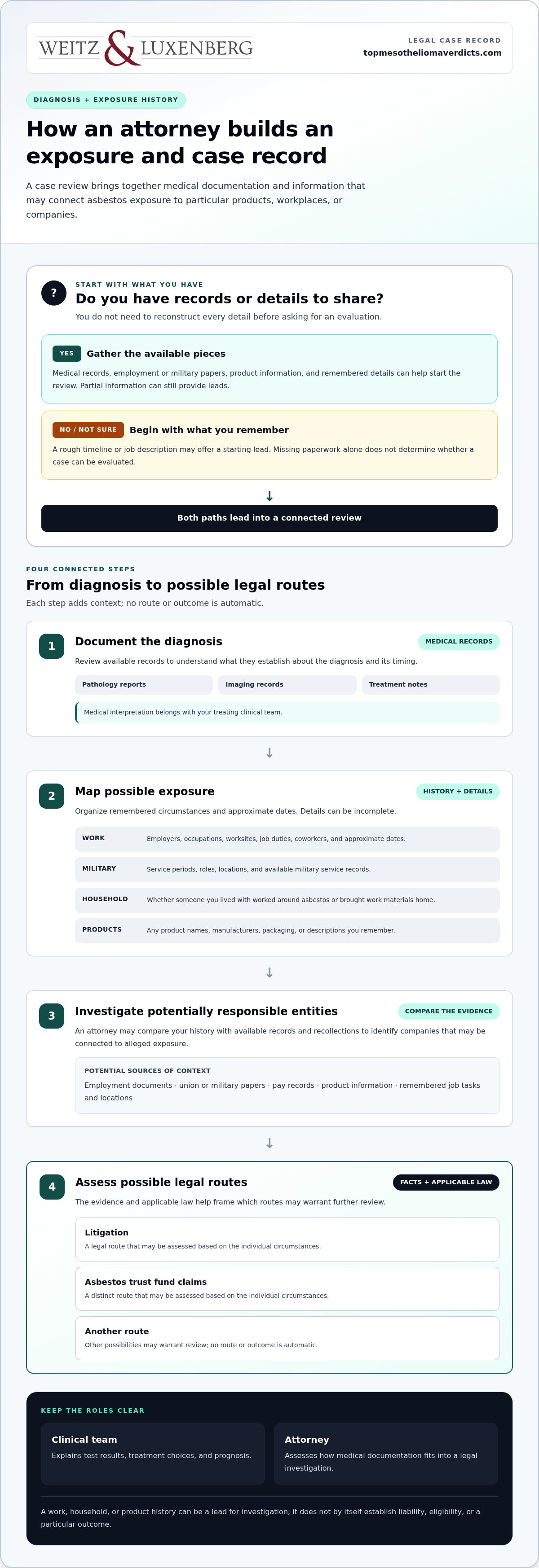
How a Pleural Mesothelioma Attorney Builds an Exposure and Case Record
A legal review brings together two kinds of information: records documenting the pleural mesothelioma diagnosis and evidence that may connect asbestos exposure to particular products, workplaces, or companies. Case evaluation combines diagnosis documentation with an investigation into where and how exposure may have occurred. A pleural mesothelioma attorney can guide that process. You don’t have to reconstruct every detail before asking for help.
The investigation generally moves through four connected steps:
- Document the diagnosis. Review available medical records to understand what they establish about the diagnosis and its timing. Medical interpretation remains with your treating clinical team.
- Map possible exposure. Organize remembered jobs, worksites, products, military service, or household circumstances, along with approximate dates.
- Investigate potentially responsible entities. Compare your history with available records and recollections to identify companies that may be connected to alleged exposure.
- Assess legal routes. Consider the evidence and applicable law to evaluate whether litigation, asbestos trust fund claims, or another route may warrant further review. No route or outcome is automatic.
Records and details that may help document a case
Pathology reports and other medical records can help document the diagnosis, while employment history and available military service records can provide context for possible exposure. Note product names, job duties, worksites, coworkers, and approximate dates if you remember them. The National Cancer Institute Mesothelioma Information provides medical background, but questions about your diagnosis or care should go to your clinicians. Missing paperwork alone doesn’t determine whether a case can be evaluated.
Even a rough timeline can help start the review. For example, a job title and description of the work may give an attorney a lead to investigate, even if you don’t recall a product’s manufacturer or have old employment files.
How legal teams investigate asbestos exposure
An attorney may compare your account with records, product and work histories, and recollections from coworkers or family members. The aim is to develop and assess potential links between exposure and companies, not to assume that a remembered product or workplace proves responsibility. As evidence takes shape, counsel can explain how the investigation may fit into a lawsuit and what further information could matter. The mesothelioma litigation resources offer a place to explore the broader legal process.
Gather what’s readily available and leave the gaps for discussion. A careful review can clarify what is known, what still needs investigation, and which legal routes may merit consideration.
Do You Need a Pleural Mesothelioma Attorney? Compare the Legal Routes
Hiring a lawyer is a personal decision. This overview explains common legal routes, but it can’t determine whether you qualify to bring a claim. A case review considers your diagnosis, exposure history, available evidence, and the laws and procedures that may apply to your circumstances.
Litigation and asbestos trust fund claims work differently, and one or both may be relevant depending on the facts. A settlement, trial verdict, or trust claim has no guaranteed result or fixed value. A pleural mesothelioma attorney can explain what a legal review may involve and help you understand possible options without treating any outcome as certain.
Legal route: Lawsuit. Process: A legal claim against potentially responsible parties, which may resolve through a negotiated settlement or proceed to trial. Factors to review: Exposure evidence, potential defendants, and applicable law.
Legal route: Asbestos trust fund claim. Process: A claim submitted to a bankruptcy trust established to address certain asbestos-related claims. Factors to review: The trust’s own procedures, requirements, and the evidence available.
Why individual review matters: Facts and rules differ across cases and trusts. A lawyer can assess how the evidence may relate to each route; no route guarantees eligibility or payment.
Lawsuit, settlement, or trial: what the terms mean
A lawsuit is a legal claim. A settlement is a negotiated resolution that may occur without a trial. Trial is one possible stage of a lawsuit, not an assured or necessary destination. The available path depends on the case and applicable law, so it isn’t accurate to say one option is always faster, better, or available to everyone. The legal team can explain the choices as a case develops.
How asbestos trust claims may fit alongside litigation
Some asbestos-related claims may involve bankruptcy trust funds created to address claims connected with companies that entered bankruptcy. Each trust has its own procedures and eligibility requirements, so an evaluation may need to consider the specific trust and supporting evidence. Depending on the circumstances, trust claims may be reviewed alongside litigation, but that isn’t automatic. The asbestos trust fund payout guide explains why trust claims follow distinct procedures.
You don’t need to choose a legal route before learning what the options mean. A confidential conversation can help you raise questions and understand what a review of your circumstances may involve. Explore mesothelioma legal resources as you consider your next step.
What to Prepare Before Speaking With a Pleural Mesothelioma Lawyer
You don’t need a complete file to have an initial conversation. A few notes about your diagnosis and past work or service can help a pleural mesothelioma attorney identify questions to explore. If you’re missing records or can’t remember exact dates, say so. The attorney can explain what information could help and how it might be gathered.
Filing deadlines vary by applicable law and individual facts; prompt legal review can clarify which rules may apply. Don’t assume a deadline based on when exposure occurred or on someone else’s experience. Ask how timing will be assessed in your circumstances.
A practical checklist for an initial consultation
Bring what’s readily available, or make a simple list. Details that may help include:
- Diagnosis and treatment records: Pathology reports, medical records, or a note of where relevant records are held.
- Employment history: Employer names, job titles, work duties, worksites, and approximate dates.
- Military service: Service dates, roles, and locations you recall, plus available service records.
- Possible exposure leads: Product names or descriptions, materials you worked with, and any household or secondhand exposure you remember.
- Potential witnesses: Names of coworkers, family members, or others who may recall relevant work or exposure details.
Approximate information is useful as a starting point. For example, “worked maintenance at a factory in the early 1980s” may help guide questions, even if you don’t remember the exact product or year. Don’t delay an initial discussion while searching for every document. Explain what you have and what remains uncertain.
Questions that clarify representation and fees
Use the conversation to understand how the legal team would work with you. You might ask who your main contact will be, how often you can expect updates, how the attorney evaluates exposure history, and what steps may be involved in investigating potential claims. A clear explanation can help you know what to expect without requiring you to decide everything at once.
Weitz & Luxenberg offers a free consultation and handles cases on a contingency basis. Ask the attorney to explain the written fee agreement, including how the arrangement works and which terms apply, before deciding whether to proceed. The mesothelioma litigation guidance can also help you understand the broader lawsuit process.
If you’re ready to discuss your diagnosis and possible exposure history, DIAGNOSED? CALL 1-800-885-MESO TODAY FOR A CONFIDENTIAL & FREE CONSULTATION.
How Weitz & Luxenberg Supports Pleural Mesothelioma Clients Nationwide
Weitz & Luxenberg represents people with mesothelioma and asbestos-related lung cancer across all 50 states. The firm handles mesothelioma litigation and asbestos trust fund claims, and assesses potential legal routes in light of each person’s diagnosis, exposure history, and circumstances. A pleural mesothelioma attorney evaluates the available information and explains possible next steps, rather than promising eligibility or a particular result.
A review can be especially useful when exposure happened long ago or details are incomplete. Share what you know, identify what remains uncertain, and learn what information may help assess your situation. You don’t need to arrive with a fully reconstructed history or a decision to pursue a claim.
What happens during a confidential, free consultation
The initial conversation is an opportunity to discuss your diagnosis, possible asbestos exposure, questions, and concerns. The legal team can listen to your account and explain how a case-specific evaluation may consider available records, potential exposure sources, and legal options. You can also ask how communication works and what further information may be useful.
A consultation is not a medical appointment, and legal counsel does not replace your treating clinical team. It also doesn’t guarantee that the firm will represent you or that a claim will succeed. You aren’t required to decide during the first conversation whether to file. The purpose is to help you understand whether further legal review may make sense for your circumstances.
A nationwide legal team for asbestos-related claims
Weitz & Luxenberg handles mesothelioma litigation and asbestos trust fund claims nationwide, representing clients across all 50 states. The firm can review whether either route, or both, may be relevant based on the facts and applicable requirements. Options can differ from person to person; a conversation can help clarify what may apply to your case.
The firm offers free consultations and works on a contingency basis. Ask for a clear explanation of the written fee terms so you understand the arrangement before deciding about representation. Outcomes depend on the evidence and circumstances of each case. Past case results, where discussed, are historical and do not predict future outcomes.
Seeking information doesn’t commit you to a lawsuit. It can be a measured first step toward understanding your options and deciding what feels right for you and your family.
DIAGNOSED? CALL 1-800-885-MESO TODAY FOR A CONFIDENTIAL & FREE CONSULTATION
Take the Next Step at Your Own Pace
You don’t have to settle every question before seeking guidance. A first conversation can help turn uncertainty into a clearer plan: what information may matter, what questions remain, and whether a legal review fits your priorities. Even a few notes about your diagnosis or exposure history can give the discussion a useful starting point.
A pleural mesothelioma attorney can explain how your circumstances may be evaluated, while leaving medical decisions with your care team and legal choices in your hands. You don’t need to decide to file simply to ask questions. If you’re ready to discuss your situation, reach out for a confidential, free consultation.
DIAGNOSED? CALL 1-800-885-MESO TODAY FOR A CONFIDENTIAL & FREE CONSULTATION
One informed conversation can be a steady first step toward deciding what comes next.
Frequently Asked Questions
Can I file a claim for pleural mesothelioma if my asbestos exposure happened decades ago?
Possibly, but the time since exposure alone doesn’t answer whether a claim can be filed. Deadlines and rules depend on the state law that applies and the facts of the case, including when the diagnosis was made. If exposure occurred many years ago, don’t assume it’s too late or that a claim is available. Prompt legal review can help clarify which deadlines and options may apply.
How much does it cost to speak with a pleural mesothelioma attorney?
Weitz & Luxenberg offers a free initial consultation, so you can discuss your situation without paying for that conversation. The firm handles cases on a contingency basis, meaning its fee is tied to financial compensation secured for the client. Ask the attorney to explain the written fee agreement, including any expenses or other terms it addresses. Understand the agreement that applies to your case rather than relying on a general description.
What evidence helps prove asbestos exposure in a pleural mesothelioma case?
Evidence may include medical documentation, employment or union records, product information, and statements from people who recall the work or materials involved. For example, an old job assignment or a coworker’s recollection might help identify a site or product for further investigation. No single item automatically proves exposure or responsibility. Share whatever is available, including uncertain memories, so an attorney can assess how the pieces may fit together.
Can my family speak with an attorney if I am too ill to manage the process?
Your family can ask an attorney about the situation and how an initial discussion may be arranged. However, a relative’s ability to act or make legal decisions for you can depend on your circumstances and any legal authority in place. The attorney can explain what’s needed to discuss your case or communicate on your behalf. If you can participate, even briefly, share your preferences and any existing authorization documents.
Do pleural mesothelioma claims always go to trial?
No. A lawsuit may resolve through a negotiated settlement or proceed to trial, depending on the case. Neither a trial nor a settlement is guaranteed. The route can depend on evidence, legal issues, and the decisions of the parties involved. Ask counsel to explain what developments could affect your case and how you’ll be consulted about important decisions. No attorney can promise a particular resolution.
What happens if I do not know which product or company exposed me to asbestos?
Not knowing a product name or company doesn’t necessarily prevent an initial case evaluation. Describe the setting, tasks, materials, and approximate period you remember, even if details are incomplete. A legal team may use those leads to investigate records and other available information. Be clear about what you know firsthand versus what you’ve heard from someone else; that distinction can guide follow-up questions.
Can an attorney help identify whether an asbestos trust claim may be available?
Yes. An attorney can review your diagnosis and exposure information to assess whether a claim involving an asbestos bankruptcy trust may be worth evaluating. Each trust has its own procedures and requirements, so an assumption about one trust doesn’t determine eligibility with another. Share any past claim paperwork or payments you know about, as that history may help counsel understand what needs review.
Disclaimer
Published by Weitz & Luxenberg, P.C. National Headquarters: 700 Broadway, New York, NY 10003. Call 800-885-MESO. Attorney Advertising. Prior results do not guarantee a future outcome. Certain contentions in blog posts need to be confirmed by a licensed attorney.


