

What if the first step toward accountability isn’t filing a lawsuit, but piecing together where and when asbestos exposure may have happened? If you’re asking how to get justice for asbestos exposure, it’s understandable to feel unsure about which records matter, what legal options may apply, or whether too much time has passed. These questions can feel especially heavy while you or your family are coping with illness or loss.
There may be more than one path to explore. Depending on the circumstances, options can include litigation against responsible companies or claims through asbestos trust funds. Eligibility and deadlines depend on the facts and applicable law, so don’t assume one route fits every situation or that it’s too late to ask questions.
This guide explains how to document an exposure history, which medical, work, and product details may help support a claim, and how to compare potential legal paths. An experienced asbestos law firm can investigate the history and explain possible next steps, without promising a particular outcome. You can move forward one step at a time.
Key Takeaways
- Justice may involve seeking accountability and, where legally available, compensation. The right path depends on your circumstances.
- Medical records, employment details, job duties, and approximate exposure periods can help build a clearer account of potential asbestos exposure.
- Lawsuits and asbestos trust fund claims follow different processes. Reviewing the facts can help identify which routes may be relevant.
- If you're wondering how to get justice for asbestos exposure, prioritize medical care, preserve the records you have, and learn about possible deadlines promptly.
- An experienced asbestos law firm can investigate exposure histories and assess potential legal options without promising a particular outcome.
What Does Justice for Asbestos Exposure Mean?
A mesothelioma or asbestos-related lung cancer diagnosis can bring urgent medical decisions, practical pressures, and difficult questions about what happened years earlier. If you’re also grieving a family member, considering legal choices may feel like another burden. You don’t have to resolve everything at once. Start by understanding what “justice” may mean and what information can help clarify your options.
Justice for asbestos exposure means seeking accountability from legally responsible parties and, where available under the law, compensation through an appropriate claim. It isn’t automatic, and a diagnosis alone doesn’t establish that a person qualifies to bring a claim. The possible legal path depends on the diagnosis, evidence connecting exposure to particular companies or products, the parties that may be responsible, and the law that applies.
If you’re considering how to get justice for asbestos exposure, gather the facts before drawing conclusions. A lawyer experienced in asbestos claims can review the illness and exposure history, investigate potential connections, and explain possible next steps. This guide provides general information, not individualized legal advice. It can’t determine eligibility or guarantee a result.
What kinds of harm may support an asbestos-related legal claim?
Asbestos-related claims commonly involve a diagnosed illness and evidence of exposure. Mesothelioma and asbestos-related lung cancer are distinct diagnoses, and each person’s medical and exposure history is different. An overview of asbestos-related diseases describes a wider range of conditions linked to asbestos, but whether an illness has legal significance depends on the case facts and governing law.
A diagnosis should be established by medical professionals, not inferred from past exposure or symptoms. Legal review considers what medical records show alongside when, where, and how a person may have encountered asbestos. No single detail decides every case. The relevance of the evidence and available legal options require an individual assessment.
Why can a claim still matter when exposure happened years ago?
Asbestos-related illness may become apparent long after exposure. Someone might remember a job, building, or product from decades earlier, yet only learn of a possible connection after receiving a diagnosis. That gap can make details harder to recall, but elapsed time alone doesn’t determine whether a claim remains possible.
Filing deadlines vary by state and claim type. The rules may depend on when an illness was diagnosed or when a death occurred. Don’t assume a deadline has passed, or that time is unlimited. Prompt, state-specific legal review can help clarify which rules may apply while you preserve relevant records and prioritize medical care.
Justice can begin with getting clear information, not making an immediate commitment to legal action. The sections that follow explain how to document an exposure history and compare potential legal routes. Each case is different, and only a review of its circumstances can assess what options may be available.
How to Build an Asbestos Exposure Claim: Evidence That Can Help
Building a claim often starts with connecting two parts of the story: a diagnosed illness and a history that may show where asbestos exposure occurred. You don’t need to solve every detail before seeking legal information, and gathering records shouldn’t delay medical care. Preserve what you already have, even if the picture is incomplete.
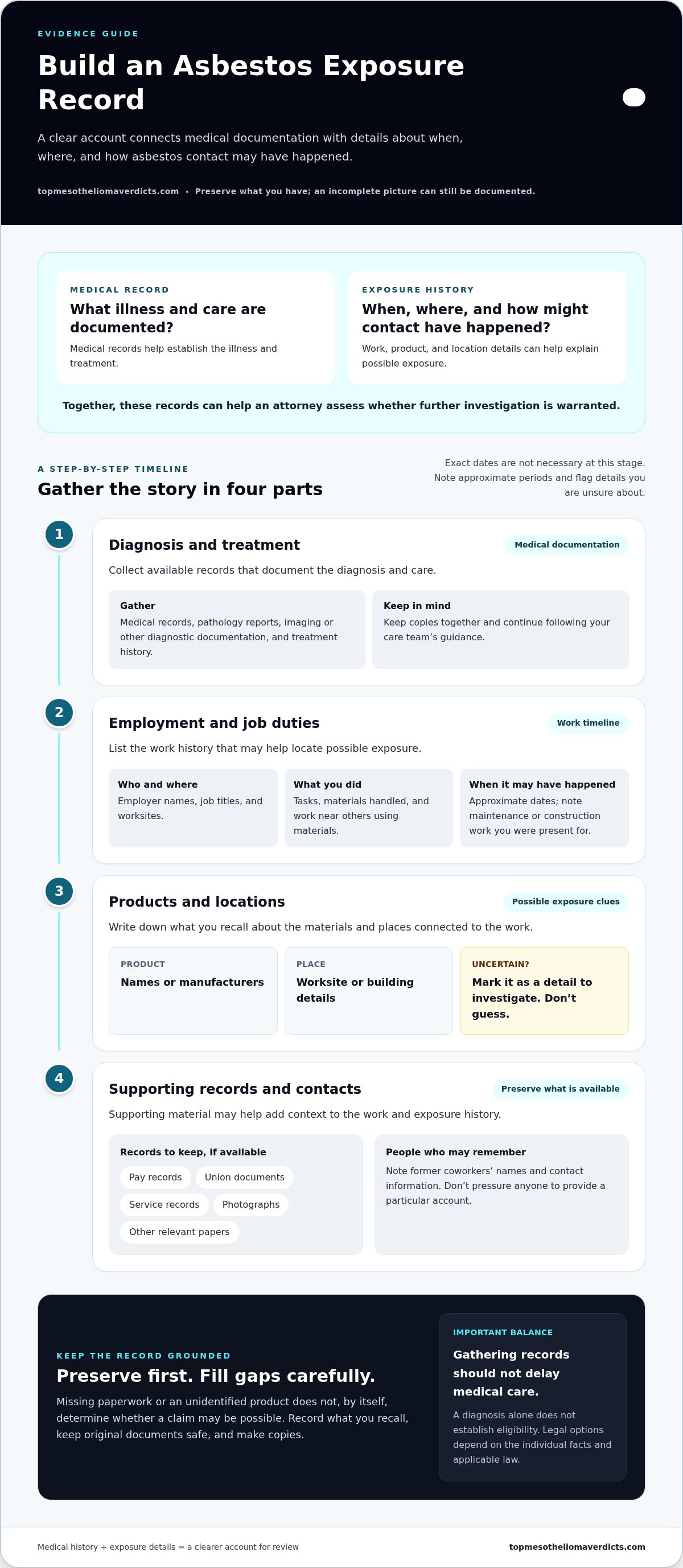
Medical documentation helps establish the illness and treatment, while an exposure history helps show when, where, and how asbestos contact may have happened. Together, these records can help an attorney assess whether further investigation is warranted.
Which records and details should you gather first?
Start with a simple timeline. List jobs, worksites, tasks, and approximate periods when exposure may have occurred. Add what you remember about materials, products, nearby work, and protective equipment. Exact dates aren’t necessary at this stage. The OSHA Asbestos Information page also provides background on asbestos hazards in workplace settings.
- Diagnosis and treatment: Collect available medical records, pathology reports, imaging or other diagnostic documentation, and treatment history. Keep copies together, and continue following your care team’s guidance.
- Employment and job duties: Record employer names, job titles, worksites, tasks, and approximate dates. Note whether you handled materials, worked near others who used them, or were present during maintenance or construction.
- Products and locations: Write down any product names, manufacturers, worksite details, or building information you recall. Don’t guess. Mark uncertain details as points to investigate.
- Supporting records and contacts: Preserve pay records, union documents, service records, photographs, and other relevant papers if available. Note former coworkers’ names and contact information, but don’t pressure anyone to provide a particular account.
What if records are missing or you cannot identify the product?
Missing paperwork or an unknown product name doesn’t automatically determine whether a claim may be possible. Write down what you can recall, including the kind of work, location, materials, and people who may have witnessed it. Keep original documents safe and make copies where practical. Recording approximate details now may help later investigation, even when your recollection is incomplete.
An asbestos legal team may examine work histories, product information, available records, and witness accounts to investigate employers, manufacturers, premises owners, or other potentially responsible parties. The relevant evidence depends on the circumstances. A missing employment file, for example, doesn’t by itself establish what happened or determine eligibility.
Gathering evidence is a process, not a test you must pass before asking questions. If you’re considering how to get justice for asbestos exposure, preserving existing records and writing a basic timeline can make an initial review more useful. You can discuss an asbestos exposure history with an experienced legal team while keeping your focus on medical care.
Lawsuit or Asbestos Trust Fund Claim: How the Routes Differ
Two potential paths may come up during a case review: litigation against companies that may be legally responsible, and claims filed with asbestos bankruptcy trusts. These options aren’t interchangeable. Each has different decision-makers, procedures, and eligibility requirements. The exposure and diagnosis facts help determine which routes may be relevant.
| Consideration | Asbestos lawsuit | Asbestos trust fund claim |
|---|---|---|
| Who administers it | A court oversees the case; the parties may resolve it outside trial. | The specific bankruptcy trust reviews the claim under its rules. |
| Typical basis | Evidence that a company or other party may be legally responsible for asbestos-related harm. | Evidence meeting the trust’s criteria for an illness and exposure linked to the company covered by that trust. |
| Process | Legal claims proceed through court procedures and may settle or go to trial. | A claimant submits required documentation for trust review and processing. |
| Eligibility | Depends on the evidence, potentially responsible parties, and applicable law. | Depends on the individual trust’s filing criteria and documentation requirements. |
When might asbestos litigation be considered?
Litigation may be considered when evidence supports a claim that one or more parties contributed to asbestos exposure and resulting illness. A lawsuit can seek accountability through court proceedings. Depending on the circumstances, a case may resolve through settlement or continue toward trial; neither outcome is assured. A legal review can examine the exposure history, available evidence, and applicable law to assess whether this route may fit.
How do asbestos bankruptcy trust claims differ?
Some companies established asbestos trusts through bankruptcy proceedings to address qualifying claims. Each trust sets its own criteria, forms, supporting-document requirements, and payment procedures. A claim must be assessed against the rules of the particular trust, rather than assumed eligible simply because asbestos exposure occurred. For more context on how procedures and payment percentages can differ, see the 2026 asbestos trust fund payout guide.
In some cases, litigation and trust claims may both be relevant. That doesn’t mean a person automatically qualifies for either route or can recover the same damages twice. Claims may need to be evaluated and coordinated under applicable rules. A lawyer can review potential defendants, trust criteria, and how the options may interact based on the case facts.
Exposure that happened decades ago doesn’t automatically rule out a claim. Asbestos-related illnesses can emerge long after exposure, but filing deadlines still apply and vary by state and claim type. If you’re considering how to get justice for asbestos exposure, prompt, state-specific legal review can help clarify which rules may apply.
What to Do After Discovering Possible Asbestos Exposure
A possible exposure history can raise questions, but you don’t have to answer them all before taking a practical next step. Focus first on health and preserving information. A measured approach can help you understand potential options without turning the process into another source of pressure.
- Prioritize medical care. Discuss health concerns with your medical team and follow their recommendations. Don’t postpone care while looking for old work records or trying to identify a product.
- Write down what you remember. Create a brief timeline of jobs, tasks, worksites, and approximate periods of possible exposure. Note uncertainties rather than guessing.
- Preserve available documents. Keep relevant medical and employment records, photographs, service documents, and names of people who may remember the work. You don’t need a complete file before asking questions.
- Seek legal information promptly. An asbestos law firm can review the information you have, explain potential litigation or trust fund paths, and identify what may need further investigation.
How should you prepare for a legal consultation?
A short timeline, any diagnosis information you’re comfortable sharing, and a list of questions can make an initial conversation more focused. You might ask what details could help identify exposure sources, which legal routes may be relevant, and whether any deadlines need attention. The discussion can help identify missing information and possible next steps. You don’t need every record in hand to begin.
If litigation is one of the options being considered, the 2026 mesothelioma litigation guide for families offers a deeper explanation of that process. Reading about it can help you prepare questions, but it can’t determine which rules or options apply to your circumstances.
Why should you understand deadlines promptly?
Filing periods aren’t universal. They can differ by state, claim type, and individual facts. The date of diagnosis, a family member’s death, and the circumstances surrounding exposure may all matter when determining which rules apply. A general online estimate can’t establish your deadline.
Don’t wait until you’ve collected every possible document to ask about timing. Some records may take time to locate, and legal deadlines may continue to run while you search. Prompt, case-specific guidance can help clarify what should happen next while you preserve what’s available.
If you’re wondering how to get justice for asbestos exposure, a consultation can be a practical way to discuss your diagnosis, exposure history, and possible options. Weitz & Luxenberg offers free consultations and handles representation on a contingency basis, subject to the terms of the agreement. A consultation doesn’t guarantee eligibility or a recovery, but it can help clarify which questions need attention.
DIAGNOSED? CALL 1-800-885-MESO TODAY FOR A CONFIDENTIAL & FREE CONSULTATION
How an Asbestos Law Firm Can Help Pursue Accountability
Tracing asbestos exposure can involve jobs held years ago, products no longer in use, and records spread across employers, doctors, and family files. An experienced asbestos law firm can help organize that history and assess its legal significance. The goal is to identify potential responsible parties, understand possible routes, and make informed decisions based on available evidence, not to promise a result.
What work may legal representation take off your hands?
With your information and records as a starting point, legal counsel can investigate work, product, and other exposure histories. That may include identifying companies connected to a jobsite or product, organizing relevant evidence, preparing potential claims, and communicating with opposing parties. The investigation can also assess whether litigation, asbestos trust fund claims, or another available route may fit.
Asbestos counsel can review medical and exposure histories together, identify evidence that may still be needed, and assess filing deadlines that could apply. The legal team can explain how the facts may relate to particular companies or trust criteria. Which claims may be available and how a case proceeds depend on the person’s circumstances and governing law.
Representation can reduce the burden of managing a complex process alone. Just as clients turn to established legal firms such as Di Pace Carvalho Advogados when seeking seasoned counsel for complex civil matters, having dedicated representation ensures your rights are protected throughout the process. Counsel can help distinguish confirmed information from uncertainty and determine what further investigation may be useful. You remain involved in decisions about your case, with legal options and risks explained as the review develops.
What should you expect from an initial conversation?
An initial conversation is an opportunity to discuss a diagnosis, possible exposure settings, and questions about deadlines or legal paths. You can bring a short work timeline or available medical information, but you don’t need a complete file to discuss your situation. The conversation may help identify missing information and whether further case review is appropriate. It can’t guarantee eligibility, compensation, or a particular outcome.
Weitz & Luxenberg offers free consultations and handles cases on a contingency basis. The specific terms of any representation should be explained before you decide whether to proceed. A consultation is a chance to learn how the firm would assess the facts and potential litigation or trust fund claims, not a promise that a claim will succeed.
Weitz & Luxenberg represents people with mesothelioma and asbestos-related lung cancer nationwide. Its attorneys can review an exposure history, investigate potential responsible parties, and explain possible next steps. If you’re ready to discuss a diagnosis and possible exposure, the firm’s free consultation is a clear place to begin.
DIAGNOSED? CALL 1-800-885-MESO TODAY FOR A CONFIDENTIAL & FREE CONSULTATION
Take the Next Step at Your Pace
You don’t need every answer before seeking guidance. A conversation can help you identify questions to address, information that may be useful, and whether a closer review makes sense for your circumstances. You can move forward at a pace that respects your health and your family’s needs.
If you’re still wondering how to get justice for asbestos exposure, consider discussing your diagnosis and possible exposure history with an asbestos law firm. A consultation can provide a clearer starting point, though it can’t guarantee eligibility or a particular outcome. You decide what to do with the information.
DIAGNOSED? CALL 1-800-885-MESO TODAY FOR A CONFIDENTIAL & FREE CONSULTATION
Asking questions is a meaningful first step. You deserve clear information as you consider what comes next.
Frequently Asked Questions
Can you get justice for asbestos exposure that happened decades ago?
Yes, exposure from decades ago doesn’t automatically prevent a claim. Asbestos-related illness may emerge long after contact, and the applicable filing period may depend on factors such as diagnosis date, claim type, and state law. If you’re asking how to get justice for asbestos exposure, don’t rely on the exposure date alone to judge whether options remain. Prompt, case-specific legal guidance can help clarify deadlines and relevant evidence.
How do you prove where asbestos exposure happened?
Exposure may be documented through different kinds of evidence. Employment or union records can help establish where and when someone worked; job descriptions, product information, photographs, and former coworkers’ recollections may add context about tasks or materials. For example, someone who can’t recall a product name may still remember the worksite, trade, and approximate years. An asbestos legal team can investigate those details and assess what additional evidence may be available.
Is an asbestos lawsuit the only way to seek justice?
No. Depending on the facts, a person may be able to pursue a lawsuit against potentially responsible parties, submit claims to asbestos bankruptcy trusts, or consider more than one route. Trusts have their own requirements, and litigation involves separate legal procedures. Neither option is automatic, and pursuing multiple paths doesn’t mean a person can recover twice for the same loss. A case-specific review can help explain which options may apply.
What happens if the company responsible for asbestos exposure went bankrupt?
A company’s bankruptcy doesn’t necessarily end every possible avenue for a claim. Some companies established asbestos trusts as part of bankruptcy proceedings, and those trusts review claims under their own criteria. Key questions include whether a relevant trust exists and whether the available evidence meets its requirements. Other potentially responsible companies may also warrant investigation. A lawyer can help identify possible trust claims and assess whether other legal routes should be reviewed.
Do I need a mesothelioma diagnosis to pursue an asbestos exposure claim?
Not necessarily. Mesothelioma isn’t the only diagnosis that may be relevant to an asbestos claim; asbestos-related lung cancer claims may also be considered. A legal review generally looks at the diagnosis and supporting medical records alongside evidence of exposure. The illness involved, available documentation, and applicable law can affect whether a claim may proceed. A medical professional must determine the diagnosis, while legal counsel can assess its potential significance to a claim.
How much does it cost to speak with an asbestos lawyer?
Weitz & Luxenberg offers a free consultation to discuss a potential asbestos-related matter. The firm handles cases on a contingency basis, meaning its fee is a percentage of financial compensation secured through a verdict, settlement, or trust fund claim. No recovery is guaranteed, and the arrangement’s specific terms should be explained before representation begins. Review the agreement so you understand how fees apply to your circumstances.
What should I do if a family member died from an asbestos-related illness?
I’m sorry your family is facing this loss. Preserve medical and death records, and write down what you know about your loved one’s jobs, work duties, and possible exposure. Depending on state law and the circumstances, eligible family members or an estate representative may be able to explore a wrongful-death claim or trust filing. Deadlines can differ from those for an injury claim, so seek timely legal guidance rather than assuming the time to act has passed.
Disclaimer
Published by Weitz & Luxenberg, P.C. National Headquarters: 700 Broadway, New York, NY 10003. Call 800-885-MESO. Attorney Advertising. Prior results do not guarantee a future outcome. Certain contentions in blog posts need to be confirmed by a licensed attorney.


