

What if the record that could explain asbestos exposure is missing, or no one remembers a product’s name? When exposure may have happened decades ago across several jobs, military service, or other activities, it can be difficult to pin down the details. Understanding how lawyers trace asbestos exposure history starts with connecting independent clues, not relying on one perfect record.
You may remember a worksite but not the dates, tasks, or materials you handled. Employment files may be incomplete, and other records may be held by former employers or institutions. Those gaps don’t necessarily end an investigation. Lawyers can compare what you recall with work and military records, product information, medical records, and accounts from coworkers or family members to build a clearer timeline.
This article explains the evidence that may help show where, when, and how exposure occurred, along with practical information you can gather to begin an investigation. It also explains how legal counsel can organize available records and identify unanswered questions, without guaranteeing a particular finding or outcome.
Key Takeaways
- An exposure history brings together possible contact, the circumstances surrounding it, and evidence that may support those details.
- Learn how lawyers trace asbestos exposure history by comparing employment, workplace, product, military, medical, and personal records.
- A timeline of jobs, duties, locations, and product clues can help reveal connections, while clearly noting details that still need verification.
- If records or memories are incomplete, start with the leads you can recall, such as former worksites, coworkers, or service history.
- An organized history can help counsel evaluate potential litigation or asbestos trust fund options, depending on the facts and applicable law.
Why Lawyers Trace Asbestos Exposure History Before Evaluating a Claim
Before evaluating an asbestos-related claim, lawyers need to understand the possible path from exposure to illness. An exposure history is a timeline of potential contact with asbestos, the circumstances surrounding it, and information that may support or challenge each detail. It helps direct an investigation toward relevant workplaces, products, records, and witnesses.
An exposure history gives investigators a structured way to connect a person’s work and other activities with possible asbestos contact, then identify evidence that may help verify the details. That investigation is separate from deciding whether a particular company is legally responsible or whether a person meets the requirements for a claim. Those questions depend on the evidence and applicable law. A timeline is a starting point for assessment, not a guaranteed conclusion.
What an asbestos exposure history is meant to establish
The history helps organize four practical questions: who may have been present, when and where contact may have occurred, and how it could have happened. For example, someone might recall maintenance work at a particular facility but be unsure which materials or products were used. That recollection can guide follow-up inquiries into job duties, work areas, and potential records, without treating an unverified detail as established fact.
When considering how lawyers trace asbestos exposure history, think of the timeline as a working map. A lawyer can use its leads to identify what information to seek next and which accounts or documents to compare. Some details may be supported; others may remain uncertain. A useful timeline labels both clearly as the investigation develops.
Why old exposure can be difficult to remember
Asbestos-related diseases can emerge long after the exposure that may have contributed to them. Mesothelioma may develop 20 to 50 years after exposure. Over that interval, a person may have changed jobs, taken on different duties, or worked at multiple locations. It’s understandable if product names, precise dates, or everyday tasks are hard to recall.
Memory gaps don’t automatically make an investigation impossible, but uncertain recollection alone neither proves nor defeats a claim. A careful account separates what someone remembers directly from what they estimate or need help verifying. Even a partial detail, such as a former employer, job title, military assignment, or coworker’s name, may provide a lead for further review.
Medical information can also help frame the inquiry. For background on one asbestos-related condition, see Asbestosis, a chronic lung disease caused by inhaling asbestos fibers, is a significant health risk associated with asbestos exposure. A diagnosis provides important medical context, but it does not, by itself, establish where exposure happened, which product may have been involved, or who may bear legal responsibility. Those are separate questions that require an evidence-based review.
What Evidence Can Lawyers Use to Trace Asbestos Exposure?
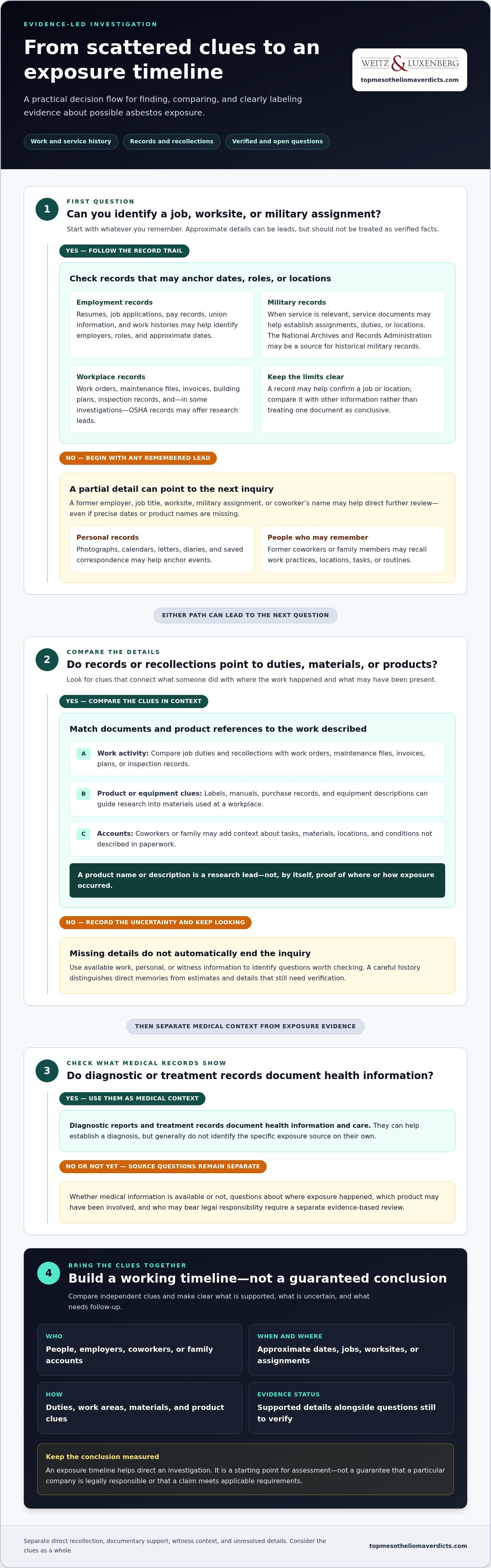
Exposure investigations often draw on several kinds of evidence. A document may help confirm a job or location, while a person’s recollection may supply context that records leave out. No single document is required in every investigation, and records may be incomplete or difficult to locate. The key is to see how separate clues fit together and identify what still needs verification.
Documents can establish dates, roles, and recorded events, while witness recollections can add context about tasks, materials, and conditions that paperwork may not describe. Neither type should automatically be treated as conclusive. Lawyers compare and assess the information as a whole.
- Employment records: Resumes, job applications, pay records, union information, and work histories may help identify employers, roles, and approximate dates.
- Workplace records: Work orders, maintenance files, invoices, building plans, or inspection records may offer leads about job duties, materials, or products at a site. OSHA records may also be a research source in some investigations.
- Product and equipment clues: Labels, manuals, purchase records, or descriptions of equipment can guide research into materials used at a workplace. Broader information about possible asbestos exposure sources may help put those clues in context.
- Military records: If military service is relevant, service documents may help establish assignments, duties, or locations. The National Archives and Records Administration may be a source for historical military records.
- Medical records: Diagnostic reports and treatment records document health information and care. They can help establish a diagnosis, but generally don’t identify the specific exposure source on their own.
- Personal records and accounts: Photographs, calendars, letters, diaries, or saved correspondence may help anchor events. Former coworkers or family members may also recall work practices, locations, or routines.
Work, product, and military records
Records become more useful when considered in context. A work order that names a repair, for instance, can be compared with someone’s job duties and recollection of the area where the work took place. Product references may point toward further research, but a name or description alone doesn’t establish exposure or responsibility. Military service records can likewise offer leads about where a person served and what duties they performed.
Medical records, witness accounts, and supporting documents
Medical documents answer different questions from workplace records. The National Cancer Institute’s asbestos fact sheet describes asbestos-related cancer risks and the latency period for disease development. A former coworker may help clarify routine tasks, while a family member might recognize a location in an old photograph. These accounts can guide follow-up, though they may not replace documentary evidence.
An asbestos-related legal discussion can help identify useful leads and organize the records you already have. Evidence availability varies, and the significance of any particular document or recollection depends on the circumstances.
How Lawyers Connect Clues Into a Credible Exposure Timeline
Once possible leads have been identified, the next task is to see how they relate. Lawyers organize dates, job duties, locations, and product descriptions into a working timeline, then compare it with available records and other people’s recollections. The goal isn’t to force every detail into a neat story. It’s to distinguish supported information from estimates, conflicts, and unanswered questions.
A practical investigation often moves through these steps:
- Build a preliminary history. Start with approximate years, employers, roles, tasks, and work locations the person remembers. Mark uncertain dates as estimates rather than guessing at precision.
- Identify leads. Look for details that may point to records or people who can add context, such as a former supervisor, a particular work area, or a recurring maintenance task.
- Seek relevant information. Use the leads to focus record requests and follow-up conversations. A broad date range or an old job title may be enough to guide the search.
- Compare accounts. Check whether the timeline is consistent with records, witness recollections, and other independent information. Note and explore differences.
- Document what remains uncertain. Keep confirmed facts separate from estimates, disputed details, and questions that still need answers.
Building a timeline from work and life history
Begin with the broad outline, not perfect recall. Someone might remember working for an employer during a particular period, performing repair tasks, and moving between several areas of a facility, while remaining unsure of exact months or product names. Record each fact with its source and level of confidence. This makes it easier to spot gaps and identify which records or witnesses might help fill them.
Chronology matters because details need to be considered in relation to one another. If job records place someone at a site during certain years, investigators can compare that period with descriptions of the person’s duties and work locations. A product clue can then be assessed against when and where the person recalls encountering it. That sequence helps guide further research without treating a possible match as proof.
Corroborating and assessing conflicting clues
Accounts don’t always line up at first. A record might list one job title while a person remembers doing several kinds of work, or two witnesses may recall different dates for the same task. Rather than ignoring a discrepancy or choosing the more convenient version, a lawyer can flag it, ask what each source is based on, and look for additional context.
Consistency is one consideration, not a shortcut to certainty. An old document may be incomplete; a witness may remember the general practice but not a specific product. Lawyers assess each clue in context, including its source, timing, and connection to other information. The resulting timeline can help identify what evidence supports a possible account and what remains unresolved, but it cannot guarantee a particular reconstruction or legal outcome.
What to Do if Exposure Records or Memories Are Missing
Missing paperwork can feel like a dead end, especially when a diagnosis raises questions about events from years ago. But an incomplete file is a reason to discuss available leads, not to assume an investigation is over. Records may be held by former employers, institutions, or other people, and useful details may come from personal documents or recollections rather than a formal archive.
You don’t need to solve every gap before speaking with a lawyer. Start with what you know, and be clear about what you’re unsure of. A rough description of a worksite or task can be more useful than a precise-sounding guess.
How to prepare useful details without perfect recall
Make brief notes in your own words. Include approximate years, employers, job duties, worksites, and materials or equipment you remember encountering. If you recall a supervisor or coworker, note their name or role if known. Add possible records, such as old correspondence or service paperwork, but don’t worry if you can’t locate everything now.
Separate remembered details from estimates. For example, write “around the early 1980s” if you’re unsure of the exact year, or note that a product name is uncertain. Don’t fill gaps by guessing. Keep original documents and photographs as they are, and list possible witnesses without contacting them or asking them to shape their recollections. These steps can preserve useful leads while leaving verification to the investigation.
How lawyers handle gaps and inconsistencies
Counsel can review what’s available, identify additional sources to pursue, and assess whether other information may corroborate a recollection. A former coworker’s account, for instance, may help clarify a job duty, while an old document may help narrow the period. The value of any lead depends on its connection to the circumstances being investigated; a possible clue is not automatically proof.
Conflicting accounts should be recorded and examined, not concealed. Someone may remember a task but not its date, while a record may show an employment period without describing daily work. A lawyer can note the difference, consider what each source can and can’t establish, and look for context that may explain the discrepancy. No single missing record automatically determines the outcome. The facts, available corroboration, and applicable legal requirements all matter.
Understanding how lawyers trace asbestos exposure history can help you prepare without feeling responsible for reconstructing everything alone. Bring your notes and any records you already have, even if they’re incomplete. A confidential conversation can help you discuss what the available information may support and which questions remain.
DIAGNOSED? CALL 1-800-885-MESO TODAY FOR A CONFIDENTIAL & FREE CONSULTATION
How an Asbestos Lawyer Uses the Exposure History in the Next Steps
An organized exposure history turns scattered details into questions a lawyer can evaluate. Counsel may review it alongside medical information, work history, and other available evidence to identify where more investigation may be needed. The history can also help identify possible asbestos-containing products or companies for further review. It guides the next steps; it is not a finding that a particular party is legally responsible.
From exposure timeline to case review
During a case review, a lawyer may consider whether the available information supports further investigation into litigation, asbestos trust fund claims, or both. The options and requirements depend on the individual facts and applicable law. Diagnosis, possible exposure circumstances, supporting evidence, and other case details all matter. A timeline can highlight unanswered questions, such as whether a product clue needs corroboration or whether additional records may exist.
For broader context, a mesothelioma litigation guide can explain how legal proceedings may fit into the larger process. The exposure history is one part of that review. It doesn’t, on its own, establish eligibility for a claim or predict a result, and different legal routes may involve different requirements.
What to expect from an initial conversation
You can share what you remember without having every date or detail settled. Approximate time periods, former employers, job duties, possible worksites, and uncertainty about a product’s identity can all help start a discussion. It’s also useful to explain which details come from personal memory and which you’ve heard from someone else. You don’t need to arrive with a complete archive.
Weitz & Luxenberg represents people with mesothelioma and asbestos-related lung cancer in litigation and asbestos trust fund claims nationwide. The firm works on a contingency basis, and the initial consultation is free and confidential. A conversation can help you understand what information may be relevant and what questions remain, without a promise about eligibility, compensation, or outcome.
Knowing how lawyers trace asbestos exposure history can make the next step feel more manageable. Counsel can organize the information, explain possible paths, and assess the facts with care. If you’ve been diagnosed with mesothelioma or asbestos-related lung cancer, discuss your circumstances in a confidential, free consultation.
DIAGNOSED? CALL 1-800-885-MESO TODAY FOR A CONFIDENTIAL & FREE CONSULTATION
Take the Next Step With the Details You Have
You don’t need a complete record of the past to begin asking questions about what happened. A first step can be as simple as writing down what you remember, noting what remains uncertain, and sharing both honestly. Understanding how lawyers trace asbestos exposure history can help you approach that conversation with realistic expectations: an investigation may clarify leads, but no particular finding or outcome is guaranteed.
Weitz & Luxenberg represents people diagnosed with mesothelioma and asbestos-related lung cancer. If you’re ready to discuss your circumstances, a confidential, free consultation can help you understand possible next steps. The firm handles asbestos litigation and trust fund claims on a contingency basis.
DIAGNOSED? CALL 1-800-885-MESO TODAY FOR A CONFIDENTIAL & FREE CONSULTATION
You can start with what you know. The rest can be explored one question at a time.
Frequently Asked Questions
Can a family member help lawyers trace someone else’s asbestos exposure?
Yes. Family members may help by sharing household papers, photographs, or recollections about a person’s routines and work history, particularly if illness makes detailed conversations difficult. Their account is one possible source, not a substitute for reviewing the full record. Preserve original documents and note whether you witnessed an event yourself or learned about it later. That distinction helps counsel assess what the account may establish.
What if the company where exposure happened has closed?
A company’s closure doesn’t automatically mean historical information is unavailable, but it also doesn’t establish that a claim can proceed. Depending on the circumstances, lawyers may look for records connected to the relevant period, such as union materials, public documents, product information, or people familiar with the workplace. If you remember a department, supervisor, or approximate employment period, share that lead. Available evidence and its usefulness vary.
Is a specific asbestos product brand always needed to trace exposure?
No, an exact brand name isn’t always the first detail someone can provide. You may remember repairing insulation, working near equipment, or handling a type of material without recalling its label. Lawyers can assess those descriptions alongside other information and look for ways to verify them. Whether product identification is needed, and how specific it must be, depends on the facts and applicable legal requirements. No single clue is sufficient in every case.
Can military service records help document possible asbestos exposure?
Yes, military service records may help establish service dates, assignments, or duties if military service is part of the exposure history. They may not describe every material a person encountered, so their usefulness depends on the circumstances and how they fit with other available information. If you have discharge papers, assignment details, or records identifying a role, preserve them and share what you know. Avoid assuming a record alone proves exposure.
Do lawyers need medical records before they can discuss an exposure history?
No, you can discuss remembered work and life details before gathering every document. Medical records may help explain a diagnosis, while other information addresses where and how possible contact occurred. If you’re unsure what to bring, describe what you have and ask what may be useful for the initial conversation. A lawyer can explain how sensitive records are handled. This discussion isn’t a medical diagnosis or individualized legal advice.
How long can lawyers investigate possible asbestos exposure from decades ago?
There’s no single universal lookback period for every investigation. The available work history, records, witnesses, and legal issues shape what may be possible to examine. The age of an exposure event alone doesn’t establish whether a claim is timely. Filing deadlines vary with applicable law and the facts, and may be measured from diagnosis or death rather than the original exposure. Prompt legal guidance can help clarify which deadlines may apply.
Disclaimer
Published by Weitz & Luxenberg, P.C. National Headquarters: 700 Broadway, New York, NY 10003. Call 800-885-MESO. Attorney Advertising. Prior results do not guarantee a future outcome. Certain contentions in blog posts need to be confirmed by a licensed attorney.


