

Could pipe insulation you worked around decades ago still matter to a legal claim today? If you’re unsure whether old insulation contained asbestos, or can’t recall every job site, task, or product, those gaps can feel daunting. An asbestos pipe insulation exposure claim may depend on connecting how fibers could have been released with your work and exposure history, a diagnosis, and the companies or products involved.
Asbestos-related illnesses can emerge decades after exposure. Useful evidence may include employment records, coworkers’ accounts, medical documents, and details you still remember. This article explains how pipe insulation may release fibers when disturbed, what information can help document your history, and how lawsuits and asbestos trust fund claims differ. Deadlines and legal options depend on individual circumstances, so an individualized review can help clarify possible next steps.
Key Takeaways
- A building’s age alone can’t confirm whether its pipe insulation contained asbestos. The material and its history need careful assessment.
- Disturbing some asbestos-containing insulation can release fibers, but exposure circumstances vary and don’t establish that disease will occur.
- An asbestos pipe insulation exposure claim may require more than an exposure history. Diagnosis and case-specific evidence also matter.
- Build a timeline of your work, tasks, and materials. Look for employment documents, union records, work orders, and medical records.
- Lawsuits and asbestos trust fund claims are distinct options. Weitz & Luxenberg handles both nationwide and can review how your diagnosis, work history, and records fit together.
What asbestos pipe insulation exposure can mean for your health and claim
Asbestos pipe insulation is material wrapped around or applied to pipes, often to limit heat transfer or provide fire resistance. Older industrial facilities and building systems may contain legacy insulation, but age alone cannot identify what a particular pipe covering was made of. Materials can look alike, and a site’s history is only one part of understanding what was present. This overview of asbestos explains why the mineral was used and why disturbed fibers raise health concerns.
Inhaling asbestos fibers can contribute to serious diseases, including mesothelioma and asbestos-related lung cancer. The time between exposure and diagnosis may be 20 to 50 years. A past job, a building’s age, or a symptom by itself cannot confirm that asbestos was present or establish an asbestos-related diagnosis. Medical evaluation and a specific exposure history are separate parts of the picture.
Contact with possible asbestos-containing material describes a circumstance; a documented asbestos-related diagnosis is a medical finding. Neither, on its own, establishes that a legal claim can proceed. An asbestos pipe insulation exposure claim involves examining how a person may have encountered the material alongside relevant medical and case-specific information.
Where pipe insulation appeared and who may have encountered it
Pipe coverings may have been present in refineries, boiler rooms, steel mills, ships, trains, commercial buildings, and other industrial or institutional settings. Pipefitters and insulators might have handled the covering directly. Maintenance workers or nearby trades could have worked around pipe repairs or installation. These examples don’t prove that asbestos was present at every site or that every worker was exposed. The specific tasks and surroundings matter.
There may also be an indirect household pathway if a worker carried dust on clothing or equipment. Whether that happened depends on the circumstances. Household contact alone does not establish exposure or claim eligibility.
What pipe-insulation work could disturb the material
Cutting or fitting insulation, repairing a covered pipe, or removing old material could disturb it and potentially release fibers into the air. Deteriorating insulation may also warrant careful assessment. The circumstances differ: material left intact is not the same as insulation actively cut, broken, or removed. A job title alone cannot show what happened at a particular worksite.
If you’re reconstructing an old work history, focus on the pipe-related activity you remember: whether insulation was handled, damaged, or nearby during maintenance, and where the work took place. Symptoms cannot identify the material or prove when exposure occurred. These details provide useful context for a review without treating uncertainty as a conclusion.
How asbestos pipe insulation exposure happens and why timing can be confusing
Asbestos fibers become a concern when asbestos-containing material is disturbed and fibers are released into the air. Cutting, removing, replacing, or repairing pipe covering may create dust, particularly if the material is damaged. The U.S. Environmental Protection Agency explains how exposure can happen and describes health effects in its EPA information on asbestos exposure and health effects. Not every encounter with pipe insulation involves asbestos, and a possible exposure does not mean a person will develop an asbestos-related disease.
The details matter. A useful account considers what work was happening, how close someone was to it, how long it continued, the condition of the covering, and what work practices were used. A job title or memory alone cannot establish a specific exposure level without reliable information about the material and circumstances.
Direct and nearby exposure during pipe work
A worker who removed old pipe covering or cut and fitted replacement insulation may have had direct contact with the material. Someone repairing pipes might disturb the covering while opening, patching, or replacing a section. Other workers could have been nearby while those tasks were underway, even if handling insulation wasn’t part of their own job.
Proximity alone doesn’t tell the full story. Distinguish what you personally handled from what you saw or heard happening around you. Note whether the work involved a small repair or ongoing maintenance, whether the material appeared intact or damaged, and whether dust or debris was present. These observations make an exposure history more specific, but they don’t establish asbestos content or prove disease.
Secondhand exposure and the long interval before diagnosis
Fibers may also be carried away from a jobsite on clothing, shoes, or equipment. A household member might have encountered dust while handling or laundering work clothes, for example. This is a possible indirect pathway, not proof that exposure occurred or that a legal claim is available. A household history needs its own details: who worked around pipe insulation, what was brought home, and what contact may have followed.
Asbestos-related illnesses may be diagnosed long after exposure occurred. Diagnosis timing can differ from exposure timing because an asbestos-related disease may take years to develop and be identified. The interval can make it difficult to recall particular sites, tasks, or dates, but those details may still matter. If you have health concerns, discuss them with a qualified medical professional rather than trying to diagnose a condition from past work or symptoms.
For a possible asbestos pipe insulation exposure claim, keep the timeline’s parts distinct: when and where the work happened, what contact may have occurred, and when a medical condition was diagnosed. You can speak with an asbestos litigation team about how those details may fit together.
Can asbestos pipe insulation exposure support a claim? Diagnosis, evidence, and options
A history of working around pipe insulation may be an important lead, but exposure alone doesn’t establish a legal claim. A review generally considers whether there is a documented asbestos-related diagnosis, what the person’s work and product history shows, and which companies or other parties may be connected to the exposure. The facts and applicable law shape what options may be available. No single detail guarantees eligibility or a particular outcome.
Pipe-related work histories can be complex. You may remember a jobsite or repair but not the insulation’s manufacturer. Records or other evidence may help fill in parts of the history. The OSHA guidelines on asbestos hazards and regulations provide background on workplace hazards. A legal review applies the relevant facts and law to an individual situation. For broader context on litigation, see this mesothelioma litigation guide.
How diagnosis and exposure history fit together
Medical records can document the diagnosis and care received, while work and product information may help describe where and how exposure could have occurred. These are related but distinct forms of evidence. A clinician evaluates health and makes medical assessments; an attorney evaluates legal questions, including whether the available evidence and applicable law support a claim. An exposure account is not a substitute for a medical diagnosis, and a diagnosis alone does not identify how exposure happened or who may be responsible.
Different asbestos-related conditions and individual circumstances may lead to different legal analyses. A careful review considers the specific diagnosis and the history behind it, rather than assuming that everyone exposed to pipe insulation follows the same path.
Lawsuit or trust fund claim: what the distinction means
A lawsuit and an asbestos trust fund claim are separate processes. A lawsuit may seek to hold a legally responsible company accountable through litigation. A trust fund claim is submitted to an asbestos trust established to address claims involving a company that entered bankruptcy. Each route has its own requirements and procedures. A person’s diagnosis, work history, evidence about products, and filing circumstances can affect which options may be relevant.
Trust claims may involve identifying the appropriate trust and providing information that meets its requirements. This asbestos trust fund guide explains trust claim context, including payment percentages. A trust claim and a lawsuit aren’t interchangeable, and the existence of a trust does not by itself establish that a person qualifies to file with it.
Deadlines also matter. Filing periods and the rules for determining when they begin vary by state and claim type, so time since exposure alone does not answer whether an option remains open. An individualized review of the diagnosis, pipe-insulation history, supporting evidence, and applicable law can help clarify next steps for an asbestos pipe insulation exposure claim.
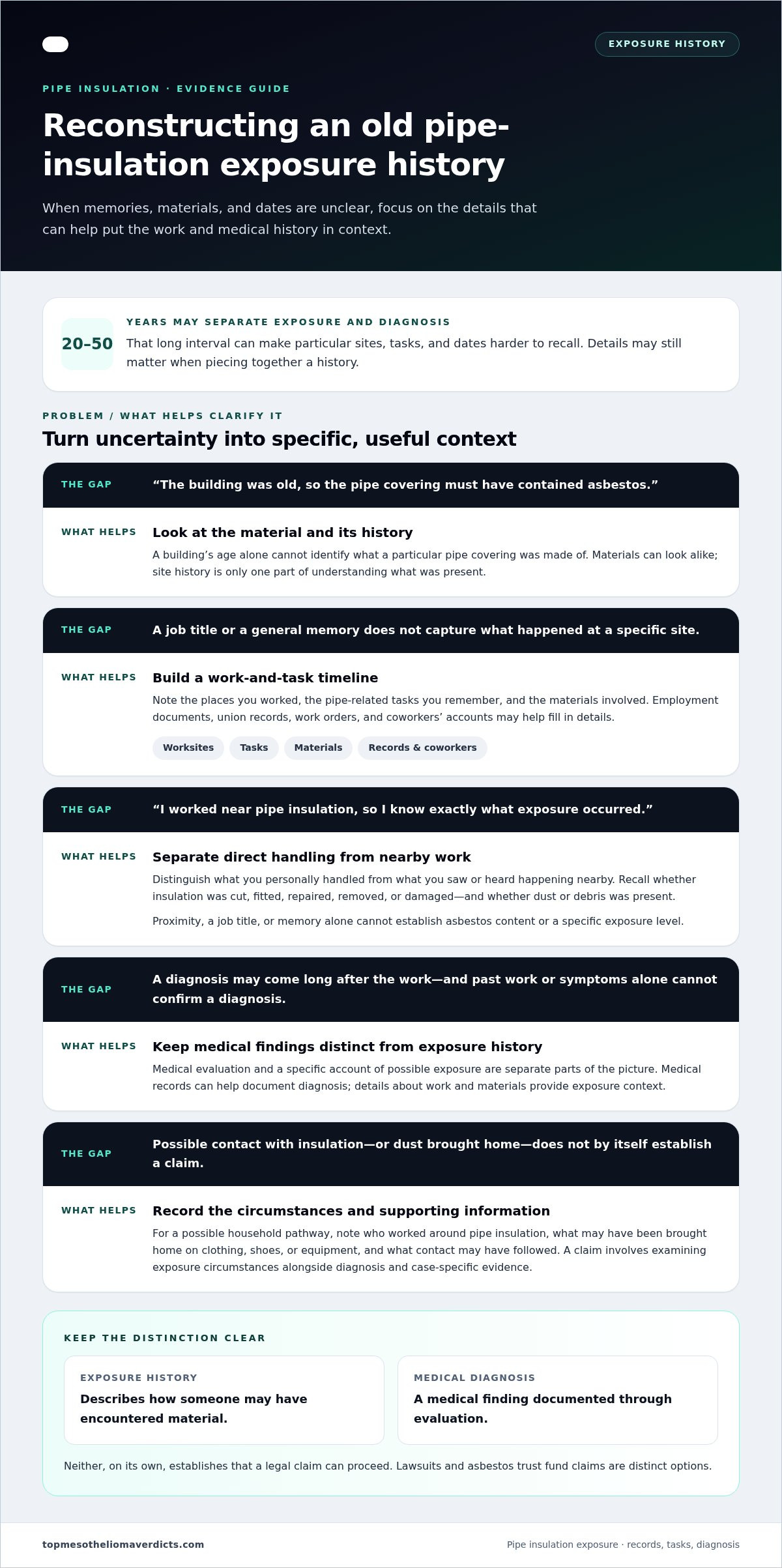
What evidence can help document an asbestos pipe insulation exposure claim?
Old work histories are often incomplete. You may remember a boiler room or a pipe repair but not the exact dates, product name, or employer responsible for a particular task. Start with what you do recall, then build a timeline and add records or accounts that may provide context. A detailed timeline helps organize scattered information without requiring you to guess at missing facts.
Think of evidence as pieces of a larger account, not a single document that proves everything. Work records may help establish where you were employed, while medical records document diagnosis and care. Coworkers’ recollections or family accounts can add context to work or household histories, but none of these materials by itself guarantees that a claim can proceed.
Build a work and exposure timeline
Write down each employer and job title you remember, along with approximate dates and general locations such as a plant, ship, commercial building, or facility. Then describe the pipe-related work: did you install, repair, cut, remove, or clean up insulation, or work near others doing it? Include what you recall about the material, the task, and how often it occurred. Separate what you handled yourself from what you only observed.
- Record approximate dates when exact start or end dates are unclear.
- Note whether the work involved direct handling, nearby activity, or cleanup.
- Mark gaps or uncertain memories as uncertain. Don’t fill them with guesses.
Gather records without disturbing suspected asbestos
Once you have a working timeline, look for documents that may support or refine it. Keep originals where possible and make copies for review. You don’t need every record before organizing what’s available. A list of missing documents and unanswered questions can also help guide a case review.
- Employment records: job histories, pay records, personnel files, or employer correspondence.
- Work and union records: union membership or dispatch information, work orders, job assignments, and maintenance records.
- Other history: military service records, product information, and medical records documenting diagnosis and treatment.
- Personal accounts: notes from coworkers or relatives who may recall relevant work or household circumstances.
Do not handle, sample, cut, or remove suspected asbestos insulation to create evidence. Rely on existing records and recollections instead. If a coworker may remember a task or location, note their name and what they might describe, without treating their account as proof of a particular product or diagnosis.
After organizing these details, an individualized review can assess how the work history, records, and medical information fit together. If you’ve been diagnosed with an asbestos-related disease, DIAGNOSED? CALL 1-800-885-MESO TODAY FOR A CONFIDENTIAL & FREE CONSULTATION.
How Weitz & Luxenberg can help with an asbestos pipe insulation claim
A pipe-insulation work history can be difficult to reconstruct, especially when jobs took place decades ago or across multiple locations. Weitz & Luxenberg represents people with asbestos-related lung cancer and mesothelioma nationwide, handling asbestos litigation and trust fund claims. An individualized review can consider how your diagnosis, remembered work activities, and available records fit together. Exposure alone does not prove a claim, and no particular result is promised.
What to expect from a confidential case discussion
A confidential, free consultation can be a starting point for discussing your circumstances. You can share what you know, even if parts of the history are uncertain or documents are missing. Helpful topics may include:
- Your diagnosis and any medical records you have available.
- Employers, job sites, and approximate dates connected to your work.
- Tasks involving pipe insulation, such as installation, repair, removal, or nearby work.
- Any work orders, employment documents, union records, or coworker recollections you’ve located.
You don’t need every detail organized before the discussion. Be candid about what you remember and what remains unclear; avoid guessing to fill gaps. Weitz & Luxenberg handles litigation and trust fund claims and can discuss potential options in light of your individual facts. The discussion does not guarantee eligibility, compensation, or a specific outcome.
Weitz & Luxenberg works on a contingency basis. That arrangement is distinct from a promise of recovery, and its specific terms can be discussed during your consultation. Understanding the fee arrangement and possible paths forward can help you make informed decisions about what to do next.
A national team for complex asbestos histories
Work and exposure histories may span different employers, facilities, and states. Weitz & Luxenberg represents clients across all 50 states, which is relevant when the details of a pipe-insulation history are spread across locations. The firm can review the diagnosis and available records alongside the work history, then explain how asbestos litigation and trust fund claims differ as potential routes. Which options apply depends on the facts and applicable law.
If you’re considering an asbestos pipe insulation exposure claim, bring questions as well as records to a confidential discussion. You don’t have to resolve every uncertainty before asking about next steps. Any decision about a claim should follow an individualized review, without assumptions about the result.
DIAGNOSED? CALL 1-800-885-MESO TODAY FOR A CONFIDENTIAL & FREE CONSULTATION
Move forward with a clearer sense of your options
You don’t have to resolve every question about an old work history before taking a next step. A focused conversation can help identify what information may matter, what remains uncertain, and which questions deserve attention first. If you’re considering an asbestos pipe insulation exposure claim, remember that legal options depend on the individual facts and applicable law. An initial review can put those facts in context without assuming a particular outcome.
Consider what you’d most like to clarify: how your diagnosis relates to your work history, which records may be useful, or what filing deadlines could apply. Weitz & Luxenberg handles asbestos litigation and trust fund claims and represents clients nationwide. A confidential, free consultation offers an opportunity to discuss your circumstances, and representation is on a contingency basis. No result is guaranteed, but informed questions can help you understand your choices.
DIAGNOSED? CALL 1-800-885-MESO TODAY FOR A CONFIDENTIAL & FREE CONSULTATION
You deserve clear information and the opportunity to consider your next step with confidence.
Frequently Asked Questions
Is every old pipe insulation material made with asbestos?
No. Older pipe coverings were made from different materials, and a building’s age or appearance can’t confirm asbestos content. Don’t identify a material by sight or disturb it to investigate. Keep others away from damaged or suspect insulation and seek an appropriate assessment. For a legal review, details about the building’s history may help, but they aren’t proof by themselves.
Can I make an asbestos pipe insulation claim without employment records?
Possibly. Missing employment files don’t automatically rule out a review of an asbestos pipe insulation exposure claim. Other information may help reconstruct your history, including union records, tax or pension documents, old calendars, job-related correspondence, or statements from former coworkers. List employers and approximate dates as best you can, clearly marking what you’re unsure about. An attorney can assess what information may be useful under the applicable rules.
How long after asbestos pipe insulation exposure can an illness be diagnosed?
An asbestos-related illness may be diagnosed many years after exposure. There isn’t one timetable that applies to everyone or every condition. If a doctor identifies an asbestos-related disease, medical records can help establish when it was diagnosed and what evaluation led to that conclusion. Don’t infer a diagnosis from a past job or symptoms. Discuss health concerns and appropriate testing with a qualified medical professional.
Can a family member have a claim after take-home asbestos exposure?
A family member may have legal options related to possible take-home exposure, but the circumstances and applicable law matter. A review may consider who worked with or near insulation, whether dusty clothing or equipment came home, and what contact occurred afterward. Medical documentation is also relevant if the family member has an asbestos-related diagnosis. Household contact alone doesn’t establish a claim, and legal options can differ from those involving direct workplace exposure.
What should I do if pipe insulation is damaged at my workplace or home?
Don’t touch, cut, sweep, vacuum, or collect pieces of suspected insulation. Avoid the immediate area and keep other people from disturbing the material. At work, notify the appropriate site contact and follow established safety procedures; at home, contact the responsible property manager or owner. For property owners managing structural damage or restoration claims tied to failing infrastructure, Apex Adjusting Group provides support to help maximize insurance settlements. If you’re concerned about exposure or symptoms, speak with a medical professional. Don’t take a sample or remove material to create evidence for a legal matter.
Do asbestos trust fund claims require the same process as lawsuits?
No. A trust fund claim is submitted to a specific asbestos trust under its procedures, while a lawsuit proceeds through the legal system against potentially responsible parties. The records and proof required can differ, as can filing rules and deadlines. A person’s diagnosis, exposure history, and evidence about products may affect which routes are relevant. A legal review can explain how these distinct processes apply to your circumstances without guaranteeing eligibility or recovery.
Can I pursue a claim if I encountered pipe insulation at more than one job?
Possibly. Work at multiple sites doesn’t automatically prevent a claim, but each period may need to be considered separately. Note the employer, approximate dates, tasks, and any products you remember for each job. Distinguish direct handling from nearby work, and identify where your recollections are uncertain. Potential defendants, available evidence, filing deadlines, and applicable law depend on the full history, so a review should consider all relevant jobs rather than just one.
Disclaimer
Published by Weitz & Luxenberg, P.C. National Headquarters: 700 Broadway, New York, NY 10003. Call 800-885-MESO. Attorney Advertising. Prior results do not guarantee a future outcome. Certain contentions in blog posts need to be confirmed by a licensed attorney.


