

Could a single brief encounter with asbestos put your health at risk? If you’re asking how much asbestos exposure is dangerous, the unsettling answer is that medical experts recognize no safe level. Even limited exposure may create risk, although it doesn’t mean you’ll necessarily develop an asbestos-related disease. That uncertainty can be frightening, especially when symptoms may not appear for 20 to 50 years.
Conflicting numbers can add to the confusion. OSHA’s workplace exposure limits are regulatory controls, not a guarantee that exposure below those limits is harmless. Risk can depend on how much material was disturbed, how long the exposure lasted, and whether fibers became airborne and were inhaled.
This guide explains how exposure is assessed, what to discuss with a doctor, and which details to document. You’ll also learn how asbestos-related claims work and why deadlines vary by state. If exposure has affected your health or your family’s financial security, Weitz & Luxenberg handles mesothelioma and asbestos lung cancer cases on a contingency basis, with legal fees tied to recovery rather than paid upfront.
Key Takeaways
- Assess how much asbestos exposure may have occurred by considering both time around the material and how much dust may have entered the air.
- Understand how industrial workplaces and military settings can involve asbestos exposure, and record details that may help clarify where contact occurred.
- Build a clearer exposure history by writing down dates, locations, job tasks, and any product names you remember.
- Learn how asbestos claims may rely on evidence of exposure and illness, and how asbestos trust funds can provide a route to compensation.
Is There a Safe Level of Asbestos Exposure?
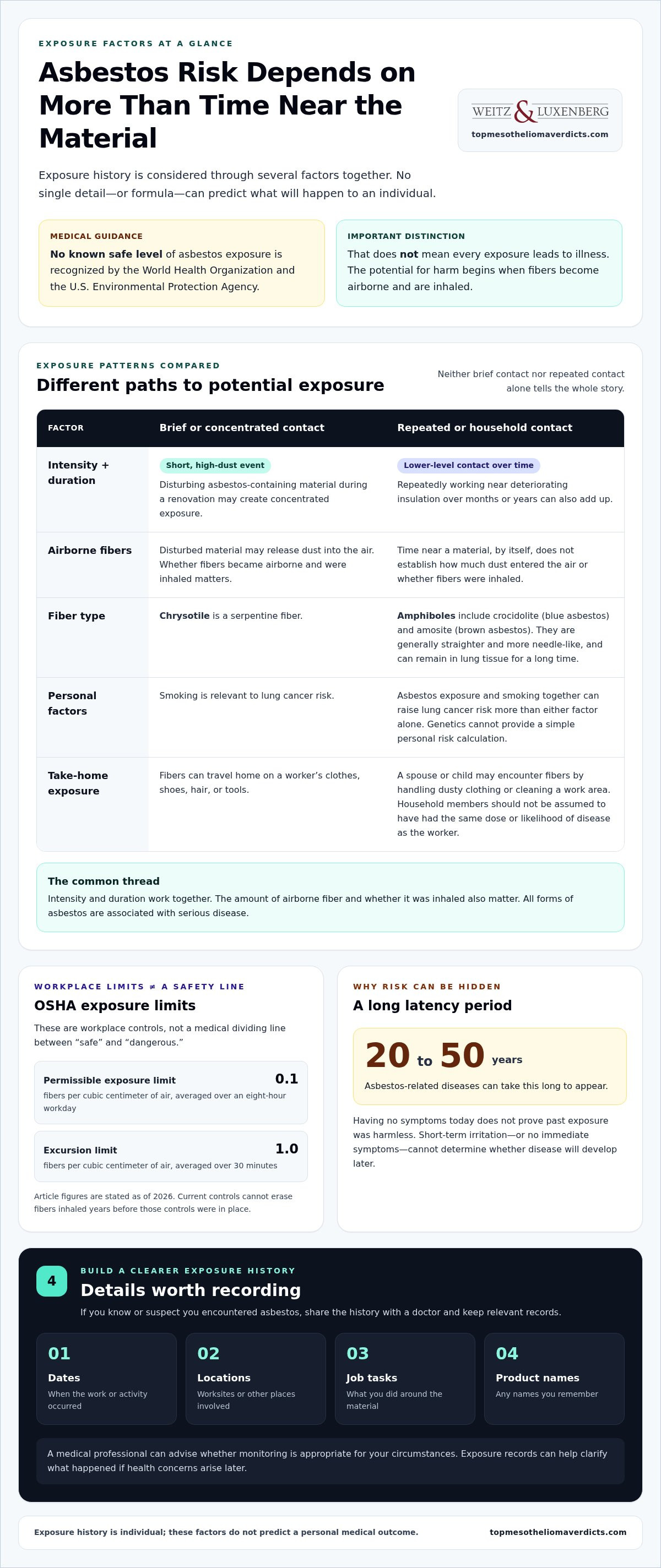
There’s no reliable exposure threshold that can tell you asbestos is harmless. The World Health Organization and the U.S. Environmental Protection Agency recognize no known safe level of exposure. That doesn’t mean every exposure leads to illness, but it does mean you can’t automatically dismiss a brief encounter as safe. To understand how much asbestos exposure is dangerous, consider whether fibers became airborne and could be inhaled, not just how long you were near the material.
Asbestos exposure danger involves inhaling fibers that may lodge and accumulate in the lungs. These fibers are microscopic, and the body may have difficulty clearing them. The “single fiber” idea needs care: no one can say that one fiber will cause cancer in every person, and there is no established safe fiber count. The potential for harm begins with inhalation. Asbestos fibers can trigger persistent inflammation and cellular damage that may contribute to cancer over time. The Asbestos overview explains the material’s properties and its association with serious diseases, including mesothelioma and lung cancer.
Regulatory Limits vs. Biological Reality
OSHA sets workplace limits to control exposure, not to certify that exposure below a particular number carries no health risk. As of 2026, OSHA’s permissible exposure limit (PEL) is 0.1 fibers per cubic centimeter of air averaged over an eight-hour workday. Its excursion limit is 1.0 fibers per cubic centimeter averaged over 30 minutes. These are workplace standards, not a medical dividing line between “safe” and “dangerous.” They also cannot erase fibers inhaled years before current controls were in place. EPA rules address different aspects of asbestos; OSHA’s occupational limits should not be mistaken for an EPA workplace PEL.
Short-term irritation and long-term cancer risk are different issues. Someone might have no immediate symptoms after inhaling fibers, or experience irritation that soon passes. Neither response can determine whether an asbestos-related disease will develop later.
The Latency Period: Why Danger Is Often Hidden
Asbestos-related diseases can take 20 to 50 years to appear. Fibers may remain in the body and contribute to damage over time, while a person feels healthy for decades. Having no symptoms today doesn’t prove that past exposure was harmless.
If you know or suspect you encountered asbestos, tell a doctor about the exposure history, including the work or activity involved and when it occurred. A medical professional can advise whether monitoring is appropriate for your circumstances. Keep relevant records, too. Clear documentation can help you and your care team understand the exposure history if health concerns arise in the future.
Factors That Determine the Severity of Asbestos Risk
No single exposure history predicts what will happen to everyone. Risk assessment considers how long you were exposed, how much asbestos dust may have been airborne, the type of fiber, and personal factors such as smoking. These details help explain why two people who worked in similar settings may face different health risks. The National Cancer Institute’s overview of asbestos exposure and cancer risk also describes dose and duration as important considerations.
Fiber type can matter, too. Chrysotile is a serpentine fiber, while amphiboles include crocidolite, often called blue asbestos, and amosite, often called brown asbestos. Amphibole fibers are generally straighter and more needle-like, and they can remain in lung tissue for a long time. All forms of asbestos are associated with serious disease, but fiber characteristics may affect how the body responds. Smoking is especially relevant to lung cancer risk: asbestos exposure and smoking together can raise that risk more than either factor alone. Researchers continue to study individual susceptibility, but genetics can’t provide a simple personal risk calculation.
Intensity vs. Duration: Which Matters More?
Intensity and duration work together, so neither alone tells the whole story. A short, high-dust event, such as disturbing asbestos-containing material during a renovation, may involve concentrated exposure. Lower-level contact over months or years, such as repeatedly working near deteriorating insulation, can also add up. In either situation, the amount of airborne fiber and whether it was inhaled matter.
There’s no single formula that turns a work history into a medical prediction. In asbestos litigation, a brief exposure isn’t automatically dismissed, but a legal claim depends on the evidence and the law that applies. Records of job duties, worksites, products, and dates can help establish what happened and how exposure may relate to an illness.
Secondary Exposure: Danger for Family Members
Asbestos fibers can travel home on work clothes, shoes, hair, or tools. A spouse or child who handles dusty clothing or cleans a work area may therefore have had secondary exposure without entering the workplace. That contact can pose a health risk, but it isn’t accurate to assume every household member faced the same dose or likelihood of disease as the worker. The circumstances and extent of exposure matter.
Families affected by take-home exposure have pursued asbestos claims, though legal standards and outcomes vary by state and case. If your family is trying to understand whether past contact may be relevant, information about asbestos litigation can provide a starting point for learning about legal options.
Common Scenarios of Dangerous Asbestos Exposure
Asbestos exposure has occurred in many settings, including industrial jobs, military service, construction, and damage to older buildings. Work on asbestos-containing materials can release fibers into the air. If you’re trying to understand how much asbestos exposure is dangerous, the setting can help explain how fibers may have become airborne, but it can’t determine an individual’s health outcome on its own.
Exposure in High-Risk Industrial Trades
Power plants and factories often contained asbestos in insulation, boilers, pipes, turbines, and electrical equipment. Pipefitters and boilermakers could encounter it while repairing or replacing insulated systems. Electricians might disturb asbestos-containing materials while working near wiring, panels, or equipment. Routine maintenance could release dust, particularly when insulation was cut, scraped, or removed. Learn more about asbestos exposure in power plants. OSHA’s asbestos regulations explain workplace rules for controlling exposure, though present-day standards don’t reconstruct conditions at a past job.
Veterans and Asbestos: A National Crisis
Asbestos was used on Navy vessels and in shipyards, including in insulation and other heat-resistant materials. Service members and shipyard workers could encounter it in engine rooms, where maintenance or repairs might disturb materials in enclosed spaces with limited ventilation. Exposure varied by task, location, and conditions. For more context, see this guide to Navy veteran asbestos exposure claims. A veteran’s service history, ship assignments, duties, and dates may help document possible exposure.
Construction, Demolition, and Building Damage
Older buildings may contain asbestos in insulation, floor tiles, roofing, or other materials. Asbestos is especially concerning when material is friable, meaning it can be crumbled by hand and release fibers. Cutting, drilling, sanding, or demolition can also disturb material that wasn’t friable before. Fires, storms, and structural deterioration may damage building materials and scatter dust without a planned renovation. Don’t handle suspected asbestos debris yourself. Avoid disturbing it and follow applicable safety guidance for assessment and cleanup.
Whatever the setting, useful details include where and when you were present, what work was underway, which materials were disturbed, and what protective measures were in use. These records can clarify your exposure history and may matter if an asbestos-related illness is later diagnosed. Legal options depend on the exposure facts and the law that applies.
What to Do If You Were Exposed to Dangerous Amounts
Past asbestos exposure can be difficult to measure, and symptoms may take decades to appear. You don’t need to know the exact fiber level before taking sensible steps. If you’re asking how much asbestos exposure is dangerous, focus on your health, a clear record of your exposure history, and any deadlines that could affect legal options.
Medical Monitoring and Early Detection
Tell your primary care physician when and where you may have encountered asbestos, what work or tasks you did, and whether you remember dust or damaged insulation. Ask whether evaluation by a clinician familiar with asbestos-related disease is appropriate. Depending on your history and health, a doctor may consider imaging such as a CT scan or tests of lung function. These tests serve different purposes, and a clinician can explain whether they’re suitable for you.
Watch for persistent cough, shortness of breath, or chest pain, and report new or worsening symptoms promptly. These symptoms can have many causes and don’t, by themselves, establish an asbestos-related diagnosis. Asbestosis is a chronic lung disease caused by asbestos scarring; it isn’t a precursor to mesothelioma or lung cancer, although a person may have more than one asbestos-related condition.
Preserving Evidence for Potential Claims
Write down what you remember while details are accessible. Useful information may include:
- Employers, job titles, worksites, dates, and specific duties.
- Materials or product names, if known, and the equipment or areas where you encountered them.
- Protective gear, ventilation, visible dust, and nearby maintenance or renovation work.
- Names and contact details of former coworkers who may recall the conditions.
Employment records, union or military service records, photos, and medical records may help fill gaps. Don’t worry if you can’t identify a product or remember every date. A detailed, honest account is still useful, and an attorney can assess what evidence may be available.
Consider legal advice promptly if you’ve received an asbestos-related diagnosis. Personal injury and wrongful death filing deadlines vary by state; they commonly range from one to six years, with the clock often tied to diagnosis or, in wrongful death cases, the date of death. The applicable rule depends on the circumstances and jurisdiction, so delaying could affect your options. Weitz & Luxenberg handles mesothelioma and asbestos lung cancer cases nationwide on a contingency basis. Learn about asbestos litigation options.
Legal Rights and Compensation for Asbestos Exposure
There’s no universal legal exposure threshold that automatically proves or defeats an asbestos claim. In many cases, lawyers must connect a person’s diagnosis to asbestos exposure and show that the exposure was a substantial factor in causing the illness. Evidence may include work and service histories, product records, medical documentation, and testimony from people who remember the conditions. The legal standard and available claims depend on the facts and applicable state law.
So, how much asbestos exposure is dangerous in a legal case? The answer isn’t decided by a single fiber count. Even a brief exposure may be worth investigating, but a claim requires evidence connecting exposure, illness, and responsible parties under the applicable rules.
Filing a Claim Against Bankrupt Manufacturers
Some companies that faced asbestos liabilities established trust funds as part of bankruptcy proceedings to compensate people who later develop asbestos-related diseases. A trust claim is generally handled outside a trial, but payment isn’t automatic. Each trust sets criteria that may include a qualifying diagnosis, evidence of exposure to the company’s products, and supporting work or medical records. Learn how asbestos trust fund payout percentages can affect claims.
Depending on the circumstances, a person may be able to pursue claims against more than one company or through different legal channels. An attorney can assess how the claims interact and whether filing deadlines apply. Trust payments and settlements aren’t guaranteed, and each claim is evaluated on its evidence.
Compensation and National Asbestos Advocacy
Mesothelioma and asbestos lung cancer claims may seek compensation for losses such as medical expenses, lost income, and the impact of illness on quality of life. Eligible family members may also have legal options after a death. What can be recovered depends on the evidence, the claim type, and the applicable law. A settlement is one possible resolution; a case may instead proceed through litigation.
Weitz & Luxenberg has secured more than $13 billion in verdicts and settlements and handles asbestos cases nationwide. The firm has over 40 years of experience and more than 500 professionals. In 2025, it secured a record $117 million verdict. The firm handles mesothelioma and asbestos lung cancer cases on a contingency basis, with legal fees tied to recovery. A national firm can investigate exposure histories across different employers, products, and locations, but no result is guaranteed.
If you’ve been diagnosed and want to understand your options, discuss your asbestos exposure and legal options.
Take the Next Step Toward Clarity and Support
There’s no known safe level of asbestos exposure. Risk depends on factors such as how much dust may have been inhaled, how often exposure occurred, and the type of asbestos. A brief encounter doesn’t guarantee illness, but it shouldn’t automatically be dismissed. If you may have been exposed, share your history with a doctor, keep records of where and when it happened, and report concerning symptoms.
If you’ve received a mesothelioma or asbestos lung cancer diagnosis, legal options may include litigation or an asbestos trust fund claim. Evidence about your exposure, diagnosis, and the companies or products involved can help determine which claims may apply. Deadlines vary, so learning about your rights promptly can help protect your options.
Weitz & Luxenberg has secured more than $13 billion in verdicts and settlements for clients and was ranked the #1 filer of asbestos injury cases in the U.S. in H1 2026. The firm handles cases on a contingency basis, so legal fees are tied to recovery.
DIAGNOSED? CALL 1-800-885-MESO TODAY FOR A CONFIDENTIAL & FREE CONSULTATION
You deserve clear answers and support as you decide what comes next.
Frequently Asked Questions
How much asbestos exposure causes mesothelioma?
There’s no known exposure amount that reliably predicts whether someone will develop mesothelioma. Risk can depend on factors such as exposure intensity, duration, fiber type, and individual health, but even brief exposure can’t be declared harmless. That doesn’t mean every exposure leads to cancer. If you’re wondering how much asbestos exposure is dangerous, there’s no single number that can determine your personal outcome or serve as a guaranteed safe threshold.
Can a one-time exposure to asbestos be dangerous?
Yes, a one-time exposure can pose a health risk if asbestos fibers become airborne and are inhaled, but it doesn’t mean you’ll necessarily become ill. The circumstances matter, including whether material was disturbed, how much dust was released, and how close you were. If you’re concerned, write down what happened and discuss it with a doctor, especially if you have a history of other asbestos exposure.
How long after exposure to asbestos do symptoms appear?
Asbestos-related diseases often take decades to develop. The latency period can be about 20 to 50 years, so feeling well now doesn’t rule out effects from past exposure. Timing varies by person and disease. Share your exposure history with your doctor, including approximate dates, workplaces, and tasks. A clinician can advise whether monitoring or evaluation is appropriate for your circumstances.
What are the symptoms of dangerous asbestos exposure?
Exposure itself may not cause noticeable symptoms. If an asbestos-related disease develops, symptoms can include shortness of breath, a persistent cough, or chest pain, but these signs also have many other possible causes and can’t confirm asbestos disease on their own. Seek medical advice about persistent or worsening symptoms, and tell your clinician about any known asbestos contact. Don’t wait for symptoms to document an exposure history.
Is it dangerous to live in a house with asbestos?
Asbestos-containing material that’s intact and undisturbed may pose less risk than damaged material that releases fibers into the air. Risk can arise if material is deteriorating or disturbed during repairs, renovations, or demolition. Don’t cut, sand, drill, or remove suspected asbestos yourself. Avoid disturbing damaged material and seek appropriate assessment and handling guidance. A building’s age alone can’t confirm whether asbestos is present.
Can I sue for asbestos exposure if I am not sick yet?
In many asbestos injury cases, a person must have a diagnosed illness to pursue a personal injury claim, but the rules and available options depend on state law and the facts. Some asbestos trust funds also require a qualifying diagnosis and exposure evidence. Don’t assume a future claim is available or that waiting is risk-free. Filing deadlines vary, so getting legal guidance about your circumstances may help protect your options.
How is dangerous asbestos exposure proven in court?
Evidence may include medical records, employment and military service histories, worksite details, product identification, and testimony from coworkers or family members. In many cases, the legal question includes whether exposure to a defendant’s asbestos-containing product was a substantial factor in causing the illness. The precise standard varies by jurisdiction. No single document or fiber count automatically proves a claim; the evidence is assessed together under applicable law.
Are there different danger levels for different types of asbestos?
All six types of asbestos are carcinogenic, but their physical characteristics differ. Chrysotile is a serpentine fiber, while amphiboles such as crocidolite, or blue asbestos, and amosite, or brown asbestos, are generally straighter and more needle-like. Fiber type is one factor in assessing exposure, alongside dose and duration. No type can be considered safe to inhale, and identifying a fiber type alone can’t predict whether an individual will become ill.
Disclaimer
Published by Weitz & Luxenberg, P.C. National Headquarters: 700 Broadway, New York, NY 10003. Call 800-885-MESO. Attorney Advertising. Prior results do not guarantee a future outcome. Certain contentions in blog posts need to be confirmed by a licensed attorney.


