

What if the first step in figuring out how to pay for mesothelioma treatment is understanding how several funding sources may work together? It’s understandable to worry that insurance won’t cover every service or that bills will arrive before you’ve arranged help. You don’t have to solve every financial question at once, and you shouldn’t have to wait to discuss treatment with your care team while you look for answers.
This 2026 guide compares practical options, including private insurance, Medicare or Medicaid, veterans’ benefits, disability benefits, assistance programs, and legal compensation. You’ll find questions to ask your insurer and hospital financial counselor, documents to organize, and ways to explore asbestos-related claims alongside other funding sources. A legal claim or trust fund payment isn’t guaranteed and may not arrive in time to pay current bills. Understanding the options can still help you build a more complete plan. Start by clarifying near-term coverage, then consider how other sources may fit your circumstances.
Key Takeaways
- Build a funding plan around your coverage, eligibility, and individual needs. Several sources may work together.
- Learn how to pay for mesothelioma treatment by checking insurance benefits and asking focused questions about coverage and out-of-pocket costs.
- Compare insurance, public benefits, hospital assistance, nonprofit programs, and legal claims by purpose, eligibility, and timing.
- Keep bills, benefit decisions, deadlines, insurance details, and call notes in one shared record so you can track next steps.
- Explore whether an asbestos-related legal claim may apply, while remembering that eligibility and outcomes vary and compensation may not arrive in time for current bills.
How to Pay for Mesothelioma Treatment: Start With the Main Funding Options
A mesothelioma diagnosis can bring urgent care decisions and difficult financial questions at the same time. There isn’t one funding plan that fits every family. Your options depend on factors such as your insurance, eligibility for public benefits or assistance, and individual circumstances. You can begin reviewing costs while continuing conversations with your oncology team.
Potential funding sources include private health insurance, Medicare or Medicaid, veterans’ or disability benefits, hospital assistance, nonprofit or manufacturer programs, payment arrangements, and legal compensation. Each has different rules and timing. Treatment coverage may not include related expenses such as travel, lodging, prescriptions, or help at home. Ask the hospital’s financial counselor or patient navigator which billing questions they can address and where to direct questions about other expenses.
As you consider how to pay for mesothelioma treatment, don’t choose or postpone care based on funding alone. Discuss treatment options, potential benefits, and medical concerns with your oncology team. For general background on the disease and its treatment, see Mesothelioma.
Which sources may help cover treatment and related expenses?
Private insurance and public coverage may help pay for eligible care, but plan rules determine which services, providers, and medicines are covered and what costs remain yours. A hospital financial counselor can explain bills and payment arrangements. Patient navigators may help connect you with support resources. Nonprofit assistance and drug manufacturer programs may also be options, but eligibility, covered expenses, and application requirements differ. Ask what information an application requires and whether support applies to treatment, prescriptions, or nonmedical costs.
What does legal compensation have to do with treatment costs?
A settlement, trial verdict, or asbestos trust claim may be relevant to a family’s broader financial needs, including expenses connected with an illness. These are legal avenues, not insurance or guaranteed treatment funding. Eligibility depends on the circumstances, and a claim does not guarantee compensation or immediate payment for care. Weitz & Luxenberg handles asbestos litigation and trust fund claims. A lawyer can explain potential claim routes and whether they may apply, without promising an outcome. If you’re weighing this option, learn more in our mesothelioma litigation overview.
How to Check Insurance, Medicare, or Medicaid Coverage for Mesothelioma Care
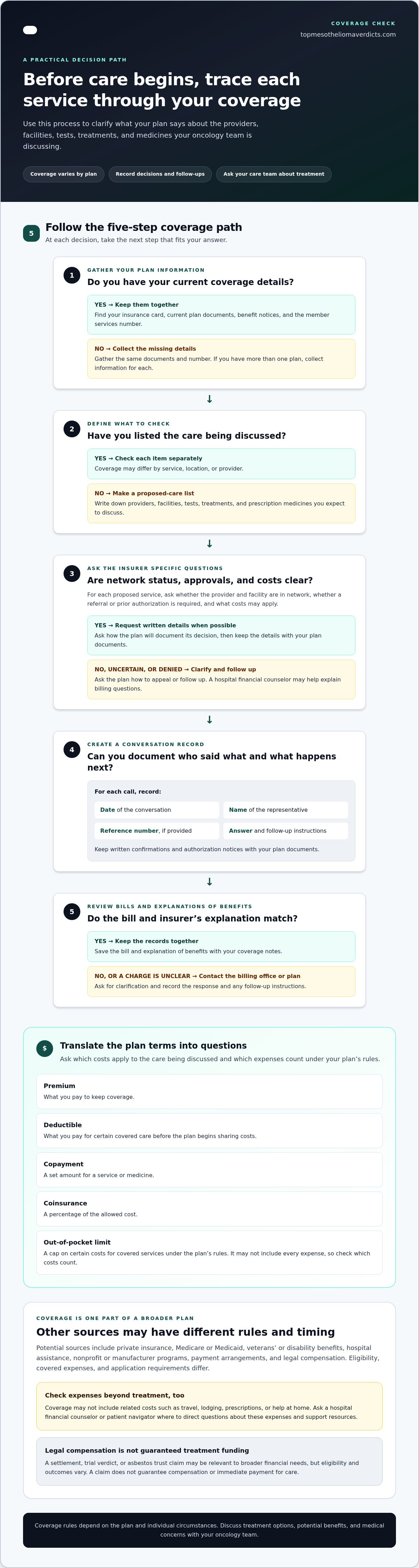
Clear coverage information can help you anticipate bills and ask focused questions before care begins. Plans differ, so don’t rely on a general description of benefits or assume a diagnosis guarantees coverage. Use this process to understand what your plan says about the care your oncology team is discussing.
- Gather your plan information. Find your insurance card, current plan documents, and notices about benefits. Note the insurer’s member services number. If you have more than one plan, gather information for each.
- List the proposed services. Write down the providers, facilities, tests, treatments, and prescription medicines you expect to discuss. Coverage may differ by service, location, or provider.
- Ask specific coverage questions. Find out whether each provider and facility is in network, whether a referral or prior authorization is required, and what costs may apply. Ask how the plan will document its decision.
- Record each conversation. Save the date, representative’s name, reference number, answer, and follow-up instructions. Keep written confirmations and authorization notices with your plan documents.
- Review bills and explanations of benefits. Compare each bill with the insurer’s explanation. If a charge or coverage decision is unclear, contact the billing office or plan and record the response.
Know the basic terms, too. A premium is what you pay to keep coverage. A deductible is what you pay for certain covered care before the plan begins sharing costs. A copayment is a set amount for a service or medicine. Coinsurance is a percentage of the allowed cost. An out-of-pocket limit caps certain costs for covered services under the plan’s rules. It may not include every expense, so check which costs count.
What should you ask a health insurer before treatment?
Ask whether proposed providers, facilities, and services are in network, and whether a referral or prior authorization is needed. Clarify which costs may remain your responsibility and how to appeal or follow up if coverage is denied or uncertain. Request written details when possible. Record the representative’s name, the date, any reference number, and the next steps. A hospital financial counselor may also help explain billing questions.
How can Medicare or Medicaid fit into a funding plan?
Medicare and Medicaid may provide coverage, but a diagnosis alone doesn’t guarantee eligibility or specific benefits. Eligibility, covered services, and coordination with other insurance depend on individual circumstances. Review current plan documents and official Medicare or Medicaid guidance, and consider speaking with a qualified benefits counselor. This can help clarify how public coverage fits alongside other insurance as you assess how to pay for mesothelioma treatment. If you’re also considering an asbestos-related claim, explore mesothelioma legal options as one possible part of a broader funding plan.
Compare Mesothelioma Treatment Funding Options by Eligibility and Timing
No single funding source is right for every patient. Compare options by what they may help pay for, the rules that apply, and how uncertain the application or payment process may be. Use this overview to decide which organizations to contact first, not to assume coverage or assistance is guaranteed.
| Source | Typical purpose | Eligibility questions | Timing uncertainty | First contact |
|---|---|---|---|---|
| Private insurance | Eligible treatment, services, and prescriptions under the plan | Are the providers and services covered? Do network or authorization rules apply? | Coverage decisions, claims, and appeals may take time. | Health plan member services |
| Medicare or Medicaid | Covered care under program and individual eligibility rules | Do you qualify, and how does this coverage coordinate with other insurance? | Eligibility reviews and coordination can affect when benefits apply. | Program office or qualified benefits counselor |
| Hospital assistance or payment arrangements | Potential help with facility bills or managing balances | What are the institution’s application rules and required records? | Review procedures and payment terms vary by institution. | Hospital billing office or financial counselor |
| Nonprofit or manufacturer programs | Program-specific help, which may include eligible medicines or related needs | Who qualifies, what costs are included, and what documents are needed? | Applications, decisions, and available support vary by program. | Program administrator or patient navigator |
| Asbestos trust claims or lawsuits | Potential legal compensation for eligible asbestos-related claims | Which legal route may apply, and what evidence is needed? | Eligibility, outcomes, and payment timing are uncertain. | Lawyer experienced in asbestos-related claims |
Consider what each source is designed to address. Insurance and public coverage generally concern eligible medical care under their rules. A hospital arrangement may address facility bills, while nonprofit or manufacturer programs may be limited to specific expenses. Some assistance may help with travel or other needs, but don’t assume it does. Ask what expenses a program can consider.
When might financial assistance or a payment arrangement help?
If a bill is difficult to manage, contact the hospital billing office to ask whether financial assistance or a payment arrangement may be available. Policies differ. Ask how to apply, which records to provide, how the decision is reviewed, and what follow-up is required. Nonprofit and drug manufacturer programs may offer other possibilities, but their eligibility rules and covered expenses are specific to each program.
Can asbestos trust funds or a lawsuit pay for treatment?
Trust claims and lawsuits are separate legal routes, each with its own eligibility requirements. Neither guarantees compensation or provides dependable, immediate treatment funding. Weitz & Luxenberg handles asbestos litigation and trust fund claims, and a lawyer can discuss potential options in light of your circumstances. For more detail about trust claims, see this asbestos legal options resource.
As you consider how to pay for mesothelioma treatment, compare each option’s purpose and next steps rather than treating one source as a complete solution. A layered plan can account for medical bills and related needs while applications and decisions are pending.
How to Build a Mesothelioma Treatment Funding Plan Step by Step
Organizing financial details can make your next conversation clearer, even while your care plan is taking shape. Keep the process manageable: gather key records, assign follow-up tasks, and update one shared file or folder that the patient and trusted family members can access.
- Step 1: Collect the essentials. Bring together insurance cards, current plan documents, treatment estimates, bills, and written coverage decisions. Add benefit notices or assistance applications as they arrive.
- Step 2: Write down open questions. List questions about prior authorization, referrals, denied claims, appeals, payment arrangements, and applications for financial assistance. Note who can answer each one, such as the insurer or hospital billing office.
- Step 3: Ask for help coordinating. Ask the care team whether a patient navigator or social worker can help organize financial conversations or connect you with relevant support.
- Step 4: Review bills promptly. Request an itemized bill if a charge is unclear. Compare it with your records and the insurer’s explanation of benefits. If something appears incorrect or a claim was denied, contact the billing office or plan for an explanation and the next step. Keep a record of the response.
- Step 5: Track every follow-up. Record call dates, names, reference numbers, deadlines, decisions, and promised follow-ups in the shared file. Save copies of letters, bills, and submitted forms together.
“A clear record of coverage decisions helps families see what’s resolved, what needs follow-up, and which next step to take.”
What documents and questions should families organize first?
Start with documents that explain coverage and current charges: insurance cards, plan documents, treatment estimates, bills, and written decisions. Keep a short question list so calls stay focused. Ask about required authorizations, appeal steps, payment options, and assistance applications. If the paperwork feels difficult to manage, ask the care team whether a patient navigator or social worker can help coordinate conversations.
How can you keep funding decisions from delaying care discussions?
Tell your treating team promptly if you encounter a coverage barrier, such as an authorization question or an unexpected bill. Coverage and medical choices are connected, but they’re separate decisions. Your insurer explains plan benefits, while your qualified care team discusses clinical options and medical concerns. Don’t make treatment decisions based on an unanswered billing question alone. Raise it with the team so you can understand appropriate next steps.
If asbestos-related legal options are part of your broader financial questions, a consultation with Weitz & Luxenberg can help you understand potential routes without promising eligibility or recovery. DIAGNOSED? CALL 1-800-885-MESO TODAY FOR A CONFIDENTIAL & FREE CONSULTATION.
When to Explore Legal Compensation for Mesothelioma Treatment Expenses
Legal compensation may be one part of a broader financial plan, alongside health coverage, public benefits, and assistance programs. It isn’t a substitute for those sources, and it shouldn’t be treated as money available to pay an upcoming bill. Weitz & Luxenberg represents people with mesothelioma and asbestos-related lung cancer. A lawyer can explain possible legal routes and discuss whether the facts of your situation may support exploring them, without promising eligibility or a recovery.
What can an asbestos attorney explain about possible claims?
An attorney may review your work, military, or other asbestos exposure history and help identify records that could be relevant. Depending on the circumstances, possible routes may include asbestos litigation or a claim with an asbestos trust fund. These are distinct processes with separate eligibility requirements. Applicable deadlines and available options depend on case-specific facts and law, so ask what information is needed to assess potential routes and what steps may follow.
Legal representation doesn’t determine whether a treatment is medically appropriate or whether an insurer will cover it. Those questions belong with your care team and coverage provider. Weitz & Luxenberg handles asbestos claims on a contingency basis. Ask for a clear explanation of the written representation agreement, including how attorney fees depend on its terms and the outcome.
What should families understand before relying on legal compensation?
Claims can take time, and outcomes are uncertain. A lawsuit or trust claim may ultimately contribute to broader financial needs, but it shouldn’t be budgeted as immediate funding for treatment, travel, or household expenses. Continue discussing near-term bills with your insurer, hospital billing office, and benefits or assistance contacts while separately learning about possible legal options.
A consultation gives you a chance to ask questions about exposure history, potential claim routes, eligibility, deadlines, and the representation agreement. It can help clarify what may be worth exploring, but it can’t guarantee payment, determine medical coverage, or replace advice from your oncology team. That distinction matters as you consider how to pay for mesothelioma treatment and plan around known resources rather than assumed outcomes.
Weitz & Luxenberg offers a free consultation to discuss potential asbestos-related legal options.
DIAGNOSED? CALL 1-800-885-MESO TODAY FOR A CONFIDENTIAL & FREE CONSULTATION
Take the Next Step Toward a Clearer Funding Plan
Learning how to pay for mesothelioma treatment starts with understanding your coverage, asking about assistance, and tracking bills, decisions, and follow-ups. A shared record can help your family see what’s resolved and what still needs attention. Your oncology team should guide medical decisions, while insurers and benefits counselors can clarify coverage questions.
Legal compensation may be another avenue to explore, but a lawsuit or asbestos trust fund claim has separate eligibility requirements and uncertain timing. It isn’t a substitute for insurance or assistance, and it shouldn’t be counted on to pay immediate treatment expenses. A legal consultation can help you understand potential options without promising a recovery. Weitz & Luxenberg handles asbestos litigation and trust fund claims on a contingency basis, with attorney fees governed by the representation agreement and its terms.
To discuss possible legal options, request a free consultation with Weitz & Luxenberg. The conversation can help clarify questions to consider as you build your broader funding plan.
DIAGNOSED? CALL 1-800-885-MESO TODAY FOR A CONFIDENTIAL & FREE CONSULTATION
You can take these decisions one step at a time, with your care team and family beside you.
Frequently Asked Questions
How can I pay for mesothelioma treatment if I do not have health insurance?
Start by telling your oncology team and the hospital billing office that you’re uninsured. Ask about financial assistance, payment arrangements, and whether a patient navigator or social worker can help identify resources. You can also explore eligibility for public benefits and nonprofit or medication assistance programs. Ask what care and related expenses each option may cover, what documents are required, and whether applications should be submitted before bills are due.
Does Medicare cover mesothelioma treatment?
Medicare may cover mesothelioma care when services meet program coverage rules, but benefits and out-of-pocket costs depend on your coverage and circumstances. Before treatment, review current plan documents and ask whether proposed providers, facilities, services, and medicines are covered, and whether authorization or referrals are required. Medicare eligibility isn’t automatic because of a diagnosis. A qualified benefits counselor can help explain how Medicare may coordinate with other insurance.
Can Medicaid help pay for mesothelioma treatment?
Medicaid may help pay for eligible care if you qualify, but eligibility, covered services, and coordination with other coverage vary. A mesothelioma diagnosis alone doesn’t guarantee enrollment or specific benefits. Review official Medicaid guidance and ask a qualified benefits counselor about your circumstances, including how to apply and what records are needed. If you’re already enrolled, ask how the program handles the services and providers involved in your care.
What happens if my insurance denies mesothelioma treatment coverage?
Ask the insurer for the denial and its reason in writing, then review your plan’s instructions and deadlines for challenging the decision. Confirm whether the issue involves authorization, provider network status, or a service the plan considers uncovered. Keep copies of medical records, bills, correspondence, and call notes. Ask your care team and the insurer what information is needed for review, and contact the hospital billing office about possible assistance while you pursue an answer.
Can an asbestos lawsuit pay for mesothelioma treatment?
An asbestos lawsuit or trust fund claim may result in compensation that could contribute to broader financial needs, but neither guarantees a recovery or provides dependable, immediate treatment funding. Eligibility, legal routes, outcomes, and timing depend on individual circumstances. Weitz & Luxenberg handles asbestos litigation and trust fund claims, and a lawyer can discuss potential options and explain the representation agreement. Keep working with your insurer, care team, and assistance contacts on near-term bills rather than relying on a possible legal recovery.
How much does mesothelioma treatment cost, and what expenses should I plan for?
There’s no single cost that applies to every patient. Expenses depend on the recommended care, coverage, providers, and individual needs. Ask your care team and billing office for available estimates and an explanation of what insurance may pay and what you may owe. Include more than direct treatment bills in your planning: prescriptions, travel, lodging, and other care-related needs may add expenses. Save estimates and compare them with bills and insurer explanations.
Are there grants or financial assistance programs for mesothelioma patients?
Potential resources include hospital financial assistance, nonprofit programs, and manufacturer assistance for certain medicines. Each program sets its own eligibility rules, covered expenses, application process, and required documents, so support isn’t guaranteed. Ask a hospital financial counselor or patient navigator about programs that may fit your situation. Before applying, clarify whether assistance can address treatment, prescriptions, travel, or other costs, and note any application steps or follow-up requests.
Disclaimer
Published by Weitz & Luxenberg, P.C. National Headquarters: 700 Broadway, New York, NY 10003. Call 800-885-MESO. Attorney Advertising. Prior results do not guarantee a future outcome. Certain contentions in blog posts need to be confirmed by a licensed attorney.


