

Choosing between an asbestos trust fund and a lawsuit may be the wrong first question. The answer to “asbestos trust fund vs lawsuit” isn’t always one route or the other. Depending on the companies involved and the facts of your case, both options may be available.
It’s understandable to feel unsure. Trust claims and lawsuits have different purposes, requirements, and review processes. Deadlines can also vary by trust and state. Pursuing one route doesn’t automatically mean the other is available or ruled out. The details matter.
This guide explains how asbestos trust claims differ from lawsuits, when the routes may overlap, and what information can affect potential eligibility. You’ll learn why diagnosis records and evidence of asbestos exposure matter, what to consider about filing deadlines, and how the processes may interact. Reviewing your diagnosis, work and exposure history, and applicable rules can help clarify practical next steps, without promising a particular outcome.
Key Takeaways
- Asbestos trust claims and lawsuits are separate legal routes, each with its own rules and process.
- Understanding asbestos trust fund vs lawsuit means comparing who reviews the claim, what evidence is needed, and how a decision is reached.
- Some people may have potential claims through both routes, but eligibility and coordination depend on case-specific facts and applicable rules.
- Gathering diagnosis, treatment, employment, military, and exposure-history records can help prepare for an informed review.
- A legal review can help identify possible options and relevant deadlines without promising a particular outcome.
Asbestos Trust vs. Lawsuit: What Each Route Does
Asbestos trust claims and lawsuits are separate legal avenues with different foundations. A trust claim is submitted to an established asbestos bankruptcy trust and reviewed under its rules. A lawsuit is a civil court case brought against potentially responsible parties, subject to evidence and applicable law. The phrase asbestos trust fund vs lawsuit describes two distinct processes, not a guaranteed choice between outcomes.
In plain English: a trust claim asks a bankruptcy-established fund to review a claim under its criteria, while a lawsuit asks the civil court system to resolve claims against responsible parties. The history of asbestos litigation and bankruptcy trusts helps explain why these routes developed separately. Neither route guarantees that a person qualifies, receives payment, or obtains a particular result.
What is an asbestos trust fund claim?
Some companies established asbestos trusts through bankruptcy-related proceedings to address eligible claims. A person seeking review generally must show that their illness and exposure meet the requirements of a particular trust. Each trust sets its own criteria, procedures, and supporting-document requirements, so the process differs among trusts. Exposure to asbestos alone doesn’t establish eligibility. The specific evidence and trust rules matter.
What does an asbestos lawsuit involve?
An asbestos lawsuit is a civil claim against one or more potentially responsible parties. The case may examine the person’s diagnosis, exposure history, and evidence connecting that exposure to a defendant. The legal standards and procedures depend on the circumstances and governing law.
A lawsuit may resolve through a settlement or proceed toward trial, where a court or jury considers the evidence. Filing a case does not guarantee a settlement or a verdict in the claimant’s favor. Unlike a trust review, a lawsuit follows court procedures rather than the relevant trust’s claims process.
These distinctions are a starting point, not a decision about which route fits a particular situation. The companies connected to the exposure, available records, trust criteria, and applicable law can all affect which options are worth evaluating.
How Trust Claims and Asbestos Lawsuits Differ in Process and Proof
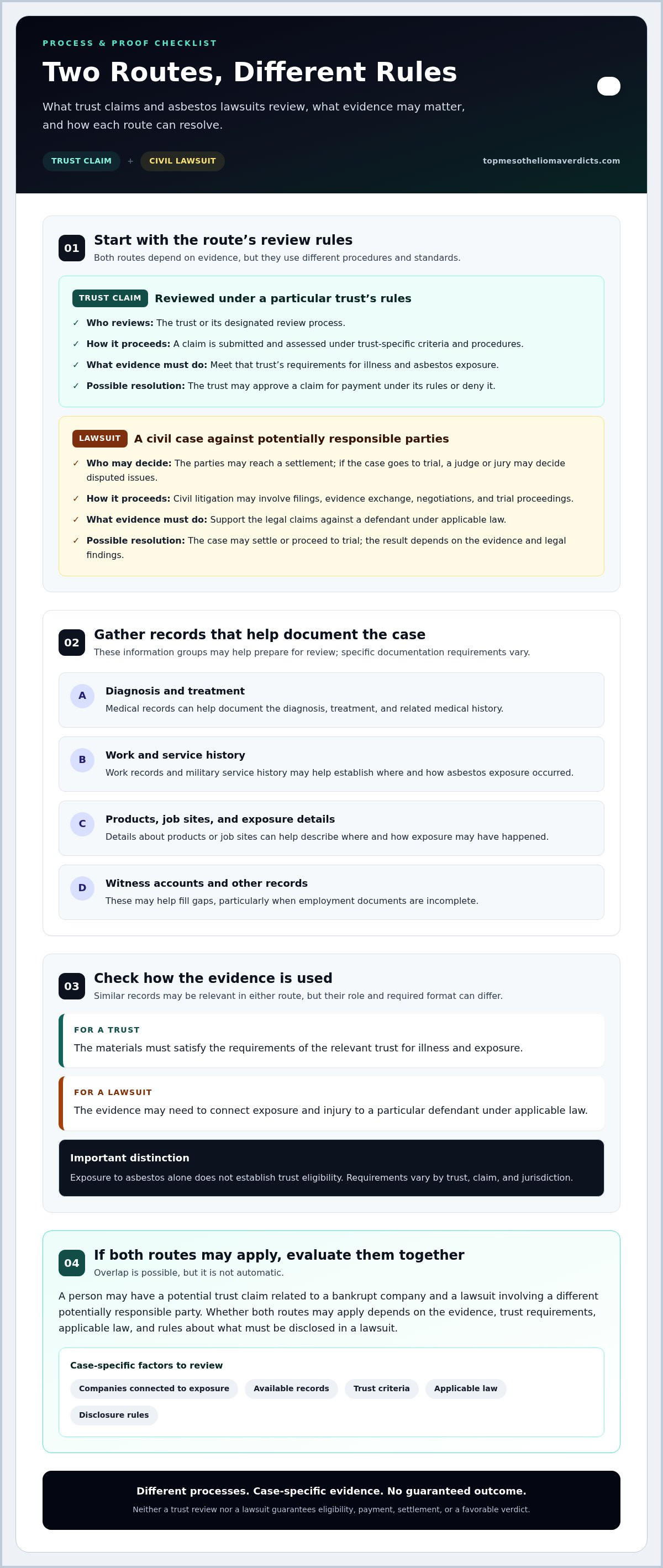
Both routes depend on evidence, but they apply different rules and reach decisions in different ways. A trust claim is reviewed under the requirements of the specific trust. A lawsuit follows court procedures and applicable law. In either route, eligibility depends on the specific trust or legal claim, not exposure alone.
| Comparison | Trust claim | Asbestos lawsuit |
|---|---|---|
| Decision-maker | The trust or its designated review process evaluates the claim. | The parties may reach a settlement. If the case goes to trial, a judge or jury may decide disputed issues. |
| Process | The claim is submitted and assessed under trust-specific criteria and procedures. | The case proceeds through civil litigation, which may involve filings, evidence exchange, negotiations, and trial proceedings. |
| Evidence | Claim materials must satisfy the relevant trust’s requirements for illness and exposure. | Evidence must support the legal claims against the defendant under applicable law. |
| Possible resolution | A trust may approve a claim for payment under its rules or deny it. | A case may settle or proceed to trial, where the outcome depends on the evidence and legal findings. |
What evidence may support a trust claim or lawsuit?
Medical records can help document a diagnosis, treatment, and related medical history. Work records, military service history, and details about products or job sites may help establish where and how asbestos exposure occurred. Witness accounts and other records can help fill gaps, particularly when employment documents are incomplete.
The same broad categories of information can matter in either route, but their purpose and required format may differ. A trust may require proof that meets its criteria, while a lawsuit may require evidence connecting exposure and injury to a particular defendant. Documentation requirements vary by trust, claim, and jurisdiction.
How do review and resolution processes compare?
Trust claims are assessed through the procedures established by the relevant trust. Lawsuits follow court rules and may involve filing a complaint, exchanging evidence, and pursuing settlement discussions or trial. Each case follows its own path, so neither route is always faster or simpler.
For wider context, RAND’s research brief discusses asbestos litigation costs and compensation. That background can inform general understanding, but it can’t predict an individual claim’s eligibility or result. Reviewing asbestos-related legal case information may help you prepare questions about the evidence and process.
Can You File an Asbestos Trust Claim and a Lawsuit?
Sometimes a person may have potential claims through more than one route, such as a trust claim related to a bankrupt company and a lawsuit involving a different potentially responsible party. But overlap isn’t automatic. Whether both routes may apply depends on the evidence, the trust’s requirements, applicable law, and rules governing what must be disclosed in a lawsuit.
That’s why the asbestos trust fund vs lawsuit question isn’t just about choosing a process. If claims may overlap, they need to be evaluated together. The companies connected to the exposure, available records, and rules for each claim can all affect how the routes interact.
What rules can affect overlapping claims?
Trust procedures and court requirements may call for information about exposure, other claims, or payments. The effect of a trust filing on a lawsuit, including disclosure or sequencing requirements, can vary by jurisdiction and case. There’s no universal rule that every person must file in a particular order or that the same combination of claims is available to everyone. Jurisdiction-specific questions should be reviewed with qualified counsel.
Federal law provides a framework for certain asbestos-related bankruptcy trusts. For background on a specific trust proposal, the U.S. Department of Justice statement of interest describes the department’s position in that matter. It isn’t a substitute for reviewing the rules and facts that apply to an individual claim.
Why coordination matters when more than one route may apply
A clear, documented exposure history can help identify which employers, products, or companies may be relevant to a broader claim review. It can also help keep information consistent across submissions. If dates, job duties, worksites, or product details are incomplete or described differently in separate claims, that may complicate the review and prompt questions about the record.
Start with what you know, and distinguish confirmed details from anything you’re unsure about. Old employment records, medical files, or witness recollections may help fill gaps, but don’t guess to make the history seem complete. A careful review can organize available information and identify what still needs clarification before decisions are made.
Trust payment percentages are specific to each trust and don’t guarantee what an individual will receive. The article Asbestos Trust Fund Payout Percentages: 2026 Compensation Guide provides broader context on that topic. A percentage alone doesn’t determine eligibility or resolve how a trust claim may interact with litigation.
How to Prepare for a Case-Specific Comparison
You don’t need a complete file before getting legal guidance. A few records and notes can make an initial review of asbestos trust fund vs lawsuit more focused, and missing information can be identified along the way. Don’t delay seeking guidance just because you’re still looking for documents.
Which information can help an initial legal review?
Gather what’s readily available and make a simple timeline of work and possible exposure. Useful starting points include:
- Diagnosis and care: diagnosis details, medical records, and treatment history.
- Employment: former employers, job titles, duties, worksites, and approximate dates.
- Potential exposure: products or materials you remember, how they were used, and where exposure may have occurred.
- Military service: service records or notes about duties, locations, and possible asbestos exposure during service.
Write down what you recall, even if dates or product names aren’t exact. Mark uncertain details as estimates rather than filling gaps with guesses. Records may include employment documents, old calendars, or information from people who remember the work. The purpose is to give a legal team a starting point, not to prove every detail on your own.
For broader context on court claims and what families may encounter, read Mesothelioma Litigation: 2026 Guide for Families.
Questions to ask when comparing potential routes
A case-specific review should connect the facts to possible options and identify what still needs investigation. Useful questions include:
- Which trust criteria or potential legal claims may relate to my diagnosis and exposure history?
- What records could help clarify my work, military service, or product exposure?
- Which deadlines and disclosure rules may apply, and how will they be assessed?
- If more than one route may be relevant, how will the claims be coordinated?
- Who will explain the process and keep me informed about what happens next?
These questions can turn a complicated history into a clearer starting point. Weitz & Luxenberg offers a free consultation to discuss potential asbestos trust claims and litigation. The consultation doesn’t guarantee eligibility or an outcome.
DIAGNOSED? CALL 1-800-885-MESO TODAY FOR A CONFIDENTIAL & FREE CONSULTATION
Choosing Your Next Step: A Careful Review of Trust Claims and Litigation
There isn’t one route that fits every asbestos-related claim. Potential options depend on the diagnosis, evidence of exposure, requirements of any relevant trust, and applicable law. A case-specific review can help explain which paths may apply, how they might interact, and what deadlines or disclosure rules need attention.
That’s the practical value of looking beyond a simple asbestos trust fund vs lawsuit comparison. Trust claims and litigation have different procedures, but available records and legal requirements may connect them. Reviewing the full picture can help you make informed decisions without assuming that either route is available or will lead to a particular result.
What a case-specific review can clarify
An attorney can review your diagnosis and exposure history, consider whether trust criteria or potential legal claims may fit the facts, and explain what additional information could be useful. If more than one route may be relevant, legal review can also assess coordination and the rules governing each claim. The goal is to clarify possible next steps, not to promise eligibility, compensation, or a specific outcome.
Weitz & Luxenberg represents people nationwide in mesothelioma and asbestos-related lung cancer litigation, as well as asbestos trust fund claims. The firm offers a free consultation and works on a contingency basis. Discuss the terms of representation as part of understanding your options. Neither a consultation nor legal representation guarantees a claim or recovery.
Take a clear next step with experienced asbestos counsel
For more than 40 years, Weitz & Luxenberg has represented people affected by asbestos-related diseases. The firm handles trust claims and litigation, while every case still depends on its own evidence, legal requirements, and circumstances. No past result predicts what will happen in another case.
You don’t need to have every record in hand to begin a conversation. Sharing what you know about your diagnosis, work history, and possible exposure can help start a review and identify questions to address.
DIAGNOSED? CALL 1-800-885-MESO TODAY FOR A CONFIDENTIAL & FREE CONSULTATION
Take the Next Step with a Clearer View of Your Options
Trust claims and lawsuits follow different processes, and some people may have potential claims through both routes. The right path depends on your diagnosis, exposure evidence, trust requirements, and applicable law. Accurate records and a careful review can help clarify possible options, relevant deadlines, and how claims may need to be coordinated.
If you’re weighing asbestos trust fund vs lawsuit, you don’t have to sort through every rule alone. Weitz & Luxenberg represents people nationwide in asbestos trust claims and mesothelioma and asbestos-related lung cancer litigation. A free consultation can help you discuss your circumstances and possible next steps. It can’t guarantee eligibility, compensation, or a particular result, but it can offer a starting point for understanding your options.
DIAGNOSED? CALL 1-800-885-MESO TODAY FOR A CONFIDENTIAL & FREE CONSULTATION
Your history and questions matter. Informed guidance can help you approach the next step with greater clarity.
Frequently Asked Questions
Is an asbestos trust fund claim the same as a lawsuit?
No. An asbestos trust fund claim is submitted to a trust created to address eligible claims connected to a bankrupt asbestos-related company. A lawsuit is a civil court case against potentially responsible parties. The processes, evidence requirements, and possible outcomes differ. When comparing asbestos trust fund vs lawsuit, the options that may apply depend on the person’s diagnosis, exposure history, trust criteria, and applicable law.
Can you file an asbestos trust fund claim and a lawsuit at the same time?
Some people may have potential claims through both routes, but it isn’t automatic. Trust eligibility, case evidence, disclosure duties, and jurisdiction-specific rules can affect whether and how claims may be coordinated. Filing decisions should reflect the individual facts, not the assumption that both options are available. A lawyer experienced in asbestos claims can explain relevant requirements and potential interactions before you decide how to proceed.
How much can an asbestos trust fund claim or lawsuit pay?
There’s no single amount that applies to every asbestos claim. A trust reviews claims under its own criteria and payment procedures, while a lawsuit’s result depends on the evidence, applicable law, and how the case resolves. Any estimate is specific to the case and isn’t a guarantee. General figures shouldn’t be treated as a prediction of what an individual claim may pay or whether someone qualifies.
What happens if I file an asbestos trust claim before a lawsuit?
The effect depends on the claim, trust requirements, jurisdiction, and case facts. Filing first may raise questions about disclosures or coordination, but it doesn’t automatically determine the outcome of other potential claims. Keep information about your diagnosis and exposure history accurate and consistent. Because deadlines and rules can differ, discuss timing with qualified asbestos counsel rather than relying on a general online answer to decide when or where to file.
Do I need a lawyer to file an asbestos trust fund claim?
Legal guidance can be useful because trust criteria, exposure evidence, documentation, and possible interactions with other claims can be complex. Requirements vary among trusts, and missing or inconsistent information may affect how a claim is reviewed. Counsel can assess your circumstances and explain potential options, but can’t guarantee eligibility or a particular result. General information can help you prepare questions, but it isn’t a decision about whether you qualify or a substitute for legal advice.
What records can help with an asbestos trust claim or lawsuit?
Potentially useful records include diagnosis and medical documents, treatment history, employment and military service information, and notes about jobs, worksites, products, and approximate exposure periods. The documents needed depend on the trust and case, and you may not have a complete file. Gather what’s readily available, but don’t delay seeking guidance just because older records are missing. A review can help identify what information may still be useful.
Disclaimer
Published by Weitz & Luxenberg, P.C. National Headquarters: 700 Broadway, New York, NY 10003. Call 800-885-MESO. Attorney Advertising. Prior results do not guarantee a future outcome. Certain contentions in blog posts need to be confirmed by a licensed attorney.


