

What if the most important part of an asbestos deposition isn’t remembering every detail, but being honest about what you do and don’t remember? If you’re preparing to testify, uncertainty about the questions asked in an asbestos deposition is understandable, especially when exposure happened decades ago. A deposition is sworn testimony, not a test you have to pass or a script you need to memorize.
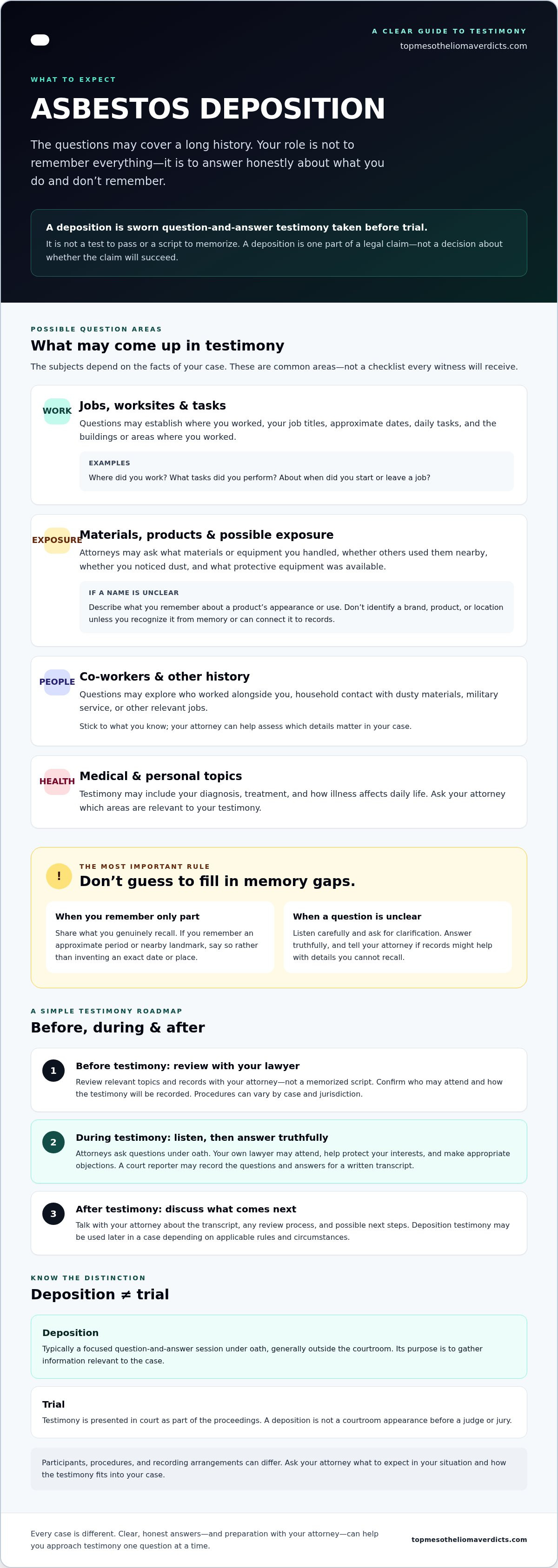
Questions may cover your work history, possible exposure to asbestos-containing products, job sites, co-workers, medical history, and how your illness affects daily life. You may not recall every date, product name, or conversation. Don’t guess to fill in gaps. Your attorney can help you understand the process and prepare to answer clearly and truthfully.
This article explains common deposition topics and sample questions, how to respond when your memory is incomplete, and what to discuss with your lawyer before and after testimony. With a clearer sense of what to expect, you can approach the deposition one question at a time.
Key Takeaways
- A deposition is sworn testimony taken before trial, but its procedures and role can vary by case and jurisdiction.
- The questions asked in an asbestos deposition may cover work history, job duties, worksites, products, and possible exposure. No two cases are exactly alike.
- Medical and personal topics may also come up, including treatment and how illness affects daily life. Ask your attorney which areas are relevant to your testimony.
- Prepare by reviewing topics and records with your lawyer, not by memorizing a script. Listen carefully, answer truthfully, and ask for clarification if a question is unclear.
- After testimony, discuss the transcript, any review process, and possible next steps with your attorney. A deposition alone does not decide the outcome of a claim.
What Is an Asbestos Deposition, and Why Does It Matter?
An asbestos deposition is sworn question-and-answer testimony taken before trial, usually to gather information relevant to a legal claim. Unlike testimony in court, it generally takes place outside the courtroom. Procedures, participants, and recording arrangements can vary by case and jurisdiction, so ask your attorney what to expect in your situation.
A deposition helps the parties understand facts relevant to the case, including a person’s work history, possible asbestos exposure, and diagnosis. When exposure may have happened years or decades earlier, testimony can help create a record of what a witness remembers about jobs, tasks, worksites, and materials. A deposition is one part of the legal process, not a decision about whether a claim will succeed. For historical context, see this overview of asbestos litigation in the United States.
Who asks questions, and who may be present?
You’ll answer questions from attorneys, commonly including lawyers representing companies on the opposing side. Your own lawyer may attend, help protect your interests, and make appropriate objections. A court reporter may record the questions and answers to create a written transcript. Depending on the case, other participants or recording methods may also be involved. Beforehand, confirm with your attorney who will attend and how the testimony will be recorded.
How is a deposition different from a trial?
A deposition is typically a focused session where attorneys ask questions and a witness answers under oath. It isn’t a courtroom appearance before a judge or jury. At trial, testimony is presented in court as part of the proceedings. Deposition testimony may be recorded and, depending on applicable rules and circumstances, used later in the case. The questions asked in an asbestos deposition may help clarify disputed facts, but no single answer automatically determines the result. Your attorney can explain how the testimony fits into your case and answer questions about the process.
What Questions Are Asked About Asbestos Exposure and Work History?
The questions asked in an asbestos deposition often focus on how and where you may have encountered asbestos. The topics depend on the facts of your case. Attorneys may ask about employment, military service, household exposure, or other parts of your history. These examples are possibilities, not a checklist that every witness will receive. A deposition as part of discovery helps the parties gather information. Your attorney can explain which areas matter in your case.
Questions about jobs, worksites, and tasks
Questions about your work history can help establish a timeline and clarify what you did on the job. For example:
- Where did you work, and what were your job titles?
- About when did you start and leave each job?
- What tasks did you perform during a typical workday?
- Which buildings, sites, or areas did you work in?
Follow-up questions may explore approximate dates, changes in your duties, and the conditions around your work. If you can’t recall an exact year or location, don’t guess. Share what you genuinely remember, such as an approximate period or a nearby landmark, and tell your attorney if records might help. For broader background, see this mesothelioma litigation guide.
Questions about products and possible exposure
Attorneys may ask what materials or equipment you handled, whether you worked near others using them, and whether you noticed dust. They may also ask what protective equipment was available and who worked alongside you. If you remember a product’s appearance or use but not its name, describe what you recall. Don’t identify a brand, product, or location unless you recognize it from memory or can connect it to records.
Questions may also cover household contact, such as whether someone in your home worked with dusty materials, or military service and other relevant jobs. Stick to what you know. Your lawyer can help assess which details may be relevant. If your work involved construction, you can review information about asbestos exposure in construction claims for related context.
Work and exposure histories can be complex. Consider discussing your recollections and any available records with experienced asbestos counsel. You can learn more about asbestos-related legal representation and prepare case-specific questions for your attorney.
What Medical and Personal Questions May Come Up?
Medical and personal questions may clarify your diagnosis, health history, treatment, and how illness affects your daily routine. These topics aren’t guaranteed in every deposition. Which subjects are relevant, and how broadly they may be explored, depends on the individual case. Ask your attorney what to expect and whether there are records or sensitive subjects to discuss beforehand.
Questions about diagnosis, treatment, and health history
Depending on the case, attorneys may ask when you first noticed symptoms, when you received a diagnosis, which providers you saw, and what treatment you’ve had. They may ask about medical records, earlier health conditions, or smoking history if those subjects are considered relevant. Possible questions include:
- When were you diagnosed, and who provided the diagnosis?
- What symptoms have you experienced, and when did they begin?
- What treatment have you received, and which medical providers were involved?
- Have you had other health conditions or a history of smoking?
These examples don’t predict what you’ll be asked. Answer from your own recollection, and don’t try to interpret what a medical detail means legally. Your attorney can explain how health records may relate to the case. For general background on federal asbestos rules, the EPA’s Asbestos Laws and Regulations page is a reference, but it doesn’t determine which questions will be asked in your testimony.
Questions about daily life and prior statements
Testimony may also cover how illness affects your routines, responsibilities, and relationships. An attorney might ask whether you’ve changed or stopped activities, need help with household tasks, or noticed changes in what you can comfortably do. Questions may also address earlier statements or testimony in another proceeding, if relevant. These topics don’t arise in every deposition.
A simple chart can help you organize possible topics without scripting answers:
- Medical: diagnosis, symptoms, providers, treatment, and records.
- Personal impact: activities, limitations, household roles, and changes over time.
- Prior statements: earlier accounts or testimony that counsel identifies as relevant.
Review these categories with your lawyer to identify records or questions you want to raise. If a topic feels difficult or private, tell counsel beforehand and ask how it may be addressed. The goal is to understand the process, not memorize a response.
How Should You Prepare and Answer Questions Truthfully?
Preparation means getting familiar with relevant topics and records, not memorizing answers or rehearsing a script. The questions asked in an asbestos deposition may concern events from years ago, so it’s understandable if some details are unclear. Your attorney can help you review your work and exposure history, identify relevant records, and understand how the testimony will be conducted. Accurate testimony matters more than a perfectly complete memory.
What to review with your attorney beforehand
Set aside time to discuss topics that may come up and any concerns that could affect your participation. Ask which documents, if any, you should review, and what to do if an attorney shows you an unfamiliar document or exhibit. Take time to look at it and answer based on what you know rather than trying to interpret it on the spot.
Before the deposition, confirm logistics with counsel, including where and how it will take place, who is expected to attend, and how to request a break. Discuss stamina, accessibility needs, or other concerns that could make it harder to participate comfortably. Your attorney can explain what to expect in your case.
How to respond when you do not know or remember
Listen to the full question before answering. Keep your response focused on what was asked, and ask for clarification if you don’t understand. If a question assumes something you can’t confirm, explain that rather than accepting the premise.
- Answer truthfully. Say “I do not know” or “I do not remember” when that’s accurate.
- Separate estimates from certainty. If you recall only an approximate date, make clear that it’s an estimate.
- Don’t guess. Avoid filling gaps with assumptions or presenting uncertain details as facts.
- Ask your attorney for guidance. Direct questions about an objection, legal strategy, or the significance of an answer to counsel.
These habits keep your testimony grounded in your own knowledge. You don’t need to supply a detail just because a question calls for one. A clear, honest response is better than speculation. For advice about your testimony or an asbestos-related legal matter, speak with an attorney familiar with your case.
DIAGNOSED? CALL 1-800-885-MESO TODAY FOR A CONFIDENTIAL & FREE CONSULTATION
What Happens After an Asbestos Deposition, and Where Can You Get Help?
After testimony, your attorney can explain what happens next in your case. That may include reviewing the transcript, addressing any permitted review or correction process, responding to follow-up questions, or gathering additional documents. Next steps depend on the case and applicable procedures. A deposition is one part of the legal process. It doesn’t by itself decide whether a claim succeeds or what compensation, if any, may follow.
What to ask your lawyer after testimony
Share questions and concerns with your attorney while the deposition is still fresh in your mind. Mention if you felt fatigued, didn’t understand a question, or think an answer may not have reflected what you meant. Your lawyer can explain whether the transcript may be reviewed and whether corrections are allowed under the process that applies to your case. Don’t assume there’s a universal deadline. Ask promptly so you understand any relevant timing.
You may also want to ask:
- When and how can I review the transcript, if review is available?
- What should I do if I notice a possible error or omission?
- Are there follow-up questions, records, or other steps I should expect?
- How will I learn about developments in my case?
These questions can help you understand the process without trying to predict what a particular answer will mean. Your attorney can explain the significance of your testimony in the context of the full case.
When to seek asbestos legal guidance
If you don’t have counsel or need advice about your situation, an attorney can review the facts, discuss potentially applicable deadlines, and explain legal options that may be available. The questions asked in an asbestos deposition and the steps afterward depend on the circumstances. General information can help you prepare, but it can’t replace advice about your specific case.
Weitz & Luxenberg represents people with asbestos-related lung cancer and mesothelioma in litigation and trust fund claims nationwide. The firm offers free consultations and works on a contingency basis. A discussion with counsel can help you raise deposition concerns and understand what to ask next, without promising a particular result.
DIAGNOSED? CALL 1-800-885-MESO TODAY FOR A CONFIDENTIAL & FREE CONSULTATION
Approach Your Testimony with Confidence and Support
The questions asked in an asbestos deposition may cover your exposure history, health, and how illness affects daily life. The exact topics depend on your case. You don’t need a perfect memory or a rehearsed script. Prepare with your attorney, answer honestly, and say when you don’t know or remember rather than guessing.
After testimony, ask counsel about the transcript, any review process, and what may happen next. A deposition is one part of a claim, not a decision on its outcome. Your attorney can explain how the testimony fits your case and address questions about your options.
Weitz & Luxenberg represents people with asbestos-related lung cancer and mesothelioma in litigation and trust fund claims nationwide. If you need case-specific guidance, consider discussing your circumstances with the firm.
DIAGNOSED? CALL 1-800-885-MESO TODAY FOR A CONFIDENTIAL & FREE CONSULTATION
With clear guidance and truthful preparation, you can take the next step one question at a time.
Frequently Asked Questions
What questions are asked in an asbestos deposition?
Questions often cover your work history, possible exposure, medical background, and how illness affects your life. Attorneys may ask where and when you worked, what tasks you performed, what materials you encountered, and whether you recall coworkers or dusty conditions. They may also ask about diagnosis, treatment, symptoms, or prior health history. The questions vary by case, so your attorney can identify likely topics for your testimony.
Do I have to remember every detail about asbestos exposure?
No. You’re not expected to invent details you can’t recall. If you don’t remember a date, product name, or location, say so. If you can give an approximate timeframe, make clear it’s an estimate rather than a precise memory. Don’t guess to fill gaps. Records or other information may help clarify some details, and your attorney can discuss what materials are relevant to your case.
Can I take a break during an asbestos deposition?
You can tell your attorney if you need a break because of fatigue, discomfort, or difficulty concentrating. Ask counsel beforehand how breaks are handled in your deposition and how to request one. The procedure can depend on the circumstances and applicable rules. If you need a break while a question is pending, follow your attorney’s guidance so the record remains clear about whether you’ve answered the question.
Should I review documents before an asbestos deposition?
Ask your attorney which documents, if any, you should review before testifying. Relevant records might include employment or medical documents, but the appropriate materials depend on your case. Don’t try to memorize information or independently draw conclusions from records. If an attorney shows you a document during the deposition and you don’t recognize it, take time to look at it and explain honestly what you do or don’t know.
Can my lawyer answer questions for me during a deposition?
Generally, no. You’re the witness and must provide your own answers under oath. Your lawyer may make objections, help address procedural issues, and advise you about how to proceed. In some circumstances, counsel may instruct you not to answer, but the applicable rules and situation matter. If you don’t understand a question or are unsure how to respond, ask for clarification or follow your lawyer’s guidance.
What happens after an asbestos deposition?
After testimony, your attorney can explain whether a transcript will be prepared, whether you may review it, and what steps may follow. Procedures and deadlines can vary, so ask counsel about your case rather than assuming a set timeframe. Promptly tell your lawyer if you think an answer was unclear or a detail was misstated. A deposition is one part of a claim and doesn’t decide its outcome by itself.
Can I prepare without memorizing answers?
Yes. Effective preparation means reviewing relevant topics and records with your attorney, not rehearsing a script. You can discuss your work and exposure history, health information, and concerns about the process. During testimony, listen to the full question, answer what’s asked, and request clarification when needed. Be truthful about what you remember, distinguish estimates from certainty, and say when you don’t know.
Disclaimer
Published by Weitz & Luxenberg, P.C. National Headquarters: 700 Broadway, New York, NY 10003. Call 800-885-MESO. Attorney Advertising. Prior results do not guarantee a future outcome. Certain contentions in blog posts need to be confirmed by a licensed attorney.


