

Finding companies connected to asbestos exposure is a process of reviewing records and corroborating details, not a test of how much you can remember. If you’re asking how to find companies responsible for asbestos exposure, you can begin without recalling every product name or worksite.
Details may be incomplete, especially when exposure happened at several jobsites over many years. Old labels, employment records, and witnesses can be difficult to find. A remembered employer, product, or task can still be a useful starting point when checked against other evidence.
This 2026 guide explains how to build a timeline of possible exposure and identify records and people who may help connect that history to manufacturers, contractors, or other companies. It also explains how legal counsel may review those connections, consider medical and work history evidence, and discuss potential next steps. The aim is to organize what you know without treating an uncertain memory as a confirmed fact.
Key Takeaways
- Start with the details you remember, then build an exposure timeline using jobs, tasks, worksites, products, and service history.
- Learn how to find companies responsible for asbestos exposure by treating each employer, site owner, manufacturer, supplier, or contractor as a lead to investigate, not proof of legal responsibility.
- Compare possible company connections with records and witness accounts. Consider what each piece of evidence can and cannot establish on its own.
- Organize documents, photographs, notes, and witness contact details. Label what is confirmed, estimated, or still unknown.
- Understand how legal counsel may investigate company connections and assess potential litigation or asbestos trust fund claim routes. A lead does not automatically mean a claim is available.
How to Find Companies Responsible for Asbestos Exposure: Start with What You Know
Exposure from decades ago may still be investigated. Your memory is a starting point, not the only source. Employment and service records, old product information, and accounts from people who worked alongside you may help fill in the picture. You do not need to know every company name before you begin.
The goal is to connect a person, time period, place, task, product, and company. Treat each possible connection as a lead to check, not a conclusion about legal responsibility. A product name, for example, may point to a manufacturer or supplier, but additional evidence and legal analysis are needed to assess that connection.
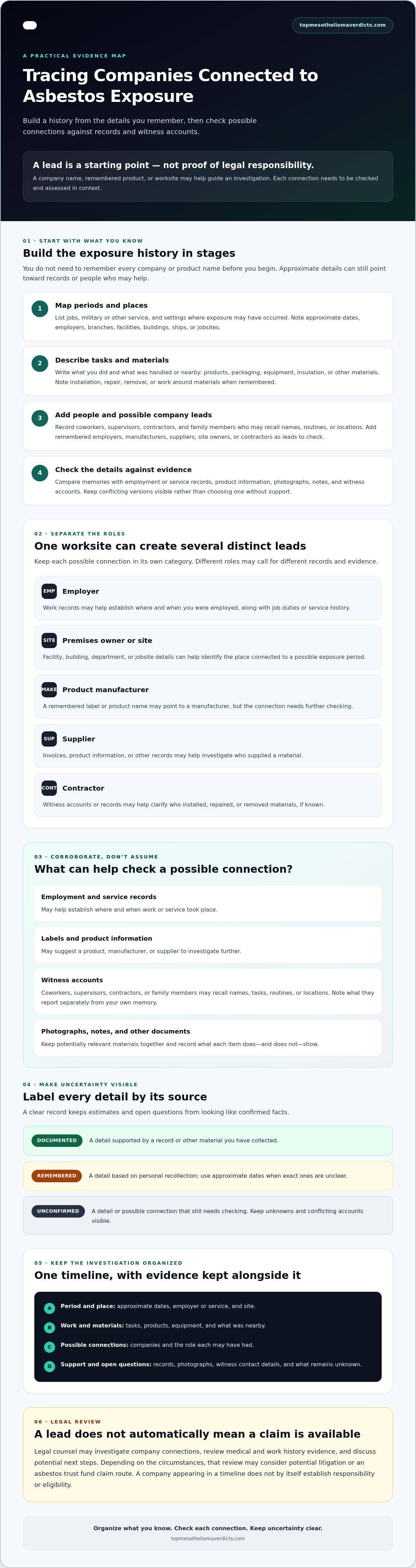
A simple timeline can keep details organized without making uncertain memories seem exact:
- Approximate dates: Add a year range if you cannot recall exact dates, and mark it as uncertain.
- Employer, service, or site: Note the company, branch, ship, building, or jobsite you remember.
- Task and materials: Describe the work and any products, packaging, equipment, or insulation involved.
- People and source: List possible witnesses and note whether each detail comes from memory, a document, or still needs confirmation.
What details help identify an asbestos exposure source?
Write down employers, occupations, military service, worksites, job duties, and approximate dates. Include what you handled or worked near, such as insulation, equipment, or materials with a product label you recall. Note who supplied, installed, or removed materials, if you know. Coworkers, supervisors, contractors, and family members may remember names, routines, or locations you have forgotten. Keep their contact details with your notes, and distinguish what they told you from what you remember personally.
Why can several companies appear in one exposure history?
One worksite can raise several distinct leads: an employer, premises owner, product manufacturer, supplier, or contractor. Each has a different role, so the records and other evidence needed to investigate the connection may differ. A company’s name in a timeline does not, by itself, establish responsibility.
A company lead is a possible connection to an exposure history, not proof that the company is legally responsible.
Keep leads separate rather than grouping every name under “employer.” An invoice or product label may suggest who made or supplied a material, while work records may help establish where and when you were employed. If a company later went through bankruptcy, research may also uncover asbestos bankruptcy trusts established to address claims. That is another avenue to evaluate, not evidence that a particular person qualifies to file. Keeping these details distinct makes how to find companies responsible for asbestos exposure a structured investigation rather than a memory test.
How to Trace Exposure Through Jobs, Products, Worksites, and Service
Build the history in stages rather than trying to recall every detail at once. Work, household, and military service experiences may each reveal a different path to investigate. For industry-specific examples, see this guide to asbestos exposure in power plants.
- Map exposure periods. List jobs, service, and other settings where exposure may have occurred. Use approximate date ranges when needed.
- Describe tasks. Note what you did, what materials or equipment were nearby, and whether the work involved handling, repairing, installing, or removing products.
- Name worksites. Record facility names, departments, buildings, ships, or other locations as accurately as possible.
- Research products and organizations. Add any remembered labels, manufacturers, suppliers, contractors, or employers. Then look for records or witnesses who can help check those leads.
Mark every entry as remembered, documented, or unconfirmed. Keep conflicting accounts visible instead of choosing the version that seems most likely. A historical RAND report offers broader context on the scale of asbestos litigation, but identifying a particular exposure history still depends on evidence tied to the person, place, and period.
Which records may help reconstruct work and service history?
Look for employment histories, union records, pay records, personnel files, and military service records. Social Security work history records may also offer leads, but check current access rules and limitations before relying on them. For each document, note where it came from, its date, and which job or exposure period it may help establish. A record can confirm employment without identifying the materials present.
How can a product or worksite lead point to a company?
Write down any product label or manufacturer name you recall. Note packaging details, equipment identifiers, and where photographs or records that might show them are located. Keep site and department names in your private notes, and do not post sensitive personal or medical information publicly. Records made at the time and witness accounts may support a recollection, add context, or contradict it. Evaluate each item rather than treating it as conclusive on its own.
These steps can make how to find companies responsible for asbestos exposure more manageable by turning scattered memories into leads that can be checked. If you want to understand how legal counsel may review those connections, explore information about asbestos-related legal claims.
Which Companies Might Be Connected, and What Evidence Can Support Each Lead?
A single exposure history can point to several companies in different roles. An employer may have assigned the work, a property owner may have controlled the site, and separate businesses may have manufactured, supplied, or installed materials. These are distinct investigative leads, not automatic findings of legal responsibility. The evidence and applicable law must be considered for each possible connection.
A product name, employment record, or site history is a lead to corroborate, not proof by itself that a particular company caused an exposure or is legally responsible.
| Potential company | Evidence that may support a lead | What it cannot establish alone |
|---|---|---|
| Employer | Employment or personnel records, pay documents, job assignments, coworker accounts | Which asbestos-containing materials were present or who made them |
| Premises owner | Site records, ownership documents, building or maintenance files, witness accounts | That the person encountered asbestos at the site or that the owner is legally responsible |
| Manufacturer | Product labels, catalogs, invoices, packaging, photographs, or archived product records | That the product was used at the worksite or that the person encountered it |
| Supplier | Purchase records, invoices, delivery documents, work orders | That a supplied product contained asbestos or reached the specific job or worker |
| Contractor | Contracts, project files, maintenance logs, work orders, witness accounts | What work the contractor performed or whether it created the exposure being investigated |
More than one company may warrant review. Construction work, for example, can involve employers and contractors working at sites owned or operated by other entities. For more context about that type of work history, read this guide to construction asbestos exposure claims.
What evidence can connect a product to its manufacturer or supplier?
Compare any remembered product name with labels, purchase records, catalogs, invoices, work orders, photographs, and archived documents. A product description and approximate date may help narrow the search to items or businesses active during a particular period. They do not prove the product was used where or when exposure occurred. If you cannot identify an item, mark it unresolved. Do not assign a manufacturer based on appearance alone.
How do employers, site owners, and contractors differ?
Employment records may help identify who hired or paid you, while site documents may point to ownership or control. Contracts and maintenance logs can suggest which contractors worked on a project, and witnesses may add context. Each record answers a different question. The EPA’s State Asbestos Program Contacts page can help readers locate state asbestos agencies for relevant program inquiries, but it does not establish responsibility for an individual exposure.
Organizing evidence by company role can make how to find companies responsible for asbestos exposure more precise. Legal responsibility depends on the specific facts and applicable law, not simply on a company’s name appearing in a record.
How to Organize Missing Records, Witnesses, and Uncertain Memories
Gaps in an old work history are common. A missing employment file or forgotten product name does not automatically prove or disprove exposure, or determine whether a company may be responsible. Keep the gap visible and record what you have already checked. This makes it easier to identify useful next steps without filling in details through guesswork.
Use this checklist to preserve what you have:
- Save original records: Keep copies of employment documents, letters, medical or service records, and product materials. Note where each item came from and when you received it.
- Preserve photographs and notes: Keep original files when possible, and add dates or context without altering what an image shows.
- Separate certainty levels: Label details as known, estimated, or unanswered. If you are unsure of a year, write “approximate” rather than choosing a date.
- Track missing information: List records you looked for, where you searched, and likely record holders you have not contacted.
- Do not disturb suspected asbestos: Do not handle, remove, or collect samples from materials you suspect may contain asbestos. Leave assessment and sampling to appropriately qualified professionals.
How should you document memories and potential witnesses?
Write a dated account in the person’s own words. Include what they recall directly, what they are unsure about, and when the memory was recorded. Do not coach a witness or add details they have not confirmed. With appropriate permission, note each witness’s name and contact information, what they may know, when they knew it, and the best way to reach them.
What if records or product names are missing?
Keep the search methodical. Former coworkers may recall tasks or materials. Family records could help clarify dates or employers, while public archives and company documents may reveal additional leads. Record each search and its result, including unsuccessful attempts. Keep an unknown product unidentified until reliable information supports a name. Never infer a manufacturer from how an item looked.
These steps can make how to find companies responsible for asbestos exposure a careful evidence-gathering process, even when the record is incomplete. Legal counsel can review what is available and discuss appropriate next steps. For background on possible legal paths, read this guide to mesothelioma litigation options.
If you’ve received a mesothelioma diagnosis and want to discuss how your records and memories may be reviewed, Request a confidential, free consultation.
When to Get Legal Help Identifying Asbestos-Related Companies
Consider speaking with an asbestos attorney when you have a diagnosis but are unsure which companies, products, or worksites belong in your exposure history. Counsel may review your timeline, medical information, employment and service details, records, and witness accounts, then research product and company histories to assess which leads warrant further investigation.
The possible paths are not the same. Depending on the evidence and applicable law, a lawsuit may be considered against companies that can be pursued in court. An asbestos trust fund claim involves a trust established in connection with a bankrupt company’s asbestos liabilities. A company name or exposure lead does not establish eligibility for either path. Qualified counsel can assess the facts, available evidence, and deadlines relevant to your circumstances.
What can an asbestos attorney investigate?
An attorney may compare the exposure timeline with supporting documents, research companies connected to products or worksites, and identify records or witnesses that could clarify uncertain details. You can ask how the investigation is handled, who will work on the matter, and how the firm distinguishes confirmed information from unresolved leads. A review cannot guarantee that a claim is available or predict its outcome.
Deadlines and legal requirements vary with individual circumstances. Ask qualified counsel to assess which rules may apply rather than relying on a general estimate or assuming the timing of exposure determines a filing deadline.
What should you prepare for a confidential case review?
You do not need a complete file to begin a conversation. Gather what is readily available, and label uncertain details instead of trying to resolve them in advance:
- A basic work, service, and possible exposure timeline, including approximate dates.
- Diagnosis information and relevant medical records you already have.
- Remembered product names, employers, worksites, and possible witnesses.
- Available employment, service, product, or other supporting records.
- Questions about investigation steps, who will handle the matter, fees, contingency terms, and potential litigation or trust fund claim options.
A confidential consultation may help clarify what additional information could matter and what next steps may be appropriate. It does not confirm eligibility, establish company responsibility, or promise a particular result. If you are researching how to find companies responsible for asbestos exposure, legal counsel may help evaluate the connections and evidence without treating an incomplete history as a reason to guess.
DIAGNOSED? CALL 1-800-885-MESO TODAY FOR A CONFIDENTIAL & FREE CONSULTATION
Take the Next Step Toward a Clearer Exposure History
You do not need to remember every product or company to begin. A timeline built from work, service, and site details can help organize possible leads. Records and witness accounts may support or challenge those leads, but a company connection alone does not establish legal responsibility.
Legal counsel can review the available evidence, investigate company and product histories, and discuss whether a lawsuit or asbestos trust fund claim may be an option. If you are weighing how to find companies responsible for asbestos exposure, Weitz & Luxenberg represents people with asbestos-related illnesses across the United States. The firm has secured over $13 billion in verdicts and settlements. It offers free consultations and contingency-based representation.
A confidential review can help clarify potential next steps, but it does not guarantee a claim, eligibility, or outcome. If you have been diagnosed, consider discussing your history and questions with the firm.
Request a confidential, free consultation
Even an incomplete history can be a place to start. Take it one detail at a time.
Frequently Asked Questions
How do I find out which company exposed me to asbestos?
Start by building a timeline of jobs, military service, worksites, tasks, and products you remember. Then look for records and people who can help corroborate those details. Employment files, service records, invoices, product labels, and coworker accounts may point to employers, site owners, manufacturers, suppliers, or contractors. Each name is a lead, not proof of responsibility. An asbestos attorney may help investigate company histories and assess what the evidence supports.
Can I identify an asbestos company if I do not remember the product name?
Yes. A product name can help, but it is not the only way to investigate possible exposure sources. Note the type of material or equipment, where and when you encountered it, what task you performed, and who supplied or installed it, if known. Coworkers, supervisors, work orders, photographs, and archived records may help narrow the search. Keep unidentified products marked as unresolved rather than guessing a manufacturer based on appearance.
What records can help prove where asbestos exposure happened?
Employment histories, union and pay records, personnel files, military service records, work orders, invoices, maintenance logs, and product documents may help establish relevant details. Medical records can document a diagnosis, while photographs or witness accounts may add context about a worksite or task. No single record necessarily proves exposure or company responsibility. Record where each document came from and which time period it relates to, and preserve originals when possible.
Can more than one company be responsible for asbestos exposure?
More than one company may warrant investigation because different businesses can have different roles at a worksite. An employer, premises owner, manufacturer, supplier, or contractor might appear in the history, but each connection requires its own evidence and legal review. A company’s name in a record or a product’s presence at a site does not establish liability by itself. Responsibility depends on the specific facts and applicable law.
What if my asbestos exposure happened decades ago?
Exposure from decades ago may still be investigated using memories, records, and corroborating accounts. Start with approximate dates and clearly label them as estimates. Search for employment or service records, old product information, and coworkers who may remember the work or materials. Missing documents do not automatically prove or disprove exposure. Because filing deadlines depend on individual circumstances and applicable law, ask qualified counsel to assess timing rather than relying on a general rule.
Should I remove or test suspected asbestos materials to identify a company?
No. Do not disturb, remove, or collect samples from material you suspect may contain asbestos. Handling it could release fibers, and a sample alone may not identify when or where you encountered a product or which company supplied it. Leave assessment and sampling to appropriately qualified professionals. For an exposure investigation, record the location and what you observed without touching the material, then discuss possible next steps with a qualified professional or legal counsel.
Can an asbestos trust fund claim identify the company responsible?
A trust fund claim relates to a trust established in connection with a bankrupt company’s asbestos liabilities, so reviewing trust information may point to a company worth investigating. But filing a claim does not independently prove where or how exposure occurred, establish legal responsibility, or guarantee eligibility. Evidence must be assessed against the relevant trust’s requirements and the person’s circumstances. Counsel can explain whether a potential trust claim and a lawsuit are appropriate paths to review.
When should I contact an asbestos lawyer about identifying companies?
You can contact an asbestos lawyer when you have a diagnosis and questions about which companies may connect to your work, service, or product history, even if your records are incomplete. A lawyer may review medical and employment details, investigate product and company histories, assess witnesses, and discuss possible litigation or trust fund claim routes. Ask about the investigation process, who will handle your matter, fees, and deadlines. A review does not guarantee a claim or outcome.
Disclaimer
Published by Weitz & Luxenberg, P.C. National Headquarters: 700 Broadway, New York, NY 10003. Call 800-885-MESO. Attorney Advertising. Prior results do not guarantee a future outcome. Certain contentions in blog posts need to be confirmed by a licensed attorney.


