

A stage 4 diagnosis can make a mesothelioma claim feel urgent, but the diagnosis alone doesn’t determine compensation. A stage 4 mesothelioma lawsuit payout depends on evidence connecting asbestos exposure to the illness, the companies that may be responsible, and the losses the patient and family have experienced.
If you’re facing treatment decisions and added household expenses, it’s understandable to wonder whether the diagnosis changes what a case may be worth. The answer depends on the facts. Stage 4 may affect the urgency and circumstances of a claim, but it doesn’t guarantee compensation or a particular result.
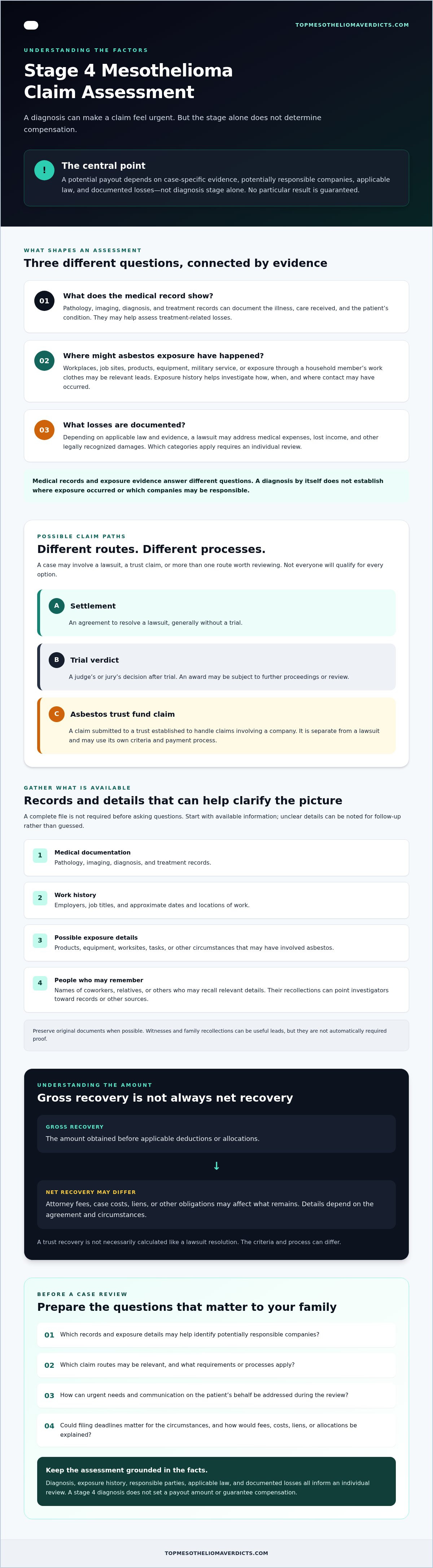
This guide explains what may influence a case assessment and how lawsuits, settlements, jury verdicts, and asbestos trust fund claims differ. It also covers how medical records, work and exposure history, and financial losses may help clarify potential options.
You’ll learn what information families can begin gathering, why filing deadlines may matter, and how a confidential case review can help clarify possible next steps. Asbestos counsel can investigate exposure history and assess potential claim routes, helping you consider your options during a difficult time.
Key Takeaways
- A stage 4 mesothelioma lawsuit payout depends on case-specific evidence and losses, not diagnosis stage alone.
- Medical records and details about workplace, product, military, or household exposure can help identify potentially responsible companies.
- Settlements, trial verdicts, and asbestos trust fund claims follow different processes. More than one route may be worth reviewing.
- Gather available records, write down exposure history, and prepare questions before requesting a legal review.
- Ask counsel how urgent needs, possible claim routes, and communication on the patient’s behalf can be addressed during the review.
What Does a Stage 4 Mesothelioma Lawsuit Payout Mean?
A stage 4 mesothelioma lawsuit payout is compensation received through the resolution of a legal claim. It isn’t a preset amount tied to a diagnosis stage. A case might resolve through a settlement, a trial verdict, or a separate claim with an asbestos trust fund. Each route has different requirements and processes, and not everyone will qualify for every option.
Individual case outcomes vary because the evidence, potentially responsible parties, applicable law, and documented losses differ from one claim to another.
A settlement is an agreement to resolve a lawsuit, generally without a trial. A verdict is a judge’s or jury’s decision after a trial, and an award may be subject to further proceedings or review. An asbestos trust fund claim is submitted to a trust established to handle claims involving a company. It isn’t the same as a lawsuit, although both may be potential routes to compensation.
Does a stage 4 diagnosis determine the payout?
No. Diagnosis stage is one case-specific consideration, not a compensation formula. Medical records can document the diagnosis, treatment, and the patient’s condition. They may help assess damages, but they don’t by themselves establish where asbestos exposure occurred or which companies may be responsible.
Exposure evidence addresses a different question: how, when, and through which products or work environments a person may have encountered asbestos. Both types of information can matter. For general background on the disease, see Mesothelioma. For questions about an individual diagnosis or prognosis, speak with a qualified medical professional. A lawyer can assess legal questions based on the case facts.
What may a lawsuit payout include?
Depending on applicable law and the evidence, compensation in a lawsuit may address losses such as medical expenses and lost income, along with other legally recognized damages. Which categories apply, and how they’re evaluated, requires an individual review. A trust may use its own claim criteria and payment process, so a trust recovery isn’t necessarily calculated like a lawsuit resolution.
The gross recovery is the amount obtained before applicable deductions or allocations. The client’s net recovery may differ after attorney fees, case costs, liens, or other obligations are addressed. Details depend on the specific agreement and circumstances. Ask counsel to explain how a proposed resolution would be accounted for, including any questions about fees, costs, liens, or allocation among claims.
How Exposure Evidence and Case Facts Shape a Stage 4 Claim
Medical records and exposure evidence help answer different questions in a mesothelioma claim. Pathology reports, imaging, and treatment records can document the diagnosis and care received. They may also help assess treatment-related losses. The National Cancer Institute’s overview of mesothelioma treatment options provides medical background, but a treating professional is the right source for questions about an individual’s care.
Assessing a potential claim also involves investigating where asbestos exposure may have happened and which companies or products could be connected to it. A person’s history might involve more than one employer, job site, product, or source of exposure, including military service or exposure through a household member’s work clothes. The stage 4 mesothelioma lawsuit payout can’t be assessed from the diagnosis alone. Evidence connecting exposure to potentially responsible parties is a separate part of the review.
Which records can help document an asbestos claim?
Start with what’s available. You don’t need a complete file before asking questions. Useful leads may include:
- Pathology, imaging, diagnosis, and treatment records
- Employment history, job titles, and approximate dates and locations of work
- Notes about products, equipment, worksites, or tasks that may have involved asbestos
- Names of coworkers, relatives, or others who may remember relevant details
Witnesses and family recollections can point investigators toward records or other sources, but they aren’t automatically required proof. Preserve original documents when possible, and let counsel help identify which records may be useful. If details are unclear, write down what you remember and what needs follow-up rather than guessing.
Why exposure history matters alongside diagnosis
A diagnosis establishes that someone is ill. It doesn’t, by itself, show where, when, or how asbestos exposure occurred. Employment records, product information, and witness accounts may help fill in those parts of the history. Counsel can investigate potential exposure sources and assess which parties or claim routes warrant further review.
Proof of illness documents the injury; exposure evidence helps connect that injury to a potential asbestos claim. The evidence needed and the legal standards that apply can depend on the state and type of claim. Filing deadlines also vary by state and claim type, so an attorney should verify the applicable rules promptly rather than relying on a general timeline.
If you’d like help organizing these details, consider requesting a mesothelioma case review to discuss what the available records may show and what questions to address next.
Settlement, Verdict, or Trust Claim: Which Payout Path Applies?
A mesothelioma claim may involve different routes, depending on the exposure evidence, potentially responsible companies, and each route’s requirements. A lawsuit against a company and a claim with an asbestos trust are separate processes. If both may be relevant, assess them together so the claimant can understand how the options interact.
The National Cancer Institute describes Stage IV mesothelioma as cancer that has spread to distant parts of the body. This medical staging information may help explain the diagnosis, but it doesn’t determine a compensation route or establish a company’s responsibility.
| Route | How it works | What remains uncertain |
|---|---|---|
| Lawsuit settlement | The parties agree to resolve a claim, usually without a trial. | Whether the parties agree, the terms, and the timing depend on the specific case. |
| Trial verdict | A judge or jury reaches a decision after hearing the case at trial. | The decision and any subsequent review or proceedings are case-specific. |
| Asbestos trust fund claim | A claim is submitted to a trust established to handle claims involving a company. | Eligibility and payment depend on that trust’s requirements and review. |
How a settlement differs from a trial verdict
A settlement resolves a lawsuit through an agreement. A verdict follows a trial, where the judge or jury decides the issues presented. Neither route is automatically faster or more valuable. The evidence, parties, procedural steps, and case circumstances can affect both the process and outcome. For background on trust-specific payment percentages, readers can also consult Asbestos Trust Fund Payout Percentages: 2026 Compensation Guide.
When an asbestos trust fund claim may be relevant
A trust claim is distinct from suing a defendant in court. A trust reviews claims under its own criteria, which may include evidence of exposure and diagnosis. A claimant doesn’t automatically qualify, and no fixed combined recovery can be assumed when considering a trust claim alongside a lawsuit. In some states, trust payments may affect a jury award, so an attorney should review how the applicable rules and claims interact.
For a stage 4 mesothelioma lawsuit payout, the practical question isn’t simply which route sounds preferable. It’s which claims the available records may support and what requirements apply to each. Reviewing potential routes together can clarify the options without treating any outcome as guaranteed.
How to Prepare for a Stage 4 Mesothelioma Case Review
A case review can help clarify what information matters and which legal options may warrant closer evaluation. You don’t need every document in hand before reaching out. Filing deadlines and legal requirements vary by state and claim type, so seek jurisdiction-specific guidance promptly rather than waiting until your records are complete.
- Gather available records. Set aside diagnosis, pathology, treatment, and employment documents you already have. These can help start the discussion, but missing records aren’t a reason to postpone an initial conversation.
- Note possible asbestos exposure. Write down known employers, worksites, products, job duties, and approximate dates. Add names of coworkers or relatives who may remember relevant details. Mark uncertain information as something to check.
- Identify your questions. Consider what you need to know about potential defendants, trust claims, deadlines, case costs, fees, and who would handle the matter. Families can also ask about urgent practical needs and who may communicate with counsel on the claimant’s behalf.
- Request a legal review. A mesothelioma attorney can assess the available information, explain what may be missing, and discuss possible next steps. A review can help you understand options, but it can’t promise a particular result.
What should families gather before speaking with counsel?
If readily available, collect medical records and employment history, along with notes about possible exposure. A simple timeline can help: list jobs, worksites, products, dates, and people who may have firsthand knowledge. These materials are helpful, not prerequisites. An attorney can explain how to pursue missing records and which details may be most relevant.
What should a case review clarify?
Ask which companies or other potential defendants may need investigation, whether asbestos trust claims could be relevant, and which state-specific deadlines and legal standards apply. Discuss how the firm communicates, who will handle the case, and how fees and case costs are addressed in the written agreement. If the claimant needs a family member to coordinate communication, ask what steps or authorization may be required.
For broader background, the Mesothelioma Litigation: 2026 Guide for Families can help frame questions about the litigation process. A focused review can then address how the available facts relate to your family’s circumstances and potential stage 4 mesothelioma lawsuit payout options.
If you’re ready to discuss your records and questions, request a free mesothelioma case review.
What to Expect From a Mesothelioma Payout Review
A payout review is an individualized assessment, not a promise of compensation. Counsel may examine the diagnosis and medical records, available exposure evidence, potentially responsible companies, possible lawsuit or asbestos trust claim routes, and the applicable law. The goal is to identify questions and options based on the facts, including what information may still be needed.
For families considering a stage 4 mesothelioma lawsuit payout, the review can also help clarify practical concerns. Ask how urgent needs may be communicated, who will be your main contact, and whether a family member can speak with counsel on the claimant’s behalf. Next steps depend on the case information, applicable deadlines, and the claimant’s decisions.
How should readers interpret law firm results?
Prior verdicts and settlements reflect the evidence, parties, and circumstances of those specific cases. They don’t predict what another claimant will recover. A firm’s experience and national practice can provide context about its work, but neither guarantees an individual outcome. Rankings and headline verdicts are background, not proof of what a new case may be worth.
What happens after an initial consultation?
After an initial discussion, counsel may request or review records, ask follow-up questions about exposure, and evaluate potential defendants, trust claims, and filing deadlines. The family can then consider the information and decide whether to take further steps. There’s no single path that fits every case, and an individual legal assessment is needed to understand which options may apply.
Weitz & Luxenberg offers free consultations and works on a contingency basis. Confirm the current terms directly with the firm, and review the written fee agreement for details about fees, case costs, and other provisions before deciding how to proceed.
You don’t need every answer before asking questions. A conversation can help you understand what a review involves and what information may be useful. To discuss your circumstances, speak with a mesothelioma legal team.
Take the Next Step With a Clearer Picture of Your Options
A stage 4 mesothelioma lawsuit payout isn’t set by diagnosis alone. Medical records can document the illness and its effects, while exposure evidence may help identify responsible companies and possible claim routes. Settlements, trial verdicts, and asbestos trust claims each have distinct processes. The options depend on the facts and applicable law.
Weitz & Luxenberg represents people with asbestos-related mesothelioma across the United States and handles litigation and trust fund claims. The firm reports more than $13 billion in verdicts and settlements. Past results don’t predict what another person may recover. The firm also offers free consultations and contingency-based representation. Confirm current terms and review the fee agreement for details.
A confidential, individualized review can help you understand what evidence may be useful, which deadlines need attention, and what questions to ask. If you’re ready to discuss your circumstances, request a free mesothelioma case review. A review can be a practical first step toward understanding your options.
Frequently Asked Questions
Does stage 4 mesothelioma guarantee a higher lawsuit payout?
No. A stage 4 diagnosis doesn’t guarantee a higher payout or any recovery. The diagnosis and its effects may be relevant when assessing damages, but a claim also depends on evidence connecting asbestos exposure to potentially responsible companies, applicable law, and documented losses. Medical records and exposure evidence serve different purposes. An attorney can review the specific facts and explain what may affect a claim’s assessment.
How much is a stage 4 mesothelioma lawsuit payout?
There’s no fixed amount for a stage 4 mesothelioma lawsuit payout. The research for this article reports average mesothelioma settlements of $1 million to $2 million, while verdicts range from $5 million to $20.7 million. Mealey’s Litigation Report cited a $20.7 million average verdict in 2024. These figures describe broader outcomes, not predictions for an individual case. Evidence, potentially responsible parties, applicable law, and losses all matter.
Can a stage 4 mesothelioma patient file a lawsuit?
A patient may be able to file a mesothelioma lawsuit while living, depending on the facts, applicable law, and filing deadlines. A stage 4 diagnosis doesn’t automatically prevent a claim, but eligibility and where to file require individual legal review. Deadlines vary by state and claim type, so a patient or family should seek jurisdiction-specific guidance promptly rather than assume a general timeframe applies.
What factors affect a stage 4 mesothelioma lawsuit payout?
Potentially relevant factors include the strength of medical and exposure evidence, which companies may be responsible, the applicable jurisdiction and legal standards, and documented losses such as medical expenses and lost wages. The availability of a lawsuit, settlement, verdict, or asbestos trust claim also depends on specific requirements. A diagnosis alone doesn’t establish liability. Counsel can review the records and assess which facts may matter in an individual case.
Is a mesothelioma settlement different from a lawsuit verdict?
Yes. A settlement is an agreement resolving a lawsuit, generally without a trial. A verdict is a decision reached by a judge or jury after a trial. Neither route guarantees a particular result, and one isn’t always faster or larger than the other. The process and outcome depend on the evidence, parties, and case circumstances. A trust fund claim is a separate process, not a trial verdict.
Can a family pursue a mesothelioma claim after the patient dies?
A family may be able to pursue a wrongful death claim after a patient dies, but who can bring it and what deadlines apply depend on state law and the circumstances. If the patient had already filed a personal injury lawsuit, the effect of the death on that case also requires legal review. Families should promptly ask an attorney about the applicable deadline and what records may be needed.
How long does it take to receive a stage 4 mesothelioma payout?
Timing varies with the claim route, evidence, defendants, and procedural requirements. Research for this article indicates that most mesothelioma cases settle within 6 to 12 months, but that isn’t a guarantee for any particular case or a timeline for every trust claim or trial. Ask counsel what steps may apply, what could affect timing, and whether any filing deadlines require prompt attention.


