

What if the best mesothelioma attorney isn’t the one making the boldest promises, but the one who answers your questions clearly? Choosing legal counsel can feel like another burden when you’re facing treatment or supporting someone who is ill. The questions to ask a mesothelioma attorney can help you assess more than experience. They can clarify who will handle your case, how an investigation may work, and what financial terms to review before you decide.
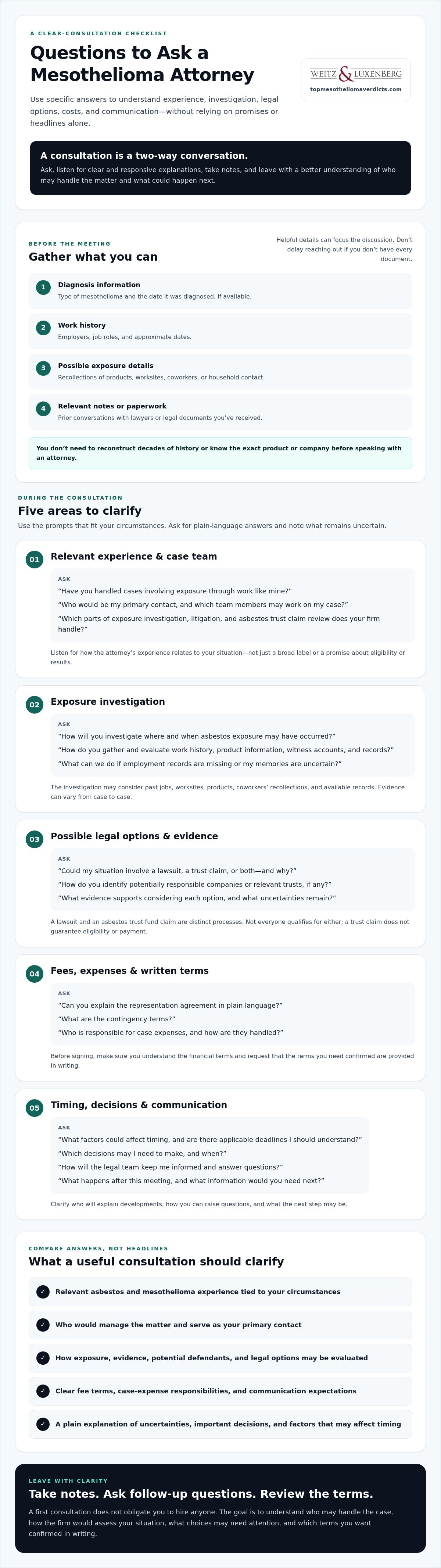
A consultation is a two-way conversation. Ask about the attorney’s experience with asbestos cases, how the firm would investigate possible exposure, and which legal options may fit your circumstances. You can also ask about fees, case expenses, decisions you may need to make, and how the legal team will keep you informed.
This checklist can help you compare attorneys using specific answers rather than marketing claims alone. Take notes during the consultation and leave with a clearer understanding of who would manage the matter, what may happen next, and which terms you’ll want confirmed in writing. Asking questions can bring clarity without adding unnecessary pressure.
Key Takeaways
- Bring diagnosis details, work history, and any information about possible asbestos exposure to make your consultation more focused.
- Use questions to ask a mesothelioma attorney to understand how the lawyer would investigate exposure and assess possible legal options.
- Ask how the attorney evaluates evidence, potential defendants, uncertainties, and factors that may affect timing.
- Before signing, request a plain-language explanation of the representation agreement, including contingency terms and responsibility for case expenses.
- Compare attorneys by relevant experience, who will handle the case, clear answers, fee transparency, and communication, not headlines alone.
Questions to Ask a Mesothelioma Attorney at Your First Consultation
A first consultation gives you a chance to ask questions, learn about possible options, and decide whether you feel comfortable with the lawyer. It doesn’t obligate you to hire anyone. Use the conversation to understand how the firm approaches asbestos-related claims and whether its answers address your situation.
Preparing a few details can make the discussion more useful, but don’t delay reaching out because you don’t have every document. If available, gather:
- Diagnosis information, such as the type of mesothelioma and the date it was diagnosed
- A brief work history, including employers, job roles, and approximate dates
- Any recollections of possible asbestos exposure, including products, worksites, or household contact
- Notes about prior conversations with lawyers or any legal paperwork you’ve received
For a general medical overview before discussing legal questions, see Mesothelioma. Your attorney can explain which details may matter to an initial legal review.
How much mesothelioma and asbestos litigation experience do you have?
Ask about the attorney’s experience with mesothelioma cases and asbestos-related claims that resemble your circumstances. For example: “Have you handled cases involving exposure through work like mine?” and “Which parts of exposure investigation, litigation, and asbestos trust claim review does your firm handle?” Relevant experience is more useful than a broad label such as “best.” Listen for an explanation of how that experience relates to your situation, without promises about eligibility or results.
Who will handle my case, and what should I bring?
Ask who would be your primary contact, which team members may work on the matter, and who will explain developments or answer questions. Then ask what records or recollections could help with an initial review. If readily available, you might bring medical information, employment records, or notes about products and worksites. You don’t need to reconstruct decades of history before seeking guidance.
Write down your questions in advance. If it would help you listen, take notes, or remember follow-up points, consider bringing a trusted support person. Include “What happens after this meeting?” and “What information, if any, would you need next?” among your questions to ask a mesothelioma attorney. Notice whether the answers are specific, understandable, and responsive to your circumstances. Clear explanations matter, and so does feeling heard.
Questions About Asbestos Exposure Investigation and Legal Options
Asbestos exposure may have happened decades before a mesothelioma diagnosis, and the details can be difficult to piece together. An investigation may consider past jobs, worksites, products, coworkers’ recollections, and available records. You don’t need to know the exact product or company before speaking with an attorney. Ask how the legal team would build an exposure history and which facts could matter to your circumstances.
How will you investigate where and when asbestos exposure occurred?
Ask what steps the firm takes to gather and evaluate work history, product information, witness accounts, and records. You might ask, “What can we do if employment records are missing or my memories are uncertain?” A useful answer should explain how the team would approach those gaps and what information could help. You shouldn’t be expected to solve the history on your own. The evidence that matters can vary from case to case.
If you need medical or patient-support information alongside legal guidance, the Mesothelioma Applied Research Foundation offers a separate resource for people affected by the disease. Keep the roles clear: ask your attorney about the legal investigation, and direct medical questions to your healthcare team.
Could my situation involve a lawsuit, a trust claim, or both?
Ask which potential legal routes the attorney will evaluate and why they may apply to your circumstances. A lawsuit and an asbestos trust fund claim are distinct processes, and not everyone qualifies for either. A trust claim is a request for compensation from an asbestos bankruptcy trust, assessed under that trust’s criteria. Filing a claim does not guarantee eligibility or payment. Ask how the attorney identifies potentially responsible companies or relevant trusts, if any, and what evidence supports considering each option.
Ask how the firm will explain your choices, important decision points, and how applicable laws or deadlines may affect the analysis. Details vary, so request guidance specific to your situation rather than relying on a general timeline. For a broader overview of the litigation process, see Mesothelioma Litigation: 2026 Guide for Families.
These questions to ask a mesothelioma attorney can help you assess whether the proposed investigation is clear and grounded in your history. To learn more about how an exposure history and possible legal routes may be reviewed, you can learn about mesothelioma claim evaluation.
Questions That Reveal Whether the Attorney’s Strategy Fits Your Case
A firm overview doesn’t show how an attorney would assess your circumstances. Ask for a case-specific explanation: what appears supported by the information available, what remains uncertain, and what the legal team would investigate next. The goal isn’t to demand a prediction. It’s to understand the reasoning behind the proposed approach.
Use this table to guide the conversation. A useful answer should address your facts, acknowledge what the attorney doesn’t yet know, and leave room for follow-up questions.
| Question | Useful answer signals | Follow-up prompt |
|---|---|---|
| What strengths, challenges, and unanswered questions do you see? | The attorney distinguishes known evidence from gaps and explains what needs further investigation. | What new information could change your assessment? |
| Which companies or other parties might be involved? | The attorney describes how potential defendants would be identified and evaluated, without assuming responsibility is established. | What evidence would help connect a company to my exposure? |
| What legal routes might be considered? | The attorney explains which options may warrant review and why, without implying that every route applies. | What facts would affect whether each option is available? |
| What steps could come next, and what may affect timing? | The attorney outlines possible stages and factors that could influence the pace, without promising a fixed schedule. | How will you update me if the plan or timing changes? |
What strengths, challenges, and unanswered questions do you see?
Ask the attorney to explain the information behind their initial assessment. For example, a work history might suggest a possible exposure source, while product records or witness accounts still need review. Ask which developments could change that view and how the firm would explain a revised assessment. A lawyer should explain uncertainties as clearly as possible strengths. If you hear a promised result or recovery, ask what supports the statement and what factors could affect it.
What legal steps could follow, and what decisions would be mine?
Request a plain-language outline of possible next steps, not a guaranteed timeline. Ask how settlement discussions, litigation, and trial preparation may fit the strategy if relevant to your case. Clarify which choices require your informed participation and how the attorney will explain options before you make important decisions. For general legal information for people affected by cancer, Public Counsel’s Cancer Justice program may be another resource.
These questions to ask a mesothelioma attorney can help you compare the clarity and care behind each proposed strategy. If you’re considering a discussion about your case, review mesothelioma legal resources.
Questions About Fees, Expenses, Deadlines, and Communication
Before signing a representation agreement, ask the attorney to explain it in plain language. You should understand how the fee is calculated, which expenses may arise, who is responsible for them, and what the agreement says if there’s no recovery. Terms can differ, so don’t rely on assumptions or a verbal summary alone. Ask the attorney to point to the relevant provisions in writing and explain anything that isn’t clear.
How do your contingency fee and case expenses work?
Ask, “How is the contingency fee calculated, and where does the agreement explain that calculation?” Then clarify how case expenses are handled. Ask what types of expenses may arise, whether they’re deducted from a recovery or handled another way, and what happens to them if the case is unsuccessful. Don’t assume every agreement uses the same terms. If trust claims may be considered, ask how the firm explains that process and its terms. This asbestos trust fund compensation guide offers additional background, but your agreement and circumstances matter.
How will you communicate and protect important deadlines?
Ask who will provide updates, how you can reach the team, and what communication to expect as the matter progresses. You might also ask how urgent questions are handled and whom to contact if your primary attorney is unavailable. Clear expectations help you understand how you’ll stay informed and whom to contact with questions.
Raise deadlines early. Time limits and rules can depend on the jurisdiction and facts, so ask the attorney to assess them promptly rather than relying on a general deadline you’ve read elsewhere. Useful questions include:
- What information do you need to evaluate deadlines that may apply to my circumstances?
- Are there immediate steps I should understand while that review is underway?
- How will you explain any deadline or change that could affect my options?
These questions to ask a mesothelioma attorney can help you understand the financial terms and practical expectations of representation. Review the written agreement and ask follow-up questions before signing.
If you’d like to discuss your circumstances and clarify consultation and representation terms, you can request a free consultation. A consultation is an opportunity to ask questions; it doesn’t require you to hire the firm.
How to Compare Attorneys and Choose Your Next Step
After speaking with one or more attorneys, compare their answers against the same practical criteria. A firm’s size, verdict headlines, or confident sales language may provide context, but they don’t show who will manage your matter or how clearly the attorney explained your options. Your notes and the proposed agreement provide a more useful basis for comparison.
Use this scorecard to record what you learned. Mark each item as clear, needs follow-up, or not yet discussed:
- Relevant experience: Did the attorney describe experience with mesothelioma and asbestos claims like yours?
- Clear answers: Were explanations understandable and specific to your history, including what remains uncertain?
- Case ownership: Do you know who would be your primary contact and which team members may handle the work?
- Fee transparency: Can you explain the written terms for the fee, expenses, and what happens if there’s no recovery?
- Communication: Did the attorney explain how updates and questions would be handled?
What are good signs, and what deserves a follow-up question?
Specific explanations, candid discussion of unknowns, and clear descriptions of responsibilities are helpful signs. Ask for more detail if fee terms are vague, you’re unsure who will manage the case, or you feel pressured to sign before understanding the agreement. A promised outcome also calls for careful questions about what supports the claim. No single response proves that an attorney is right or wrong for everyone. Consider the full conversation and whether your concerns were addressed.
What should I do after speaking with an attorney?
Review the proposed agreement at your own pace. Write down unclear terms, then ask for clarification about next steps, documents the firm needs, communication, and time-sensitive concerns. You can ask follow-up questions and take time to understand the terms before deciding. If you’re comparing firms, use the same scorecard for each and compare written answers and agreements, not just what you remember from the conversation.
The questions to ask a mesothelioma attorney are meant to help you make an informed choice, not force a quick decision. Weitz & Luxenberg offers a free consultation as an opportunity to discuss your situation and ask questions without an obligation to hire. Request a free consultation with Weitz & Luxenberg.
Make Your Next Conversation Count
The right questions to ask a mesothelioma attorney can help you understand how your exposure history may be investigated, who would manage your case, and what fees, expenses, and deadlines need attention. Compare clear, case-specific answers and written agreements, not just firm size or headline results. Ask follow-up questions and take the time you need to understand the terms before deciding.
Weitz & Luxenberg represents people affected by asbestos-related diseases nationwide and reports more than $13 billion in verdicts and settlements over 40 years. Past results don’t guarantee a future outcome. The firm offers free consultations and contingency representation. Ask for the current, case-specific terms and make sure you understand them before signing an agreement.
A consultation can be a practical first step, not a commitment to hire. Bring your questions, share what you know, and ask what may happen next. Request a free consultation with Weitz & Luxenberg. You deserve clear information as you consider your options.
Frequently Asked Questions
What questions should I ask a mesothelioma attorney during a consultation?
Ask about the attorney’s experience with mesothelioma and asbestos claims, how the firm would investigate your exposure history, and who would manage your matter. Also ask which legal options may be relevant, what the written agreement says about fees and case expenses, and how the team communicates. The questions to ask a mesothelioma attorney should help you understand the proposed approach and what remains uncertain, not pressure you to make an immediate decision.
How do I know if a mesothelioma attorney has relevant experience?
Ask about work on mesothelioma cases and asbestos-related claims similar to your circumstances. Then ask which parts of the process the attorney or firm handles, such as investigating exposure, evaluating potential defendants, litigation, or reviewing possible trust fund claims. Listen for specific explanations that connect the experience to your situation. General claims of being “the best” are less informative than clear answers about who will do the work and how your case would be assessed.
Should I ask a mesothelioma lawyer about asbestos trust funds?
Yes. Ask whether the attorney will evaluate possible asbestos trust fund claims, how relevant trusts might be identified, and what evidence may be needed. Trust fund claims are distinct from lawsuits, and eligibility depends on the applicable trust’s criteria and the facts of the claim. An attorney should explain whether this pathway may be relevant to you without implying that you qualify or will receive payment. Ask how the lawyer will discuss the options and any decisions involved.
How do mesothelioma attorney contingency fees work?
With contingency representation, the attorney’s fee is generally tied to financial compensation secured for the client, as described in the representation agreement. The agreement should explain how the fee is calculated and how case expenses are handled. Ask whether expenses may be deducted from a recovery, who is responsible for them, and what happens if there’s no recovery. Terms can vary, so review the specific written agreement with the attorney before signing rather than relying on assumptions.
Can I ask a mesothelioma attorney about deadlines during a free consultation?
Yes. Ask the attorney to assess deadlines that could apply to your circumstances and what information is needed for that review. Time limits can vary by jurisdiction and depend on case-specific facts, so don’t assume a general deadline applies to you. A consultation can be a chance to raise the issue and understand whether prompt next steps may matter. Confirm the consultation’s availability and terms with the firm, and don’t treat an initial discussion as a substitute for case-specific legal advice.
What should I bring to a mesothelioma attorney consultation?
If available, bring diagnosis information, a brief work history, and notes about possible exposure, such as worksites, products, job duties, or approximate dates. You can also bring relevant records and details of any prior legal contact. Don’t postpone reaching out because you lack documents or can’t recall every detail. Write down your questions, and consider asking a trusted support person to join if helpful. The attorney can explain what additional information may assist an initial review.
What should I do if a mesothelioma attorney promises a specific result?
Ask what supports the statement and whether the attorney can explain the uncertainties, evidence, and factors that could affect the outcome. A confident prediction is not the same as an explanation of possible outcomes, and no attorney can guarantee a particular result. Take time to consider the answer, compare it with the attorney’s case-specific assessment, and read the agreement carefully. If you feel pressured or the explanation remains unclear, ask follow-up questions before deciding whether to proceed.


