

You don't need a flawless memory or boxes of decades-old paystubs to hold negligent asbestos manufacturers accountable. When facing a diagnosis 20 to 50 years after contact, figuring out how to prove asbestos exposure source often feels like an overwhelming challenge. It's completely natural to worry that shuttered employers, demolished worksites, or forgotten product brand names will bar you from justice. If you fear that missing employment paperwork disqualifies your claim, you aren't alone.
The reality is reassuring: you don't carry this investigative burden by yourself. Extensive historical archives, blueprints, union dispatch records, and sales invoices exist specifically to reconstruct your occupational history and identify the responsible manufacturers, even those that went bankrupt long ago. In this guide, you'll discover the exact documentation required to substantiate an asbestos claim, learn how specialized attorneys pinpoint exposure sources decades later, and explore the proven pathways to secure compensation through trust funds or civil litigation.
Key Takeaways
- Meeting the legal standard for recovery requires establishing that a specific manufacturer's product was a substantial contributing factor to your diagnosis, rather than showing generalized job-site contact.
- You will learn how to prove asbestos exposure source using historical purchase invoices, blueprints, and union dispatch records, even if your former employer shut down or worksites were demolished.
- Decades of proprietary archives and coworker testimonies enable legal investigators to reconstruct your work history without requiring you to recall specific product brand names.
- Pinpointing every responsible manufacturer enables a dual-track recovery strategy, allowing your family to pursue compensation through both asbestos bankruptcy trusts and active civil litigation.
Why Identifying the Asbestos Exposure Source Is Essential for Legal Recovery
Receiving a diagnosis of mesothelioma or asbestos lung cancer is devastating, but a medical report alone doesn't trigger legal liability. The civil justice system requires a clear bridge connecting your illness to specific corporate negligence. Understanding how to prove asbestos exposure source is the cornerstone of any legal action. Without establishing which companies manufactured, distributed, or installed the toxic materials you inhaled, courts cannot assign accountability, and trust funds cannot distribute compensation.
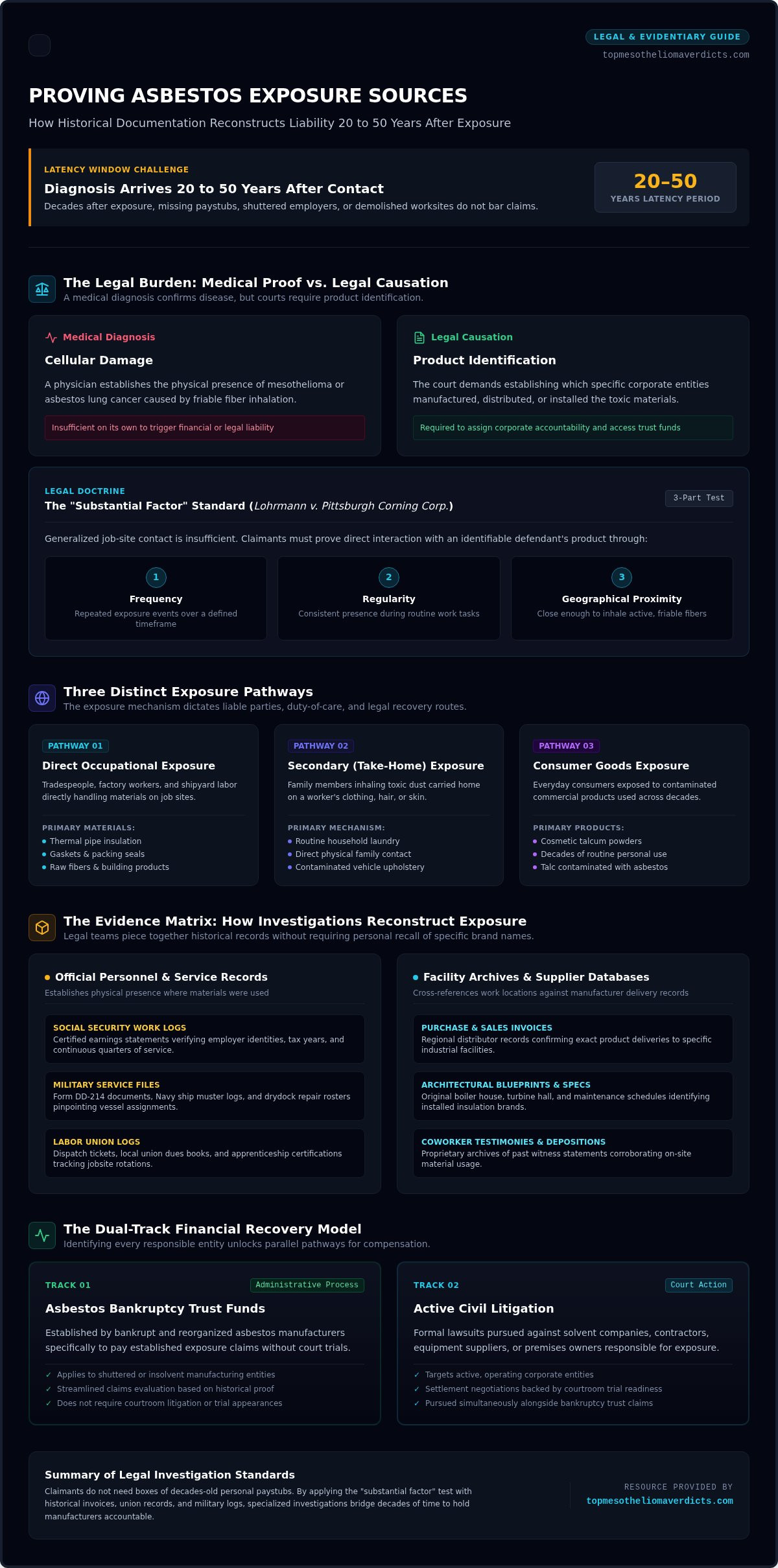
In toxic tort litigation, proving liability hinges on the "substantial factor" test. Under standard legal doctrine established in Lohrmann v. Pittsburgh Corning Corp., a claimant must demonstrate contact with a specific defendant's product with sufficient frequency, regularity, and geographical proximity. Showing that asbestos existed somewhere at a massive industrial facility isn't enough. Your legal team must prove that the particular defendant's materials contributed significantly to your cumulative exposure dose. The viability of your financial recovery, whether through bankruptcy trust fund claims or active courtroom litigation, depends entirely on linking your illness to viable corporate entities.
The Legal Burden of Proof in Asbestos Claims
Legal proof differs fundamentally from medical proof. A physician diagnoses cellular damage, but the court demands product causation. To succeed, you must demonstrate exposure to an identifiable company's product during a concrete timeframe. Building this evidentiary chain requires proving that you worked close enough to the material to breathe in its friable fibers, establishing proximate cause under state and federal standards.
Direct Exposure vs. Secondhand Exposure Distinctions
Pinpointing the exposure pathway determines how an attorney structures your claim. Exposure cases generally fall into three distinct categories:
- Direct Occupational Exposure: Tradespeople, factory workers, and shipyard labor directly handling thermal insulation, gaskets, packing, raw fiber, or building materials on job sites.
- Secondary (Take-Home) Exposure: Family members inhaling toxic dust carried home on a worker's clothing, hair, or skin, often during routine household laundry.
- Consumer Goods Exposure: Everyday consumers exposed to asbestos-contaminated cosmetic talcum powder products used across decades.
Identifying the precise mechanism is vital. Each pathway involves different liable parties, duty-of-care standards, and distinct legal avenues for financial recovery.
Essential Evidence Used to Document and Reconstruct Historical Exposure
Reconstructing events from several decades ago sounds daunting, yet the law doesn't expect patients to unearth archived corporate files on their own. Instead, seasoned legal teams bridge evidentiary gaps by tapping into specialized product databases, historic facility rosters, and architectural blueprints. If you worked in high-risk environments, review this guide to asbestos exposure in power plants to see how specific boiler houses, turbine halls, and maintenance schedules document hazardous conditions.
When determining how to prove asbestos exposure source, attorneys cross-reference your basic career details against extensive nationwide supplier archives. Purchase orders, regional distributor invoices, and equipment contractor lists identify which brand names delivered contaminated gaskets, raw fiber, or thermal pipe insulation to your specific job facility.
Employment and Military Service Records
Official records establish your physical presence where hazardous products were handled:
- Social Security Work Logs: Certified earnings statements confirm employer identities, tax years, and continuous quarters of service.
- Military Service Files: Form DD-214 papers, Navy ship muster logs, and drydock repair rosters pinpoint military assignments aboard contaminated vessels.
- Labor Union Logs: Local union dispatch tickets, dues books, and apprenticeship certifications track jobsite rotations across multiple contractors.
- Secondary Documents: Security clearance passes, pension summaries, and legacy pay stubs confirm presence at specific facilities.
Co-Worker Deposition Testimony and Affidavits
Living witnesses offer compelling support for product identification. Sworn affidavits from tradespeople who shared the same workspace verify which brands generated visible dust during daily shifts. In addition, decades of existing trial archives provide transcripts of prior co-worker depositions, matching specific equipment installations to your exact workplace even if former colleagues are no longer available.
Medical Records Corroborating Asbestos Pathology
Detailed medical diagnostics must confirm the biological signature of toxic fiber exposure. As detailed in the National Cancer Institute's guide on asbestos exposure, diseases such as mesothelioma have long latency periods and distinct physiological indicators. Crucial medical evidence includes:
- Pathology reports documenting malignant mesothelioma or asbestos lung cancer cell types.
- CT scans and chest X-rays demonstrating bilateral pleural thickening, calcified plaques, or pulmonary interstitial fibrosis.
- Biopsy tissue specimens retained for mineral fiber analysis or electron microscopy.
You can discover how strong your historical documentation is by connecting with dedicated advocates at topmesotheliomaverdicts.com to review your work history and explore your options.
The 4-Step Investigative Process: How Attorneys Trace Decades-Old Exposure
Tracing toxic materials from forty years ago follows a disciplined, four-step investigative methodology. Seasoned asbestos attorneys don't ask you to remember obscure manufacturer names. Instead, legal teams employ historical forensic methods to piece together your work history. Understanding exactly how to prove asbestos exposure source through this rigorous process protects you from unnecessary stress while establishing an unassailable evidentiary record.
National firms rely on four decades of nationwide job-site and supplier product archives to connect specific work tasks to corporate negligence. As noted in a landmark GAO report on asbestos injury compensation, establishing clear occupational documentation is central to satisfying trust fund exposure criteria and civil court thresholds across the country.
Conducting the Exhaustive Exposure Interview
The investigation starts with a gentle, structured conversation mapping your life chronologically. Investigators don't quiz you on brand names; they ask about your daily routines, tools, and work environments. Key focus areas include:
- Mapping every job site, employer, military posting, and home renovation project chronologically.
- Identifying trades working in your immediate vicinity, such as pipecoverers, drywallers, or machinists.
- Noting physical characteristics of materials you handled, including packaging colors, logos, texture, and dust density.
Deploying Proprietary National Asbestos Databases
Your work history is next matched against vast internal data depositories. These catalogs contain purchase orders, architectural specifications, and supplier invoices tracking distribution to thousands of industrial plants, shipyards, and commercial builds. For building trades, specialized asbestos exposure construction worker records pinpoint which brands of joint compounds, taping mud, acoustical plaster, and floor tiles were delivered to commercial projects during specific construction phases.
Retaining Industrial Hygiene and Archival Experts
Proving legal causation often requires specialized scientific and historical corroboration. Certified industrial hygienists calculate estimated airborne fiber concentrations based on room dimensions, work duration, and material friability. When cases involve naval ships, naval architects review original ship plans to recreate boiler room layouts and ventilation pathways. Finally, legal historians introduce internal corporate memos, proving manufacturers knew their products released dangerous fibers long before providing consumer warnings.
Overcoming Common Evidence Gaps: Bankrupt Companies, Demolished Sites, and Memory Loss
Missing paperwork, shuttered factories, and fading memories lead many patients to believe their legal window has closed. That fear is unfounded. When exploring how to prove asbestos exposure source under difficult circumstances, specialized legal strategies account directly for missing records, bulldozed facilities, and insolvent manufacturers. If your family is dealing with an advanced medical timeline, reviewing data on an average settlement for stage 4 mesothelioma offers critical perspective on case resolution speeds and financial recovery options.
Handling Faulty Memory and Decades of Latency
Asbestos illnesses take 20 to 50 years to manifest, so forgetting packaging details or exact brand names is expected. You aren't required to provide perfect recall. Attorneys utilize visual product identification manuals containing photographs of vintage packaging, trade emblems, and color-coded materials. Reviewing these historical archives often sparks recognition of standard insulation wraps, joint compounds, or brake linings you encountered daily.
Proving Exposure at Closed or Demolished Facilities
A worksite may be leveled, but its paper trail remains intact. Decades of toxic tort litigation have created comprehensive registries of industrial plants, commercial job sites, and naval yards nationwide. Legal teams reconstruct dismantled facilities by retrieving:
- Archived building permits, engineering specifications, and municipal contractor bids.
- Environmental remediation manifests and hazardous material abatement filings recorded during site decommissioning.
- Historical delivery logs and contractor invoices maintained in proprietary litigation archives.
Filing Claims Against Bankrupt Manufacturers
Dozens of major asbestos manufacturers filed for Chapter 11 bankruptcy decades ago to resolve their liabilities. As a result, courts established over 60 active asbestos bankruptcy trust funds containing more than $30 billion to compensate injured workers and their families. These administrative trusts do not require formal courtroom trials. Instead, they evaluate claims against established job-site lists and job classifications. Reviewing asbestos trust fund payout percentages will help you understand how trusts calculate scheduled values across multiple claims.
Don't let missing paperwork deter you from pursuing what you're owed. Request a free case evaluation to have experienced investigators trace your historical exposure and pursue every available trust fund and solvent manufacturer on your behalf.
Next Steps: Translating Exposure Proof into Financial Recovery
Gathering historical evidence is not just an academic exercise. Knowing how to prove asbestos exposure source directly governs which legal channels your family can pursue. Because every identified product corresponds to a separate corporate entity, uncovering multiple exposure sources dramatically broadens your recovery avenues. Timing remains critical; state statutes of limitations operate under the discovery rule, typically giving you only one to three years from your diagnosis date to initiate a claim.
Comparing Compensation Channels: Lawsuits vs. Trust Funds
Pinpointing liable parties unlocks an effective, dual-track financial recovery strategy. Bankrupt manufacturers cannot be sued in civil court, but documented exposure enables your legal team to file claims against dedicated asbestos trust funds without entering a courtroom. Concurrently, your attorneys can pursue civil lawsuits against solvent equipment makers, raw fiber distributors, and premises owners. Learn how these tracks function side by side in our guide to mesothelioma litigation.
Why Experienced Asbestos Counsel Makes the Difference
You shouldn't have to shoulder the investigative burden while navigating complex medical care. A premier national firm brings decades of resources to your defense, leveraging proprietary nationwide job-site indexes, shipping manifests, and coworker deposition libraries. Dedicated investigative departments perform the heavy lifting, matching your work trajectory to culpable corporate defendants across the country.
As an established leader in toxic tort advocacy, Weitz & Luxenberg has recovered over $13 billion for injured workers and their loved ones, including securing a record $117 million asbestos verdict in 2025 and earning recognition as the #1 filer of asbestos injury cases nationwide in early 2026. Representation is provided entirely on a contingency basis, meaning you incur zero out-of-pocket expenses and face no financial risk. Protect your legal rights and take control of your recovery by requesting a comprehensive, no-cost historical exposure review today.
Reclaim Your Peace of Mind and Hold Negligent Companies Accountable
Navigating an asbestos-related illness brings emotional and physical challenges, but you don't have to carry the legal burden alone. Understanding how to prove asbestos exposure source comes down to partnering with advocates who possess the investigative reach to bridge decades of history. Even with demolished job sites, missing paperwork, or bankrupt manufacturers, forensic records can establish the liability needed to secure vital financial compensation.
Weitz & Luxenberg stands ready to fight on your behalf. Backed by a proprietary historical database covering tens of thousands of national worksites and ranked the #1 filer of asbestos claims in the United States in early 2026, our team has recovered over $13 billion in verdicts and settlements for affected families. We handle every claim on contingency, ensuring your family faces zero out-of-pocket legal risk. Take the first step toward safeguarding your future; Request a Free, Comprehensive Asbestos Exposure Case Review today.
Frequently Asked Questions
What if I cannot remember the brand names of the asbestos products I worked with?
You don't need to recall exact brand names. Your legal team uses extensive product catalogs, witness depositions from previous cases, and historical sales records to identify the materials used at your job sites. Showing what tools you used, your daily tasks, and the physical appearance of the products allows investigators to match your duties with the specific asbestos-containing brands distributed to that workplace.
How do I prove asbestos exposure if my former employer went out of business?
A defunct or dissolved employer doesn't prevent you from recovering compensation. Understanding how to prove asbestos exposure source involves tracing the manufacturers and suppliers who sold toxic materials to your former workplace, rather than suing your direct employer. Historical corporate records, supplier delivery manifests, and bankruptcy trust archives document which products were present on site regardless of whether the operating company still exists.
Can military records alone prove asbestos exposure for Navy veterans?
Military service records provide critical baseline proof, but they are usually combined with ship construction manifests and equipment specs. Form DD-214 documents your service dates, specialty ratings, and duty stations. Legal teams pair these military papers with Navy ship engineering logs and shipyard overhaul records to prove your proximity to asbestos-lined boilers, turbines, steam piping, and pumps during your enlistment.
What evidence is required to prove secondary or secondhand asbestos exposure?
Secondhand exposure claims require proving the primary worker's contact with asbestos alongside proof of shared living quarters. You'll need the family member's employment records, coworker testimony detailing the dusty environment, and evidence showing you lived in the household while handling their contaminated laundry. Establishing that the primary worker carried friable fibers home on their work clothes provides the necessary chain of causation.
How long does it take for attorneys to trace historical asbestos exposure sources?
Experienced legal teams often establish preliminary exposure sources within a few weeks of your initial interview. Decades of litigation have produced centralized archives covering major industrial job sites nationwide, allowing investigators to quickly match your work history against known suppliers. More complex claims involving custom commercial facilities or rare equipment might take a few months to locate surviving blueprints and specialized distributor records.
Do I have to return to old work facilities or contact past employers myself?
No, you never have to visit old jobsites or contact former supervisors yourself. Dedicated legal investigators handle every aspect of the archival search, from pulling government records to tracking down historical shipping logs. You can focus entirely on your medical care and family while your attorneys discover how to prove asbestos exposure source through established corporate databases and sworn colleague affidavits.
What happens if I was exposed to asbestos from multiple sources or jobs?
Exposure across multiple jobs actually strengthens your overall financial recovery by creating several legal pathways. Asbestos diseases stem from cumulative exposure over time. Your legal team can pursue individual trust fund claims against each bankrupt manufacturer involved, while simultaneously filing civil lawsuits against solvent equipment suppliers from different career phases, maximizing the total compensation available for your care.


