

Did you know that the specific name of your vessel might be less important than the year its keel was laid or the shipyard where it was built? For decades, thousands of sailors lived and worked in cramped quarters where almost every pipe, boiler, and bulkhead was lined with toxic minerals. If you are currently facing a diagnosis of asbestos-related lung cancer, you probably feel the mounting pressure of medical bills and the frustration of trying to track down decades-old service records. You shouldn't have to carry that burden alone after serving your country.
It's common to feel confused by the lack of clear information regarding which vessels were truly dangerous. This guide provides a comprehensive asbestos exposure on navy ships list to help you identify high-risk environments and validate your experience. We will explain how ship-based exposure occurred, how to navigate complex military records, and the specific steps required to access compensation through established trust funds. You will gain a clear understanding of your risks and a professional roadmap to the financial support your family deserves.
Key Takeaways
- Understand why naval construction mandates from the 1930s through the 1970s made asbestos a standard component in nearly every vessel.
- Reference the asbestos exposure on navy ships list to determine if your ship class, such as a carrier or destroyer, is linked to confirmed toxic exposure.
- Identify the most dangerous compartments aboard, including engine rooms and galleys, where maintenance work often released microscopic fibers.
- Learn how to use your DD-214 and ship deck logs to prove your presence on a vessel and build a strong foundation for a legal claim.
- Discover the path to securing financial compensation through private trust funds and litigation without filing a lawsuit against the U.S. Navy.
Navy Vessels and Asbestos Risk: Why the List Includes Thousands of Ships
For much of the 20th century, asbestos was hailed as a miracle fiber. It was lightweight, inexpensive, and possessed an almost supernatural resistance to heat and corrosion. In the high-stakes environment of a Navy vessel, where fire is the most immediate threat to survival, these properties made asbestos the gold standard for insulation and fireproofing. However, this reliance created a hidden danger that followed sailors long after they left the service.
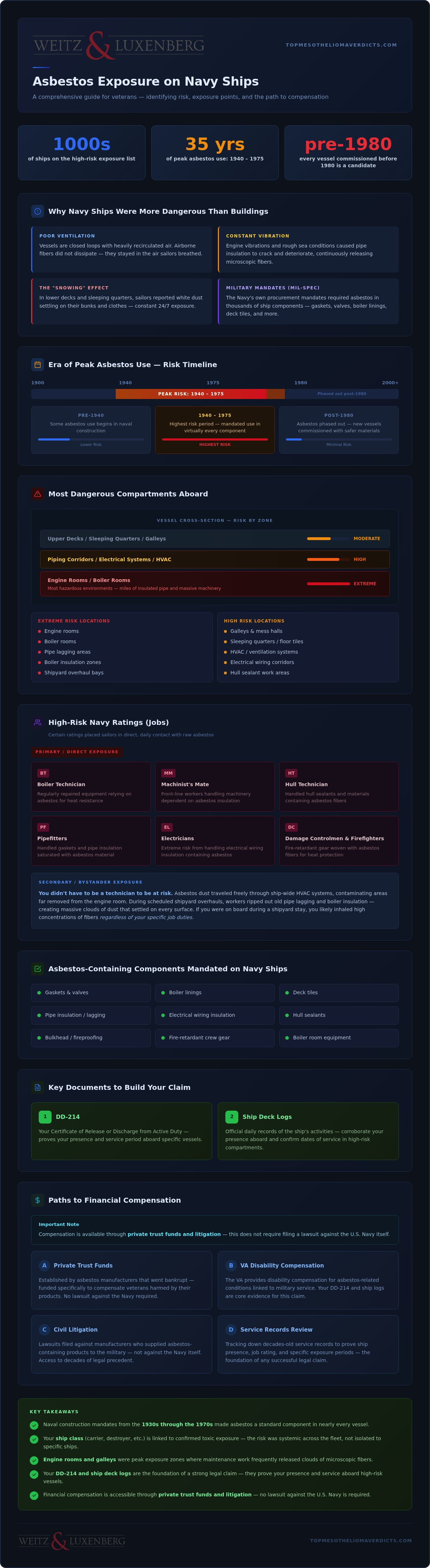
The scale of the problem is vast. Because the Navy required these materials in its design blueprints, virtually every vessel commissioned before 1980 is a candidate for the asbestos exposure on navy ships list. The risk wasn't limited to a few specific ships; it was systemic, woven into the very fabric of the fleet. While asbestos is relatively safe when it remains intact, the harsh conditions of life at sea often turned it friable, meaning it would crumble into microscopic dust at the slightest touch.
The Role of the U.S. Navy in Asbestos Mandates
The prevalence of these toxins wasn't an accident. Military specifications, known as Mil-Spec, actually mandated the use of asbestos in thousands of individual ship components. From gaskets and valves to boiler linings and deck tiles, the Navy's procurement process ensured that sailors were constantly surrounded by the material. During wartime, the immediate need to prevent catastrophic shipboard fires often took precedence over the long-term health risks of the crew. Understanding the asbestos legal history and compensation frameworks helps explain how these mandates led to the litigation we see today. The era of peak asbestos use between 1940 and 1975 represents the highest risk period for service members.
Why Ships Are More Dangerous Than Buildings
While asbestos was common in land-based construction, the environment of a ship significantly amplified the danger. Naval vessels are essentially closed loops with poor ventilation and heavily recirculated air. When asbestos fibers became airborne, they didn't dissipate; they stayed in the air you breathed. Constant engine vibrations and the physical stress of rough sea conditions caused pipe insulation to crack and deteriorate over time. In the lower decks and sleeping quarters, sailors often reported a snowing effect where white dust would settle on their bunks and clothes. This constant cycle of vibration and poor airflow meant that even those who didn't work directly with the materials were often breathing in toxic dust for months at a time.
High-Risk Areas and Occupations Aboard Navy Vessels
While the asbestos exposure on navy ships list often focuses on the vessels themselves, the specific compartments where you worked were the primary drivers of risk. Ships are essentially floating industrial plants. They required miles of insulated piping and massive machinery to function. Engine rooms and boiler rooms were the most hazardous environments, but the danger wasn't confined to these mechanical hubs. Asbestos was present in the galleys, mess halls, and even the floor tiles in sleeping quarters.
Maintenance and overhaul periods in shipyards were peak exposure events for every crew member. During these scheduled repairs, workers frequently ripped out old pipe lagging and boiler insulation. This process created massive clouds of dust that settled on every surface. If you were on board during a shipyard stay, you likely inhaled high concentrations of fibers regardless of your specific job duties. Understanding these exposure points is vital when seeking VA disability compensation for asbestos exposure to cover your medical needs.
Primary Exposure: High-Risk Navy Ratings (Jobs)
Certain Navy jobs, known as ratings, put sailors in direct, daily contact with raw asbestos. Boiler Technicians (BT) and Machinist’s Mates (MM) were on the front lines, as they regularly repaired equipment that relied on asbestos for heat resistance. Pipefitters, Electricians, and Hull Technicians (HT) also faced extreme risks while handling gaskets, electrical wiring insulation, and hull sealants. Damage Controlmen and Firefighters were frequently exposed through their fire-retardant gear, which was often woven with asbestos fibers to protect them from extreme heat during emergencies.
Secondary and Bystander Exposure
You didn't have to be a technician to be at risk. Asbestos dust traveled freely through ship-wide HVAC systems, contaminating areas far removed from the engine room. Officers and stewards often lived in proximity to insulated steam pipes that ran through bulkheads and overheads. Even those in clean administrative roles like a Yeoman or Radioman carried significant risk because ship-wide ventilation systems distributed contaminated dust into every office and bunkroom. This pervasive nature of the toxin is why so many veterans are now eligible for asbestos trust fund claims following a diagnosis. These funds were established specifically to help those who were unknowingly put in harm's way during their service.
Identifying Your Ship: Classes and Eras with Confirmed Asbestos Use
Every vessel in the fleet served a different purpose, but almost all shared a common, toxic foundation. When reviewing an asbestos exposure on navy ships list, it's helpful to categorize vessels by their specific class and the era they were constructed. This framework allows veterans to pinpoint their risk levels based on the engineering requirements of their specific ship. While some vessels are more famous than others, the risk was often determined by the machinery hidden beneath the deck.
The Ship Class Risk Framework
Aircraft carriers were essentially floating cities powered by massive steam propulsion systems. These ships required miles of piping insulated with high-percentage asbestos lagging to maintain thermal efficiency and protect the crew from the heat of catapult systems. Destroyers and frigates, while smaller, presented a different danger. Their engine spaces were incredibly cramped; this forced sailors to work in close proximity to friable insulation that frequently crumbled due to the ship's constant vibration.
Submarines represent perhaps the most intense "closed-loop" environment. Because air was constantly scrubbed and recirculated, any fibers released from gaskets or hull insulation remained trapped within the hull for the duration of the patrol. We shouldn't overlook auxiliary ships like tenders and oilers. These vessels often carried vast amounts of spare asbestos-containing parts to service the rest of the fleet, putting their crews at significant risk during transfer and repair operations.
The Construction Era Timeline
The date of a ship's commissioning is often the strongest indicator of exposure. Vessels built before 1940 utilized asbestos primarily for steam propulsion, but the entry into World War II saw a massive spike in usage. Between 1940 and 1970, the Navy mandated asbestos in nearly every shipboard component. This era, including the Korean and Vietnam Wars, produced ships with the highest concentrations of toxic materials. If you served on a ship built during this window, you were likely surrounded by these minerals every day.
By the 1970s, the military began a phase-out period. However, many ships built during this decade still utilized existing stockpiles of asbestos-containing gaskets and insulation. This created a "legacy asbestos" issue where vessels remained in active service through the 1990s and even into the 2000s without full abatement. Understanding the asbestos health risks and occupational exposure associated with these timelines is essential for veterans who may not have realized they were in danger during more recent decades of service. Even on newer ships, the presence of older, repaired components could still release dangerous fibers into the air.
How to Verify Service History and Exposure for Legal Claims
Identifying your vessel on an asbestos exposure on navy ships list is a critical first step, but it's only the beginning of your journey toward justice. To secure compensation, you must bridge the gap between your service history and your medical diagnosis. This requires a methodical approach to gathering evidence that places you in the presence of toxic materials. It isn't just about showing you were on a ship; it's about proving the environment was hazardous during your specific tour of duty.
Accessing Military Records
Start by requesting your DD-214 and service medical records through the National Personnel Records Center (NPRC). These documents establish your rating and the specific vessels where you served. However, the most compelling evidence often comes from ship deck logs. These logs record "overhaul" periods in shipyards, which are peak exposure events for anyone on board. If your records are incomplete, secondary evidence like old photos, letters home describing your work, or affidavits from former shipmates can be incredibly powerful in validating your claim.
Building the Exposure Timeline
You need to map your daily duties to specific asbestos-containing equipment. If you were a Machinist’s Mate, you likely worked on pumps, valves, or boilers manufactured by specific industrial companies. Identifying the manufacturers of these parts is key because trust funds are tied to the companies that produced the materials. Consulting a comprehensive asbestos exposure on navy ships list can help you identify which manufacturers were prevalent on your specific class of vessel. A "nexus" letter from your doctor is also vital; this document formally links your current illness to your military exposure. You don't need to prove "fault" or negligence to qualify for trust fund claims; you only need to prove exposure and a related diagnosis.
When assessing your options, reviewing the asbestos trust fund payout percentages can help you understand what level of recovery is possible. These funds were set aside specifically for veterans like you to ensure financial stability for your family. Navigating this paperwork can be overwhelming while you're focusing on your health. If you're ready to move forward, you can start your claim evaluation today with an expert who understands the complexities of naval service records.
Legal Recourse and Compensation for Navy Veterans
Many veterans hesitate to seek legal help because they feel a deep loyalty to their branch of service. It's vital to understand that pursuing justice doesn't mean filing a claim against the U.S. Navy or the military. Instead, you're seeking accountability from the private corporations that manufactured and sold toxic products to the government while knowing the health risks. This path is entirely separate from your VA benefits. You can receive both VA disability and private compensation simultaneously without one affecting the other.
Engaging in mesothelioma litigation is about securing your family's financial future and ensuring medical costs don't drain your life savings. At Weitz & Luxenberg, we bridge the gap between your service and these manufacturers using our massive internal database. This proprietary archive includes thousands of Navy ship blueprints and detailed equipment lists. We use these records to identify exactly which manufacturers were present on your vessel, even if you can't remember the specific brand of a valve or gasket from decades ago.
Asbestos Trust Funds for Veterans
Currently, more than $30 billion is available in asbestos trust funds. These funds were established by companies that filed for bankruptcy to ensure future victims could still receive compensation. For veterans with a clear diagnosis and a confirmed place on the asbestos exposure on navy ships list, there is often an expedited review process. This allows for financial recovery without the need for a traditional courtroom trial or a lengthy legal battle. It is a streamlined way to access the support you've earned through your service.
Choosing an Experienced National Advocate
You deserve a partner with a formidable history of success. Weitz & Luxenberg has spent over 40 years fighting for the rights of veterans, securing more than $13 billion in total results for our clients. Because your exposure may have happened at sea or across various shipyards, you need a national firm with the reach to handle cases in all 50 states. We operate on a contingency basis, which means there is no cost to you unless we win your case. Our goal is to alleviate your burden, not add to it. Get a free, no-obligation case evaluation from Weitz & Luxenberg today.
Take Command of Your Health and Financial Future
Your service on a Navy vessel shouldn't leave you struggling with the consequences of toxic exposure alone. We've explored how ship classes and construction eras defined your risk and why identifying your vessel on the asbestos exposure on navy ships list is the first step toward validation. You've earned the right to seek support from the private manufacturers who prioritized profits over your safety; you can do so through established trust funds without ever filing a lawsuit against the military.
As the #1 filer of asbestos injury cases in the U.S. for 2026, Weitz & Luxenberg is a national leader committed to protecting those who served. We've already secured over $13 billion for families across all 50 states. Our firm operates on a contingency basis, meaning you pay nothing unless we win your case. Let us handle the complex military records and legal details so you can focus on your health and your loved ones.
Secure Your Legacy: Request a Free Veteran Asbestos Case Review. You've stood watch for your country; now, let us stand watch for you.
Frequently Asked Questions
Is there an official "list" of Navy ships with asbestos?
There is no single, master government document, but specialized firms maintain a comprehensive asbestos exposure on navy ships list based on original construction blueprints. Nearly every vessel commissioned between 1930 and 1980 contained these toxic minerals. Weitz & Luxenberg utilizes an internal database of thousands of ship records to verify exposure. This allows us to identify specific manufacturers of boilers, pumps, and valves even if official Navy records are difficult to obtain.
Can I still file a claim if my ship was decommissioned decades ago?
You can absolutely file a claim regardless of whether your ship is still in service or was scrapped decades ago. The legal focus is on the period when you were actually on board and exposed to toxic dust. Because asbestos-related diseases like mesothelioma often take 20 to 50 years to develop, the legal system is designed to handle claims based on historical service records rather than the current status of the vessel.
Do I have to sue the Navy to get mesothelioma compensation?
You don't have to sue the U.S. Navy or any branch of the military to receive compensation. Most legal actions are filed against the private companies that manufactured and sold asbestos-containing products to the government. Additionally, many claims are resolved through private asbestos trust funds. These funds were created specifically to provide financial support to veterans without the need for a traditional courtroom trial or any litigation against the military itself.
What Navy jobs have the highest risk of asbestos exposure?
While almost everyone on a 20th-century vessel faced some risk, certain ratings had much higher exposure levels. Boiler Technicians, Machinist’s Mates, and Pipefitters worked directly with friable insulation and gaskets daily. Hull Technicians and Electricians also faced extreme risks while repairing shipboard systems. Even if your job was administrative, shared ventilation systems often carried toxic dust into every office, making an asbestos exposure on navy ships list relevant to nearly all crew members.
How long does it take for a Navy veteran to receive an asbestos settlement?
The timeline for receiving compensation varies depending on whether you are filing a trust fund claim or pursuing litigation. Trust funds often offer an expedited review process for veterans with clear service-connected exposure, which can result in payments within several months. Litigation against manufacturers may take longer but often leads to significant recovery amounts. An experienced firm can help you navigate these different paths to ensure you receive support as quickly as possible.
What happens if the veteran has already passed away from mesothelioma?
If a veteran has already passed away, their surviving family members or the estate representative can still file a claim for compensation. These are often handled as wrongful death claims or survival actions. This process helps families recover medical expenses, lost income, and funeral costs. It also ensures that the corporations responsible for the exposure are held accountable, providing a sense of justice and financial security for the veteran's loved ones.
Can I receive VA benefits and an asbestos trust fund payout at the same time?
You can receive both VA disability benefits and compensation from an asbestos trust fund or legal settlement at the same time. These are two completely different systems. VA benefits are provided by the government for service-connected disabilities; trust fund payouts come from private corporations. Receiving a legal settlement doesn't disqualify you from your VA health care or monthly disability payments, allowing you to maximize the resources available for your care.
How much is the average mesothelioma settlement for a Navy veteran in 2026?
Compensation amounts vary significantly based on the severity of the diagnosis, the veteran's age, and the number of companies responsible for the exposure. While we don't provide specific average settlement figures, factors like current trust fund payout percentages and the strength of the evidence in your ship logs play a major role. Firms with a long history have secured over $13 billion for clients by aggressively pursuing every available source of recovery.


