

What if you spend years fighting for your health only to find the bank is empty when it's finally time to collect? It's a question that keeps many families awake at night, wondering what happens if an asbestos trust fund runs out before their claim is processed. You've likely heard rumors that these multi-billion dollar reserves are drying up, leaving future victims with nothing. It's natural to feel a sense of urgency when you see headlines about corporate bankruptcies and mounting claims.
We understand this anxiety and want to provide much-needed clarity. The reality is that these trusts are structured by law to protect both current and future claimants. They don't simply vanish. In this 2026 guide, you'll discover the mechanics of payment percentages and how these funds maintain solvency for decades. We'll explore how payout adjustments work, how to maximize your specific claim, and the alternative legal paths available to ensure your family receives the justice they deserve. You'll gain a clear understanding of how the system protects your interests even when resources feel limited.
*If you were diagnosed with **Mesothelioma **or asbestos-related Lung Cancer, please call us today at **(800)885-MESO *(6376) for an unpressured and totally free consultation. You can also visit the website link on the top right of this page.
Key Takeaways
- Learn why Section 524(g) bankruptcy trusts are legally mandated to preserve assets for future victims, ensuring the system remains viable for years to come.
- Understand what happens if an asbestos trust fund runs out of immediate liquidity and how payment percentages act as a safeguard to adjust payouts and maintain long-term solvency.
- Discover the "deep freeze" process used during trust restructuring and the rare legal mechanisms that can refill a trust through parent company contributions.
- Identify strategic legal paths, such as Exigent Health filings and targeting solvent co-defendants, to expedite your compensation when funds face limitations.
- See how partnering with a national leader and the #1 filer of asbestos cases in 2026 provides the specialized insight needed to navigate complex trust landscapes.
The Reality of Asbestos Trust Fund Solvency in 2026
When a company faces overwhelming liability from asbestos exposure, it often seeks protection under Chapter 11 of the bankruptcy code. Specifically, Section 524(g) allows these companies to establish asbestos bankruptcy trusts to handle their liabilities. A trust fund is a court-ordered pool of money reserved specifically for asbestos victims. These entities are designed to resolve current claims while ensuring that resources remain available for individuals who may not develop symptoms for many years. This legal structure is a vital safeguard for victims who were exposed decades ago but are only now receiving a diagnosis.
A common fear is that a trust might suddenly vanish, leaving victims without recourse. However, these entities are built to endure. As of 2026, it's estimated that over $30 billion remains in active U.S. asbestos trusts. While the number of active trusts changes, approximately 60+ continue to process claims today. The legal framework prevents a trust from simply disappearing without warning; instead, they are strictly mandated to account for both present and future claimants. While you might worry about what happens if an asbestos trust fund runs out, the reality is far more managed and secure than it may appear on the surface.
How Trusts Are Funded and Managed
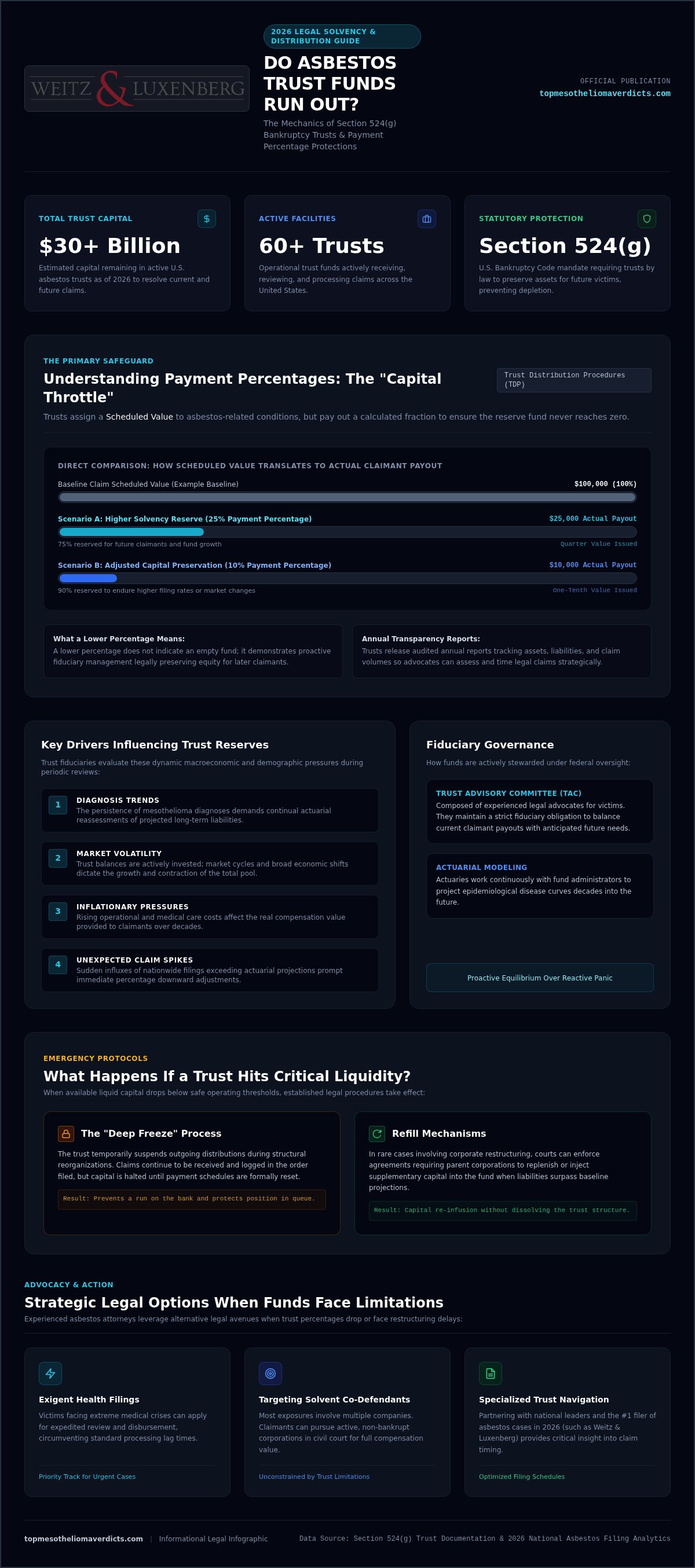
Trusts are overseen by a Trust Advisory Committee (TAC), which typically includes experienced legal advocates for victims. These managers have a fiduciary duty to balance the needs of those filing today with the expected needs of those who will file in the future. They monitor investment performance and claim volumes to maintain financial equilibrium. This professional oversight ensures that the question of what happens if an asbestos trust fund runs out is addressed through proactive financial management rather than reactive panic. Managers work closely with actuaries to predict future claim volumes and adjust strategies accordingly.
Why Solvency Concerns Arise
Concerns about solvency aren't entirely baseless. Several factors can influence the financial health of a trust over time:
- Diagnosis Trends: A persistence in mesothelioma diagnoses requires trusts to re-evaluate their long-term reserves constantly.
- Market Volatility: Since trust assets are invested to grow over time, significant shifts in the economy can impact the total pool of available funds.
- Inflationary Pressures: Rising costs can affect the real value of the compensation offered to victims over many years.
To maintain clarity, these entities release annual transparency reports. These documents provide a detailed window into the trust's financial health, allowing legal professionals to track assets and liabilities. This transparency is vital for families who need to know their path to compensation remains secure despite shifting economic conditions. By monitoring these reports, seasoned advocates can advise you on the best timing for your claim.
Understanding Payment Percentages: The Safeguard Against Depletion
Families often worry about what happens if an asbestos trust fund runs out before they can secure their recovery. The legal system prevents this through a mechanism called the "Payment Percentage." Think of this as a strategic throttle that controls the flow of capital to ensure the fund never hits zero. Every trust assigns a "Scheduled Value" to specific conditions, such as mesothelioma or lung cancer. However, to fulfill the legal mandate of protecting future victims, the trust only pays out a fraction of that value at any given time.
For example, if a claim's scheduled value is $100,000 and the payment percentage is 25%, the claimant receives $25,000. If the percentage drops to 10%, the payout becomes $10,000. While a lower percentage can be frustrating, it doesn't mean the money is gone; it means the fund is being managed for long-term longevity. A GAO report on asbestos trust administration details how these Trust Distribution Procedures (TDP) are essential for balancing the interests of current and future claimants. This proactive management keeps the doors open for everyone who needs help.
What Triggers a Percentage Adjustment?
Trust fiduciaries conduct rigorous annual or semi-annual reviews to assess the fund's health. Several factors can force their hand to adjust the "throttle":
- Unexpected Claim Spikes: If the number of national filings suddenly increases beyond actuarial projections, the trust may lower the percentage to preserve capital.
- Investment Performance: Since these funds are invested in the markets, significant economic downturns can impact the total pool of available money.
- Long-Term Mandates: Trustees are legally required to ensure money is available for claimants who may not be diagnosed for another 40 or 50 years.
Staying informed about these shifts is vital for maximizing your compensation. You can find detailed data on current rates in our Asbestos Trust Fund Payout Percentages: 2026 Compensation Guide.
Can Percentages Ever Go Back Up?
Percentages aren't always on a downward trajectory. If a trust's investment portfolio performs exceptionally well or if claim volumes stabilize, fiduciaries might increase the payout rate. When this happens, many trusts offer "pro-rata" catch-up payments. This means if you previously accepted a 10% payout and the rate increases to 15% later, you might receive an additional check for the 5% difference. It's a complex financial landscape, but having an experienced advocate helps you track these opportunities. You can explore your options for an asbestos trust fund claim to see how current percentages might affect your specific recovery.
What Happens If a Specific Trust Hits Critical Levels?
If a trust's financial reserves fall below a certain threshold, the administrators may initiate a "Deep Freeze." This isn't a permanent closure; it's a strategic suspension of all claim processing and payments. During this period, the trust undergoes a rigorous restructuring to re-calculate its ability to pay future victims. While you may fear what happens if an asbestos trust fund runs out entirely, this suspension is actually a protective measure designed to prevent that exact scenario from occurring. If you have a pending claim, it doesn't disappear. It remains in a queue, waiting for the trust to finalize its new distribution rules.
It's helpful to distinguish between a "Going Concern Trust," which expects to operate for decades, and a "Liquidating Trust." A liquidating trust is specifically designed to distribute its remaining assets and close its doors once the pool is empty. Understanding which type of entity you're dealing with is crucial for setting expectations regarding your recovery. In some rare instances, legal pressure or court orders can lead to "refilling" the trust through additional contributions from a parent company. While this is an exception rather than the rule, it represents a potential avenue for recovery when initial funding proves insufficient.
The Role of Bankruptcy Courts in Fund Exhaustion
When a trust's assets fall dangerously low, bankruptcy courts often intervene to prevent a total collapse. These courts oversee the restructuring process to ensure the entity remains solvent for the long haul. This oversight is the primary answer to what happens if an asbestos trust fund runs out of its projected reserves: the court steps in to recalibrate. Bankruptcy courts prioritize equitable distribution over "first-come" speed to protect those who haven't yet been diagnosed. In extreme cases, a parent corporation might face a secondary bankruptcy if the original trust was drastically underfunded, though the legal hurdles for this are significant.
Exhaustion vs. Low Liquidity
True exhaustion, where a trust has zero dollars, is incredibly rare. Often, the issue is low liquidity rather than a complete lack of assets. A RAND Institute for Civil Justice study highlights that many trusts hold assets in non-liquid forms, such as stocks or real estate, that take time to convert to cash. If a trust faces a liquidity crunch, it may issue "deferred payments." This means you're approved for a specific amount, but the check is delayed until more cash becomes available. For families waiting for urgent medical funding, these delays can be stressful. We work to identify these bottlenecks early, helping you understand the timeline for your specific circumstances.
Strategic Legal Options When Trust Funds Are Limited
If you're worried about what happens if an asbestos trust fund runs out, the most effective response is a multi-pronged legal strategy. You shouldn't rely on a single source of compensation. By filing claims across every trust where your exposure history matches, you diversify your potential recovery. If one trust has a low payment percentage, others might be more robust. This approach ensures that your total compensation isn't tied to the financial health of just one entity.
Speed matters when dealing with fluctuating reserves. For those facing severe health challenges, we utilize "Exigent Health" or "Hardship" filings. These designations move your claim to the front of the line, ensuring you receive funds while they are most needed. You also have a choice between "Expedited Review," which pays a set amount quickly, and "Individual Review." While individual review takes longer, it allows us to present unique evidence, such as secondary exposure or specific occupational hazards, that can lead to a significantly higher payout than the standard scheduled value.
Litigation vs. Trust Claims
Trusts aren't your only option for recovery. Many victims were exposed to products from companies that remain solvent and never filed for bankruptcy. In these cases, traditional mesothelioma litigation allows you to pursue full compensation through the court system rather than a fixed percentage. It's vital to understand the "Set-off" rule, where trust payments may be subtracted from a future jury verdict or settlement. Balancing these paths requires a sophisticated legal touch to ensure you don't inadvertently leave money on the table. For a deeper look at this process, see our Mesothelioma Litigation: 2026 Guide for Families.
Maximizing the Value of Every Claim
Securing the highest possible payout, often referred to as "Level 8" for mesothelioma, requires superior evidence of exposure. We use extensive national databases to track down every job site, shipyard, and consumer product that contributed to your illness. These databases often contain proprietary information about which companies were present on specific sites decades ago. A firm that handles both litigation and trust claims simultaneously provides a distinct advantage; the evidence gathered for a trial often strengthens your trust filings. This dual-track strategy ensures that even if you're concerned about what happens if an asbestos trust fund runs out, your overall recovery remains protected.
If you're ready to explore these strategies and maximize your potential compensation, you should start your asbestos trust fund claim review today to secure your family's future.
How Weitz & Luxenberg Navigates the 2026 Trust Landscape
Weitz & Luxenberg stands as a formidable ally in a legal landscape where financial stability can feel uncertain. As the #1 filer of asbestos injury cases in the U.S. during the first half of 2026, we maintain a deep, real-time understanding of every active trust. While individual victims may worry about what happens if an asbestos trust fund runs out, our 500-person team works daily to monitor these funds' solvency and payment percentages. This massive scale of operations allows us to identify exposure sources and proprietary evidence that smaller, local firms simply don't have the resources to uncover. We use this "inside track" to ensure your claim is positioned for the best possible outcome.
Our national reach is built on 40 years of specialized experience. We've secured over $13 billion in total verdicts and settlements for our clients, providing a level of reliability that only a seasoned leader can offer. Because we track the financial health of over 60 active trusts simultaneously, we can strategically time your filings to maximize your recovery before any potential percentage adjustments occur. We act as your professional guide, leading you through a complex process with a steady hand and a commitment to transparency.
A Proven Track Record of Success
Our strength isn't just in filing trust claims; it's in our ability to win in the courtroom when trusts aren't enough. In 2025, we secured a record $117 million verdict, proving that our litigation team remains an industry powerhouse. This results-driven professional demeanor extends to our infrastructure, which is designed to be "referral-ready" for other firms seeking to maximize their own clients' recoveries through our specialized knowledge. We operate on a contingency-based model, meaning you don't pay any fees unless we secure compensation for you. This approach is central to our commitment to reducing your financial anxiety and protecting your interests.
Protecting Your Family's Future
Securing your place in the current payment queue is the most critical step you can take today. As trusts recalibrate their percentages, those who act quickly often have the best chance of securing a higher share of the available funds. We provide free, low-pressure consultations to families across the country, acting as your seasoned protector through an intimidating legal process. We're here to lead you with a clear sense of purpose and a history of significant achievements. You can protect your rights with a free mesothelioma case evaluation to ensure your family's future is secured by a national leader.
Protecting Your Recovery in a Shifting Legal Landscape
Asbestos trusts are legally mandated to endure, but they are not static. By utilizing payment percentages and periodic restructurings, these funds ensure that compensation remains available for every victim, both now and in the decades to come. Understanding what happens if an asbestos trust fund runs out reveals a system of safeguards designed to prevent total exhaustion while prioritizing equitable payouts for future claimants. Navigating these financial fluctuations requires a partner with the national resources to track every shift in solvency and adjust your legal strategy accordingly.
With over $13 billion in verdicts and settlements secured, Weitz & Luxenberg remains a national leader in asbestos litigation. As the #1 filer of asbestos cases in the U.S. for 2026, we're also ranked as a top choice for complex asbestos referrals nationwide. Our team provides the formidable strength needed to secure your family's future while offering the gentle empathy you deserve during this difficult time. Secure your share of the asbestos trust funds with a free legal review. You don't have to face this complex system alone; a steadier path to justice is within reach.
Frequently Asked Questions
Can an asbestos trust fund actually run out of money completely?
Asbestos trusts are legally structured under Section 524(g) to ensure they never truly hit zero. Instead of running out, a trust will lower its payment percentage to preserve capital for future claimants. This proactive management is the primary answer to what happens if an asbestos trust fund runs out of its immediate liquid reserves. The system is built on long-term solvency; it ensures that every victim receives an equitable share of the available assets regardless of when they file.
What is a payment percentage and how does it affect my claim?
A payment percentage is a tool used by trust fiduciaries to balance the needs of current and future victims. If a trust has a scheduled value of $100,000 for mesothelioma and a 10% payment percentage, you'll receive $10,000. This percentage fluctuates based on the fund's investment performance and the volume of incoming claims. It's a necessary safeguard that prevents a few early claims from depleting the entire pool of money reserved for thousands of families.
If a trust fund is low, should I file a lawsuit instead?
You don't necessarily have to choose one over the other. A comprehensive legal strategy often involves filing trust claims against bankrupt entities while pursuing traditional litigation against solvent co-defendants. Litigation can often secure higher compensation because it isn't restricted by payment percentages. As a national leader that has secured over $13 billion for clients, we identify every available avenue to maximize your recovery, ensuring your family isn't limited by a single trust's financial health.
How long does it take to get a payout from an asbestos trust in 2026?
In 2026, the timeline for receiving a payout depends heavily on the review process you select. Expedited reviews are designed for speed and can often result in a check within a few months of filing. Individual reviews take longer, sometimes a year or more, because they require a detailed assessment of your unique exposure history. Our firm's status as the #1 filer of asbestos cases in 2026 helps us move claims through these systems as efficiently as possible.
What happens if the company that exposed me goes bankrupt while my claim is pending?
If a company files for bankruptcy while your claim is pending, any active litigation against them is typically paused by an "automatic stay." The company then works with the court to establish a new 524(g) trust. Your claim will eventually be transitioned into this trust system. While this may cause a temporary delay, it often creates a more streamlined path to compensation without the need for a lengthy trial against that specific manufacturer or employer.
Can I file claims against multiple asbestos trusts at the same time?
Yes, you can and should file claims against every trust where you have documented evidence of exposure. Most mesothelioma victims were exposed to asbestos from multiple sources, such as insulation, gaskets, and consumer products. Identifying these varied sources is essential for maximizing your total recovery. We use extensive national databases to link your work history to specific trusts, ensuring you receive a share of every fund that shares responsibility for your diagnosis.
Will a trust fund payout be enough to cover my medical expenses?
Trust payouts are intended to provide meaningful financial support, but because they pay a percentage of a claim's value, they may not cover every medical expense alone. This is why we focus on a dual-track approach that includes both trust claims and litigation against solvent companies. Our goal is to secure the maximum compensation possible. With 40 years of experience, we understand how to piece together multiple sources of funding to help alleviate your family's financial burden.
What is the difference between an expedited review and an individual review?
Expedited review offers a fixed payout amount based on your diagnosis, providing a faster path to compensation with less paperwork. Individual review is a more intensive process where fiduciaries examine your specific exposure history and the impact on your life. While individual review takes longer, it can result in a higher payout if we can prove your case exceeds the standard criteria. We help you weigh these options to decide which path best serves your family's needs.
Published by Weitz & Luxenberg, P.C. National Headquarters: 700 Broadway, New York, NY 10003. Call 800-885-MESO. Attorney Advertising. Prior results do not guarantee a future outcome. Certain contentions in blog posts need to be confirmed by a licensed attorney.


