

Did you know that over 60 active asbestos trust funds currently hold an estimated $30 billion in compensation specifically for families who have lost a loved one to toxic exposure? It's a staggering figure, yet many families never realize they have the right to seek justice even after their family member has passed away. If you're currently facing the heavy burden of medical debts and funeral costs, it's important to know that filing asbestos claims after death isn't just a legal option. It's a vital step toward securing your family's financial future and honoring the legacy of the person you lost.
We understand that you're likely feeling emotionally exhausted and perhaps overwhelmed by complex legal terminology. You shouldn't have to navigate this alone. This 2026 guide is designed to clarify your path forward, showing you how to manage the recovery process without added stress. You'll discover how to access significant trust fund payouts, understand current settlement timelines, and utilize a seasoned protector to handle the difficult evidence gathering on your behalf. We'll show you how to hold negligent companies accountable while ensuring your family remains protected and financially stable during this difficult time.
Key Takeaways
- Understand that legal rights do not expire upon a victim's passing, allowing families to pursue justice through survivorship and wrongful death actions.
- Learn how the Personal Representative or Executor of an estate holds the legal standing required to initiate asbestos claims after death on behalf of the deceased.
- Compare the benefits of filing with asbestos trust funds for faster recovery against the potential for higher compensation through civil litigation.
- Discover a clear, low-stress path to compensation that involves gathering medical records and death certificates with the help of specialized legal experts.
- See how partnering with a national firm provides access to specialized experience and a track record of securing billions for families nationwide.
Can You File an Asbestos Claim After a Loved One Has Passed?
Losing a loved one to an asbestos-related disease is a profound tragedy. In the wake of such a loss, many families mistakenly believe that their legal options vanish the moment a victim passes away. That isn't the case. Your right to seek justice remains intact. The legal system allows for asbestos claims after death to ensure that the companies responsible for toxic exposure don't escape accountability just because time has passed. Through the legal concepts of survivorship and wrongful death, the law provides a pathway for families to secure the compensation their loved one was owed.
You might worry that because your family member isn't here to testify about their work history or exposure, the case is impossible to prove. This is a common fear, but it's unfounded. Specialized legal teams use employment records, Social Security statements, and testimony from former coworkers to build a powerful case. We handle the heavy lifting of research and evidence gathering so you can focus on your family. The estate acts as the legal bridge, preserving the rights of the deceased and allowing the family to move forward with a claim.
The Legal Basis for Post-Death Asbestos Claims
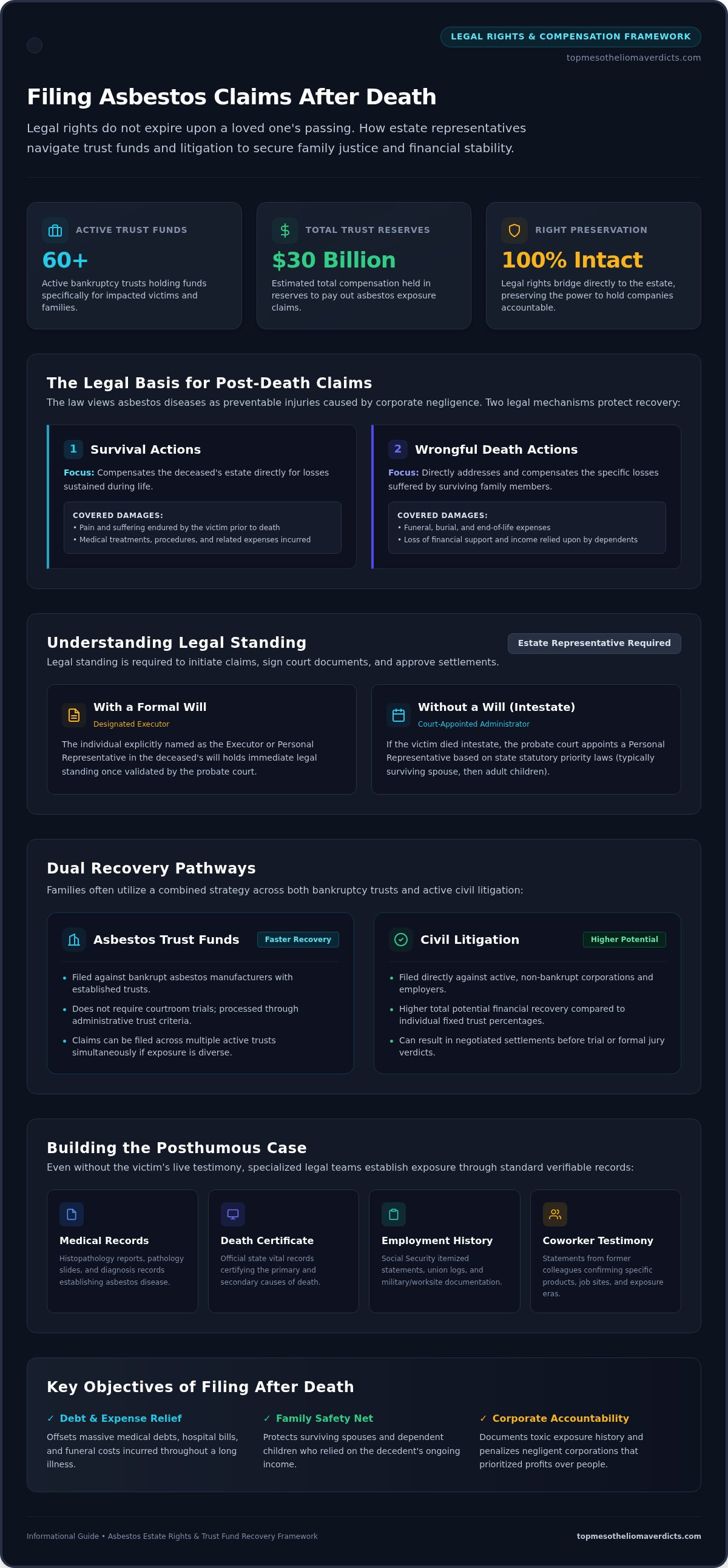
The law views asbestos-related diseases like mesothelioma as entirely preventable injuries caused by corporate negligence. When a victim passes away, their legal rights are preserved through their estate. A wrongful death claim serves as a vital tool for family financial protection, allowing survivors to recover damages for their own losses. While a survival action compensates the estate for the victim's pain and suffering prior to death, a wrongful death action addresses the direct impact on the survivors.
Many families also seek compensation through asbestos bankruptcy trusts, which were specifically established to pay claims to victims and their surviving relatives. These trusts ensure that even if a company has filed for bankruptcy, funds remain available to provide for those affected by their products. This dual approach of trust claims and litigation ensures that all avenues for recovery are explored.
Why Families Choose to Pursue Justice Posthumously
Pursuing a claim is often about more than just financial recovery. It's about securing a legacy and ensuring that the negligence of manufacturers is documented and penalized. Families often face overwhelming medical bills and end-of-life expenses that can threaten their long-term stability. Filing a claim helps to:
- Offset massive medical debts and funeral costs that often follow a long illness.
- Ensure accountability by documenting the corporate negligence that led to the exposure.
- Provide a financial safety net for surviving spouses and dependent children who relied on the decedent’s income.
Taking this step provides a sense of closure. It transforms a tragedy into a catalyst for change, ensuring that those who put profits over people are held responsible for the lives they've impacted. You are not just filing a lawsuit; you are protecting your family's future and honoring the person you lost.
Understanding Legal Standing: Who Can File on Behalf of the Deceased?
When a loved one passes away, the legal right to seek compensation doesn't simply vanish. Instead, it transitions to the estate. Legal standing refers to the specific legal right to bring a lawsuit or a trust fund claim before a court or administrative body. In the context of asbestos claims after death, having standing means you are the person recognized by law as the authorized representative of the person who died. This status is critical. Without it, a court cannot hear the merits of your case. This representative is the only one who can legally sign documents or approve settlements related to asbestos claims after death, making their appointment the first major milestone in your path to justice.
The individual who holds this authority is typically the Personal Representative or the Executor of the estate. If your loved one had a formal will, they likely named someone to this position. If they died without a will, a situation known as dying intestate, the court will appoint a representative based on state priority laws. This process ensures that the claim is managed by someone with the legal duty to act in the best interest of all beneficiaries. We help you navigate this appointment process, ensuring the estate is set up correctly from the start.
The Hierarchy of Eligible Family Members
State laws dictate a specific order of priority for who can file a claim. In almost every jurisdiction, the surviving spouse is the primary claimant. If there's no surviving spouse, the right typically extends to children or other direct dependents. In more complex family structures, the "Next of Kin" might include parents or siblings, depending on the specific statutes of the state where the claim is filed. Understanding legal standing in wrongful death claims is essential for ensuring that the right person leads the litigation to avoid procedural delays. Our team analyzes your specific family situation to determine the most effective way to proceed under local laws.
The Role of the Estate Representative
Processing an asbestos settlement often requires opening an estate through the local probate court. While the word "probate" can sound overwhelming, it's a standard procedural step that provides a clear framework for the litigation. An experienced law firm assists you in navigating these requirements, managing the court filings and ensuring that all documentation is in order. The representative’s primary responsibility is to oversee the claim and eventually distribute the recovered funds to the rightful heirs. They act as the steward of the victim's legacy, ensuring that the compensation reaches those who were most affected by the loss.
At Weitz & Luxenberg, we act as your guide through every step of this process, from initial court appointments to the final distribution of funds. Our goal is to make the journey as low-stress as possible while we work to hold negligent companies accountable. You can explore our notable asbestos case results to see how we have successfully advocated for families across the nation for four decades.
Types of Compensation: Lawsuits vs. Asbestos Trust Funds
Families pursuing asbestos claims after death often find themselves at a crossroads between two distinct legal pathways. It's not an "either-or" situation. Most families should pursue both simultaneously to maximize their financial recovery. Identifying every job site, military installation, and contaminated product your loved one encountered is essential for a successful outcome. This deep research allows us to target both solvent companies and the bankruptcy trusts established by those no longer in business. By casting a wide net, we ensure that every negligent party contributes to your family’s security.
The choice between these paths often depends on the companies involved in the exposure history. While some manufacturers have disappeared into bankruptcy, others remain solvent and can be held directly accountable in court. A seasoned legal protector understands how to navigate both systems, ensuring you don't leave potential compensation on the table. We handle the complex investigative work required to pinpoint these sources, allowing you to focus on healing while we build a formidable case for your family’s future.
Filing a Wrongful Death Lawsuit
A wrongful death lawsuit targets solvent companies that still operate today. These cases are often more complex but can result in the most substantial financial outcomes. In 2026, we continue to see significant jury verdicts as courts hold these manufacturers accountable for their historical negligence. For a detailed breakdown of potential recovery amounts, see our How Much Is a Mesothelioma Settlement Worth? 2026 Compensation Guide. While a negotiated settlement typically takes between 6 and 18 months, a case that goes to trial can take longer. However, the potential for a higher return often justifies the timeline, especially when dealing with companies that knowingly put workers at risk.
Accessing Asbestos Trust Funds After Death
For companies that have filed for bankruptcy, over 60 active trust funds currently hold more than $30 billion in assets. The federal government provides oversight on asbestos injury compensation and trust administration to ensure these funds remain available for surviving family members. For survivors, the process is often more streamlined than a traditional lawsuit. You won't need to step into a courtroom. Instead, we submit evidence of your loved one's diagnosis and exposure history directly to the trusts.
Since many victims were exposed to multiple products, it's common for families to file claims against 15 or 20 different trusts for a single victim. Payout percentages currently range from 4.3% to 50% of a claim's scheduled value, depending on the specific trust's assets. These distributions often begin arriving within 90 days to six months, providing relatively rapid financial relief for families facing immediate end-of-life expenses. This dual approach ensures that your asbestos claims after death cover every possible avenue of justice.
The Step-by-Step Process of Filing a Claim After Death
Filing for compensation while grieving is a heavy task, but the process is structured to lift the burden from your shoulders. It begins with a comprehensive consultation and case evaluation with an asbestos specialist. During this initial phase, we listen to your story and determine the most effective path for your family. There's no cost and no pressure; our goal is to act as your seasoned protector from the very first conversation. Once we establish the framework of your case, we move quickly to gather essential documentation, including medical records and the death certificate. These documents serve as the foundation for all asbestos claims after death, providing the clinical proof required by courts and trust funds alike.
The middle stages of the process involve deep investigative work and formal action. Our team reconstructs your loved one’s work history to identify specific exposure sites, often looking back 40 or 50 years. After we pinpoint the responsible parties, the estate’s Personal Representative formally files the claim or lawsuit. We manage every legal filing and court appearance, allowing you to focus on your family's healing. The final step is the negotiation and distribution of the settlement or award. We fight for the maximum recovery possible, ensuring that the funds are distributed to beneficiaries according to the law and the victim’s wishes.
Proving Exposure Without the Victim’s Testimony
A common concern for families is how to prove where exposure happened without the victim's own words. We solve this through meticulous research. Our investigators use Social Security earnings records and detailed employment histories to map out every job site. We also rely on the power of co-worker testimonies and union records. Often, colleagues who worked alongside your loved one can provide the specific details needed to confirm the presence of asbestos products. By using these external sources, we build a compelling case that doesn't require the victim to be present to achieve justice.
Managing the Statute of Limitations
In the legal world, time is your most significant hurdle. For wrongful death actions, the "clock" usually starts ticking on the date of death, not the date of the original diagnosis. Most states provide a window of only 1 to 3 years to file a claim. If you miss this deadline, your right to seek compensation may be lost forever. This is why seeking legal counsel immediately is vital. You can learn more about these specific requirements in our guide on How to File a Wrongful Death Mesothelioma Claim: A 2026 Family Guide. Don't let corporate negligence go unpunished because of a missed deadline; request a free case evaluation today to protect your family's rights.
Why Choosing a National Asbestos Law Firm Matters for Families
The complexity of asbestos claims after death requires more than just local legal knowledge. It demands a powerhouse with a national reach. Weitz & Luxenberg has secured over $13 billion in verdicts and settlements over 40 years of specialized experience. We were ranked as the #1 filer of asbestos injury cases in the U.S. for the first half of 2026. This scale of operation isn't just a statistic; it's a direct advantage for your family. A firm with this level of resources can stand up to massive corporations and their legal teams without flinching, ensuring your voice is heard in a system that often feels stacked against individuals.
We operate on a strict contingency basis. This "No-Win, No-Fee" promise means that grieving families never face financial risk when pursuing justice. You pay nothing unless we secure a recovery for you. This approach removes the burden of legal costs, allowing you to focus on what matters most during a difficult time. Our established history of significant achievements, including a record $117 million verdict in 2025, provides the confidence you need to move forward with a claim.
Tracking Exposure Across State Lines
Asbestos exposure rarely happens in just one place. A victim might have worked in shipyards on the East Coast, factories in the Midwest, and retired in the South. A national firm maintains a massive database of thousands of job sites across all 50 states. This allows us to track exposure history with a level of precision that a local firm simply cannot match. We don't just look at where you live now; we look at where the negligence occurred.
Our ability to file in the most favorable jurisdiction is a key factor in maximizing your recovery. Statutes of limitations and historical verdict trends vary significantly by state. With a team of over 500 professionals, we ensure that every granular detail of your loved one's history is investigated. We choose the venue that offers the most effective path to justice, rather than being restricted by geographic boundaries. This broad reach is vital for building the strongest possible case for your family.
A Compassionate, Low-Stress Legal Experience
Our "Protector" philosophy defines how we interact with our clients. We act as your professional guide, leading you through an intimidating process with a steady hand and a clear sense of purpose. We handle all the research, court filings, and evidence gathering so you don't have to. This means you won't spend your time digging through old records or navigating complex probate requirements alone.
We've streamlined our process to be as low-pressure as possible. We offer remote consultations and digital document gathering to ensure you can manage your case from the comfort of your home. Justice is still possible, even decades after the initial exposure or years after a loved one has passed. We are here to ensure that your family’s future is secure and that the companies responsible for your loss are held fully accountable.
Securing Your Family’s Legacy and Future
Taking the first step toward justice is a powerful way to honor your loved one's memory while protecting your family's financial stability. You've learned that legal rights don't expire upon death and that the estate can hold negligent manufacturers accountable through asbestos claims after death. By choosing a national leader with the resources to track exposure across state lines, you ensure that no detail is overlooked in your pursuit of a settlement. We act as your seasoned protector, leading you through every legal hurdle with a steady hand and a clear sense of purpose.
Weitz & Luxenberg stands as the #1 filer of asbestos injury cases in 2026; a position built on 40 years of specialized experience and over $13 billion secured for our clients. Our contingency model ensures that you face zero financial risk because there are no fees unless we win your case. You don't have to carry this burden alone. We invite you to Request a Free, No-Obligation Case Review with Weitz & Luxenberg to begin your journey toward resolution. Justice is still within reach, and your family's security remains our highest priority.
Frequently Asked Questions
Is there a time limit to file an asbestos claim after someone dies?
Yes, every state enforces a statute of limitations for wrongful death actions. These deadlines typically range from one to three years starting from the date of death. Because these laws vary significantly across the country, it's vital to consult a national firm immediately. Failing to file within this window can permanently bar your family from seeking justice. We help you identify the correct jurisdiction to ensure your claim is protected.
Can I still file a claim if my loved one never filed while they were alive?
You absolutely can initiate a claim even if your loved one didn't start the process during their lifetime. Many asbestos claims after death are filed by surviving family members who only discover the link between exposure and illness later. The legal system allows the estate's Personal Representative to step in and seek the compensation the victim was rightfully owed. We handle the complex research required to build the case from scratch.
How long does an asbestos claim take to pay out after a death?
Payment timelines depend on the type of claim you pursue. Distributions from asbestos trust funds often begin within 90 days to six months of filing. Negotiated settlements with solvent companies generally take between six and 18 months to resolve. If a case goes to trial, the process can extend to two years or more. Our goal is to secure your family’s financial stability as efficiently as possible while maximizing the total recovery.
Do I need to prove exactly where my family member was exposed to asbestos?
Identifying the specific source of exposure is required, but you don't have to do this work alone. Our investigators use a massive national database to track down contaminated products and job sites from decades ago. We utilize Social Security records, union files, and testimony from former colleagues to pinpoint the responsible parties. Even if your loved one isn't here to testify, we can reconstruct their history to prove exactly where the negligence occurred.
What documents do I need to start an asbestos claim for a deceased relative?
You'll need a few foundational documents to begin the process for asbestos claims after death. The most critical items include the death certificate and medical records confirming an asbestos-related diagnosis. Additionally, any available employment records or military discharge papers are helpful. Don't worry if you don't have everything right now. Our team assists you in gathering these files and navigating the probate court requirements to establish legal standing for the estate.
Will our family have to go to court for a wrongful death asbestos claim?
It's highly unlikely that your family will ever need to step into a courtroom. The vast majority of wrongful death asbestos cases result in out-of-court settlements. Claims filed against asbestos trust funds are purely administrative and never involve a trial. We prepare every case as if it's going to court to ensure maximum leverage during negotiations. Our primary focus is achieving a high-value resolution with minimal stress for your family during this difficult time.
How are asbestos settlements divided among family members?
Distribution is governed by state probate laws and the specific terms of the victim's estate plan. Generally, the recovered funds are divided among the surviving spouse and dependent children. The Personal Representative of the estate has a legal duty to ensure the money is distributed fairly to all eligible beneficiaries. We work closely with the estate's representative to ensure the process is transparent and that all legal requirements for lien resolution are handled correctly.
Can I file a claim if my loved one died from lung cancer, not mesothelioma?
Yes, you can pursue compensation for lung cancer if there's evidence of asbestos exposure. While mesothelioma is the most well-known asbestos-related disease, the mineral is also a leading cause of lung cancer. Our firm has extensive experience in asbestos lung cancer litigation, helping families hold manufacturers accountable for these preventable illnesses. If your loved one worked in a high-risk industry and developed lung cancer, you may have a valid claim for significant financial recovery.


