

Could decades-old shipyard work or military service still support a legal claim, even if records are incomplete? A shipyard asbestos exposure claim may be an option for someone diagnosed with mesothelioma or asbestos-related lung cancer whose work or service history involved possible asbestos exposure. Ship construction, repairs, and other work on older ships could expose workers to asbestos, but recalling the details years later can be difficult.
Missing employment, service, or product records do not necessarily tell the whole story or determine whether you have a claim. A legal review can start with the information you do have: your work history, the ships or facilities involved, possible exposure circumstances, and medical records.
This article explains which shipyard jobs and circumstances may be relevant, what information can help an attorney assess your situation, and how lawsuits differ from asbestos trust fund claims. It also covers why filing deadlines vary and why prompt legal guidance matters. You’ll have a practical starting point for organizing your records and discussing your options with an asbestos legal team.
Key Takeaways
- Asbestos exposure could have occurred during ship construction, repair, maintenance, or overhaul, though conditions varied between shipyards.
- A shipyard asbestos exposure claim may involve a lawsuit, an asbestos trust fund claim, or a review of more than one potential route.
- Start organizing diagnosis records and details about your employers, job duties, ships, and any products you remember.
- Missing records do not necessarily prevent an initial legal discussion. Available information can help an attorney assess your circumstances.
- A free, confidential consultation with Weitz & Luxenberg can help you discuss potential claim routes, deadlines, and contingency representation terms.
Shipyard Asbestos Exposure Claims: Where the Risk Could Begin
A shipyard asbestos exposure claim is a potential legal claim by someone diagnosed with an asbestos-related illness whose exposure history may be connected to shipyard work or service. A history of possible exposure can guide a legal review, but it does not by itself establish eligibility. The medical diagnosis and the facts about a person’s exposure are assessed separately.
Asbestos was valued for its heat resistance and insulating properties, and historically appeared in some materials used in ships and industrial settings. Depending on a vessel’s age and the work performed, asbestos-containing materials may have been present around insulation, boilers, piping, or machinery. Conditions differed among ships and shipyards, so a job title or workplace alone cannot establish exposure. The Asbestos overview describes the mineral’s history, uses, and health effects.
How asbestos exposure could occur in shipyards
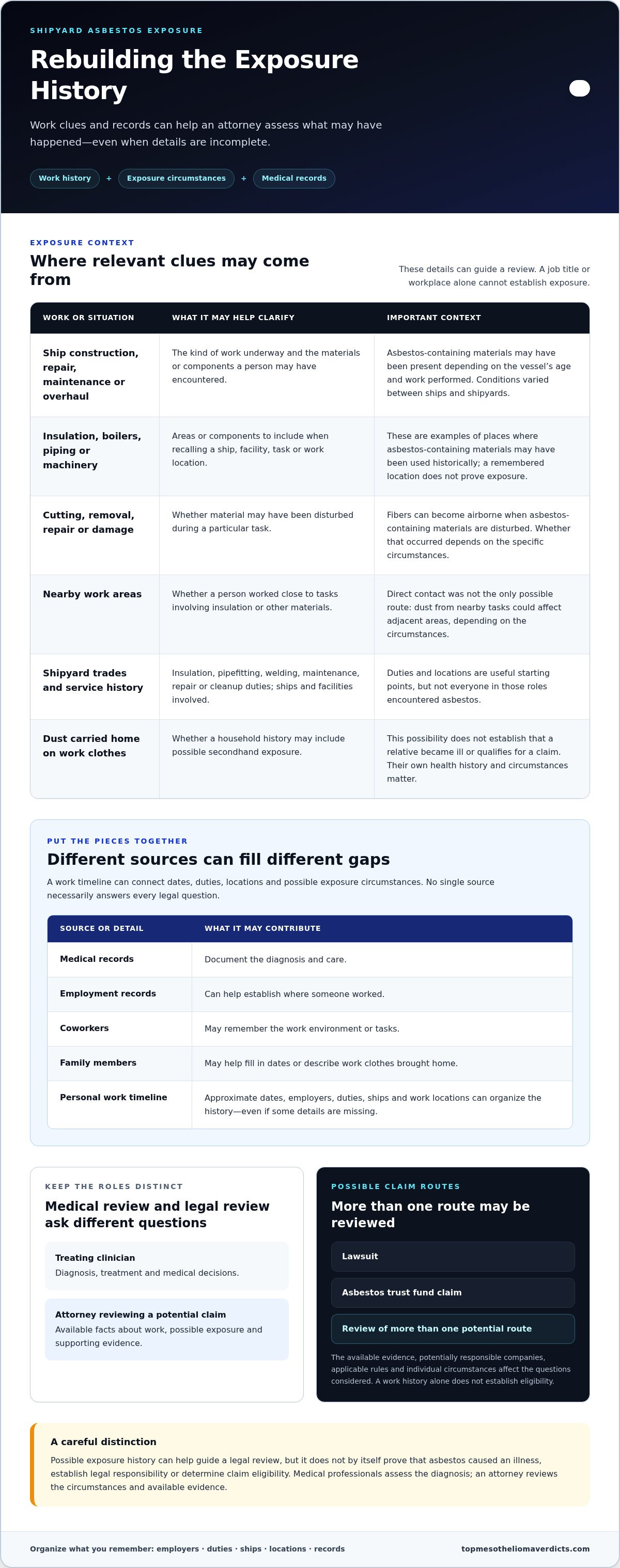
Fibers can become airborne when asbestos-containing materials are cut, removed, repaired, damaged, or otherwise disturbed. During repair or overhaul, for example, workers might have encountered dust while insulation or nearby components were being handled. Direct contact with the material was not the only possible route: workers in adjacent areas could also have been exposed to dust from nearby tasks. Whether that happened depends on the specific circumstances.
Which shipyard roles may be relevant to an exposure history?
An attorney reviewing a potential claim may ask about work involving insulation, pipefitting, welding, maintenance, repair, or cleanup. Shipyard trades and military or other service histories can help establish where and when someone worked, what tasks they performed, and which vessels or facilities they remember. These details are useful starting points, but they do not mean everyone in those roles encountered asbestos.
Household history may also be relevant. After certain shipyard tasks, a worker’s clothing could carry dust home, potentially exposing family members. That possibility does not establish that a relative developed an asbestos-related illness or qualifies for a claim. A review considers the person’s own health history and the circumstances of any possible secondhand exposure.
If you are unsure what materials were present or cannot recall every job detail, write down what you do remember: approximate dates, employers, duties, ships, and work locations. These details can help organize an exposure history for legal review, even when they do not answer every question.
How Shipyard Work and Asbestos-Related Illness Connect
An asbestos-related illness may be diagnosed long after a person’s shipyard work has ended. The interval between exposure and diagnosis varies, and there is no single timeline that applies to everyone. For health concerns, rely on your treating clinician for diagnosis, treatment, and medical decisions. A legal review serves a different purpose: it examines the available facts about your work and possible exposure.
Mesothelioma and asbestos-related lung cancer are among the conditions relevant to asbestos litigation. A history of possible exposure does not, by itself, prove that asbestos caused an illness or establish legal responsibility. Medical professionals assess the diagnosis, while an attorney reviews the circumstances and evidence related to a potential claim.
Why a diagnosis may follow shipyard exposure years later
The time between historical work and a diagnosis can make it difficult to connect present-day questions with old jobs or ships. Medical records can document the condition, but may not describe where or how exposure could have occurred. Keep medical questions with your care team, and share relevant work history with an attorney reviewing a shipyard asbestos exposure claim. Each part of the review addresses a different question.
What makes shipyard exposure histories complex?
Over a career, a person may have worked for different employers, on different ships, or in several trades and facilities. Product names and task details can be hard to recall years later, and records may be incomplete. A work timeline can connect dates, job duties, locations, and possible exposure circumstances into a clearer account.
Useful context may come from more than one source. Coworkers may remember the work environment or tasks, while family members may help fill in dates or describe work clothes brought home. Employment records can help establish where someone worked, and medical records document diagnosis and care. No single source necessarily answers every legal question, but together these details may help an attorney assess the available facts.
OSHA’s OSHA Asbestos Standard for Shipyards sets out requirements concerning asbestos in shipyard employment. It provides regulatory context, but does not determine whether a particular person was exposed or qualifies for a claim. To learn more about how a work history may relate to a potential case, you can explore asbestos-related legal claims.
Shipyard Asbestos Claim Options: Lawsuits and Trust Fund Claims
A shipyard asbestos exposure claim may involve a lawsuit, a claim with an asbestos trust fund, or a review of more than one potential route. The relevant questions depend on the available evidence, potentially responsible companies, applicable rules, and your circumstances. A shipyard work history alone does not establish eligibility or guarantee a particular outcome.
| Consideration | Lawsuit | Trust fund claim |
|---|---|---|
| How it works | A civil claim may seek to hold potentially responsible parties legally accountable. | A claim is submitted to an established asbestos trust under that trust’s procedures. |
| What may be reviewed | Diagnosis, exposure evidence, potentially responsible companies, and applicable law. | Whether the person and exposure history meet the trust’s specific criteria and documentation requirements. |
| Key point | Responsibility and available legal options depend on case-specific facts. | Each trust has its own process. A shipyard connection alone does not establish eligibility or recovery. |
When a shipyard exposure lawsuit may be considered
A legal review may examine the diagnosis, when and where exposure could have occurred, the person’s job duties, and whether evidence identifies potentially responsible companies. It also considers which laws apply. These questions require an assessment of the individual facts. A past employer or product should not be assumed responsible without supporting evidence. A civil lawsuit is distinct from workers’ compensation administrative filings.
How asbestos trust fund claims may differ
Some companies established trusts to address asbestos claims. Each trust has its own criteria, procedures, and documentation rules. Weitz & Luxenberg handles asbestos trust fund claims and can assess whether the available work and medical history may fit a trust’s requirements, alongside any potential litigation route. Eligibility and payment are not automatic. For more detail, read this asbestos trust fund guide, and explore the broader context in this mesothelioma litigation guide.
A person’s history may involve multiple ships, employers, or possible exposure sources, so comparing options calls for a fact-specific review. Gathering the details you know can help an attorney discuss which routes, if any, warrant further evaluation.
What Evidence Can Help With a Shipyard Asbestos Claim?
You do not need to reconstruct every detail before discussing a potential shipyard asbestos exposure claim. Start with the records you have and the details you remember. An attorney can assess the available information and identify what may help clarify your work history and possible exposure.
Build a timeline from work, service, and medical records
Use this checklist as a starting point. Approximate dates are useful, but do not fill gaps by guessing.
- Diagnosis and treatment: Set aside medical records documenting your diagnosis and care.
- Work and service timeline: Note approximate dates, employers, job titles, and shipyard or other work locations.
- Job duties: Describe tasks you remember, such as repair, maintenance, pipefitting, or cleanup.
- Ships and projects: List vessel names, overhaul periods, or project details if you recall them. Partial memories can still provide leads.
- Products and materials: Write down any product names or materials you remember. It is fine if you cannot identify them.
Keep medical and treatment records together, separate from your occupational timeline. Employment documents, union or service records, photographs, and recollections from coworkers or family may add context. Bring what is available rather than waiting until you have collected every possible record.
What if shipyard records or product names are missing?
Old records may be incomplete, and product names can be difficult to recall after many years. That uncertainty does not automatically determine whether a claim is possible. An attorney can assess existing documents, witness accounts, and other available evidence to determine what may help clarify your history.
Preserve documents you already have, including photographs and employment or service papers. Keep originals unchanged, and share copies when possible. If a record is missing, note what you know and distinguish it from what you are unsure about. A careful account of gaps is more useful than trying to make the history sound complete.
Filing deadlines and other legal rules vary by jurisdiction and claim type. Some deadlines may depend on diagnosis or death, and asbestos trusts may have separate procedures and time limits. Do not rely on a general timeline to judge your situation. A prompt, individualized legal review can help clarify which rules may apply to your circumstances.
If you have received an asbestos-related diagnosis and want to discuss your records and work history, DIAGNOSED? CALL 1-800-885-MESO TODAY FOR A CONFIDENTIAL & FREE CONSULTATION.
Discuss Your Shipyard Asbestos Exposure Claim With Weitz & Luxenberg
A free, confidential consultation gives you a chance to discuss a possible shipyard asbestos exposure claim and ask what may happen next. Weitz & Luxenberg represents people with mesothelioma and asbestos-related lung cancer in litigation and asbestos trust fund claims nationwide. The legal team can listen to your diagnosis, work or service history, possible exposure sources, and questions, then discuss whether further review may be appropriate. A consultation is not a promise of eligibility or a particular outcome.
What to prepare before a confidential consultation
Bring any diagnosis or treatment information you have, along with a simple outline of shipyard or service work. If possible, jot down:
- Employers, approximate dates, job titles, and duties
- Ships, shipyards, facilities, or repair projects you remember
- Materials or product names you encountered, if known
- Coworkers or others who may recall the work or conditions
Your notes do not need to be complete. If records are missing or details are uncertain, share what you remember and identify what you are unsure about. This can help the legal team understand what information may be available to assess your history.
What happens after you reach out?
The legal team can review the information you share and discuss potential litigation or trust fund claims based on your individual circumstances. Any potential route depends on the facts, available evidence, and applicable rules. You can also ask how the firm’s contingency representation works. Before deciding whether to proceed, review the written fee arrangement and ask about the terms for your case, including how fees and any costs are handled. Details may differ by matter.
Weitz & Luxenberg represents people affected by asbestos-related diseases. A conversation can help you understand what a legal review may involve, even if you do not have every old record or product name. There is no guarantee of a claim or recovery, but you can raise your concerns and learn about potential next steps.
DIAGNOSED? CALL 1-800-885-MESO TODAY FOR A CONFIDENTIAL & FREE CONSULTATION
Take the Next Step Toward Understanding Your Options
A shipyard asbestos exposure claim review starts with the details you can piece together, not necessarily a complete archive of old records. Your work or service history, possible exposure circumstances, and medical diagnosis may help an attorney assess whether litigation, an asbestos trust fund claim, or another available route warrants further consideration. Eligibility and filing deadlines depend on individual facts and applicable rules, so do not assume a general timeline applies to you.
Weitz & Luxenberg represents people with mesothelioma and asbestos-related lung cancer nationwide. A free, confidential consultation gives you an opportunity to discuss your diagnosis, work history, possible exposure sources, and questions. The firm represents clients on a contingency basis. Review the written fee arrangement and case-specific terms before deciding how to proceed. A consultation does not guarantee eligibility or a particular result, but it can help you understand potential next steps.
DIAGNOSED? CALL 1-800-885-MESO TODAY FOR A CONFIDENTIAL & FREE CONSULTATION
You do not have to resolve every uncertainty before asking questions. A clear conversation can be a practical first step toward understanding your options.
Frequently Asked Questions
Can I file a shipyard asbestos exposure claim if the exposure happened decades ago?
Possibly, but the time since exposure does not determine eligibility by itself. Some asbestos-related diseases are diagnosed long after exposure, and a shipyard asbestos exposure claim may merit review even when the work occurred decades ago. Filing deadlines vary by state and claim type. Personal injury lawsuit limits commonly run from diagnosis, while wrongful death deadlines generally run from death. Which state’s law applies can depend on the exposure history, so seek individualized legal guidance promptly.
What shipyard jobs may have involved asbestos exposure?
Possible work histories include insulation work, pipefitting, welding, ship repair, maintenance, overhaul, and cleanup. Historically, asbestos-containing materials were used in some heat-resistant ship components, so tasks that disturbed insulation or work nearby may be relevant. Exposure conditions varied, and a job title alone does not prove someone encountered asbestos. A review may consider your duties, work locations, vessels, dates, and the materials or dust you remember.
Do I need old shipyard records to make an asbestos claim?
No. Missing employment or shipyard records do not necessarily prevent you from starting a legal discussion. A timeline based on approximate dates, employers, duties, ships, and facilities can provide useful leads. Medical files, service or union records, photographs, and recollections from coworkers or relatives may also add context. Share what you have and be clear about what you are unsure of. An attorney can assess the available information.
Can a shipyard asbestos claim involve an asbestos trust fund?
It may. An attorney can review potential litigation and claims involving established asbestos trusts for someone with an asbestos-related illness. Each trust has its own criteria, documentation requirements, and procedures, so a shipyard history alone does not establish eligibility or guarantee payment. Which routes may be available depends on the evidence, potentially responsible companies, applicable rules, and the individual’s circumstances. Weitz & Luxenberg handles asbestos trust fund claims and can discuss whether a trust fund review may be appropriate.
Can veterans file a claim for asbestos exposure connected to shipyard service?
Veterans may discuss a potential asbestos-related legal claim if their service history involved possible exposure and they have a relevant diagnosis. Military service or work aboard a ship does not automatically establish exposure, eligibility, or legal responsibility. A review may consider the vessels, duties, dates, diagnosis, available records, and applicable laws. Keep service records if available, but incomplete paperwork does not have to stop you from asking an attorney about a case review.
What compensation can a shipyard asbestos exposure claim provide?
There is no guaranteed amount or outcome. Depending on the facts, applicable law, and claim route, compensation may address losses such as medical expenses, lost income, and the effects of illness. A lawsuit and an asbestos trust fund claim follow different processes, and any recovery depends on the evidence and decision-makers involved. An attorney can explain which forms of compensation may be considered in your circumstances without promising eligibility or a particular result.
Do I have to go to trial to pursue a shipyard asbestos claim?
No. Pursuing a lawsuit does not automatically mean the case will go to trial. Some cases resolve through settlement, while others may proceed in court. Whether settlement is possible depends on the case and the parties involved, and no outcome can be guaranteed. Trust fund claims generally follow the trust’s own review process rather than a trial. An attorney can explain potential paths and discuss significant decisions with you as the case develops.
Disclaimer
Published by Weitz & Luxenberg, P.C. National Headquarters: 700 Broadway, New York, NY 10003. Call 800-885-MESO. Attorney Advertising. Prior results do not guarantee a future outcome. Certain contentions in blog posts need to be confirmed by a licensed attorney.


