

What does the “average wrongful death mesothelioma settlement” actually tell a family? Some published estimates place the average between $1 million and $1.4 million, while other reported ranges are higher. These figures can be hard to compare because they may use different cases and calculation methods. None guarantees what a particular family will recover.
It’s understandable to look for a clear number while facing grief, financial questions, and unfamiliar legal decisions. An average can offer context, but it can’t account for the facts that shape an individual claim. This article explains how to interpret settlement estimates and what may affect an evaluation of your family’s potential compensation.
Factors may include evidence of asbestos exposure, the deceased person’s losses and family circumstances, and the law that applies. You’ll also learn how wrongful-death lawsuits differ from other mesothelioma claims, what records may help explain a claim, and how an individualized legal review can clarify potential pathways without treating any outcome as certain.
Key Takeaways
- Use the average wrongful death mesothelioma settlement as context, not a forecast. The mean and median can describe the same group of cases differently.
- Learn how exposure evidence and documented family losses may shape a claim under applicable state law.
- Compare lawsuits, trial verdicts, and asbestos trust fund claims. They involve different processes and should not be treated as interchangeable.
- Gather available medical records, work and exposure history, and basic family documentation at a pace that feels manageable.
- Mesothelioma counsel can review the evidence and help identify potential defendants and legal pathways.
What Does an Average Wrongful Death Mesothelioma Settlement Actually Mean?
The phrase average wrongful death mesothelioma settlement can sound like a guide to what a family might receive. But an average summarizes a specific group of cases using a particular method. Unless you know which cases were included and how the figure was calculated, it may tell you little about an individual claim.
Two common measures can tell different stories. The mean is calculated by adding all the amounts in a dataset and dividing by the number of outcomes. The median is the middle amount when outcomes are ordered from lowest to highest. A few unusually large outcomes can raise the mean, while the median may stay closer to the midpoint. Neither measure predicts the result for a particular family.
An average is useful only when the cases behind it are comparable. For instance, a dataset that combines wrongful-death lawsuits with claims brought by people living with mesothelioma may not describe either type of claim well. Figures that mix diagnoses, time periods, or outcomes, such as negotiated settlements and trial verdicts, have the same limitation.
Why wrongful-death mesothelioma settlement figures vary
Published figures may not identify their source, sample size, or calculation method. Settlement terms are often confidential, so many settlements may not appear in public records or datasets. Publicly available cases may therefore show only part of the picture. Treat a published number as uncertain context, not a dependable estimate of what a family will receive.
A wrongful-death claim is generally brought by eligible survivors after a person’s death, but the legal basis and available damages depend on applicable law. The Wrongful death claim overview provides foundational context. The rules that apply to a particular family require a case-specific legal review.
Settlement averages, individual claims, and firm-wide recoveries are different
A dataset average describes only the cases included in that dataset. An individual claim turns on its own facts and evidence, so applying a broad average to one family can create false expectations. A review of the available exposure history, records, and legal options is more useful than treating a headline figure as a forecast. For a broader explanation of the process, explore this mesothelioma litigation resource.
Firm-wide verdict and settlement totals are different, too. They may combine many cases, claim types, and circumstances over time. An aggregate recovery cannot establish a typical result or predict what a wrongful-death claim may be worth. Families need an individualized assessment that explains what is known, what remains uncertain, and why.
Which Factors Can Shape a Wrongful Death Mesothelioma Settlement?
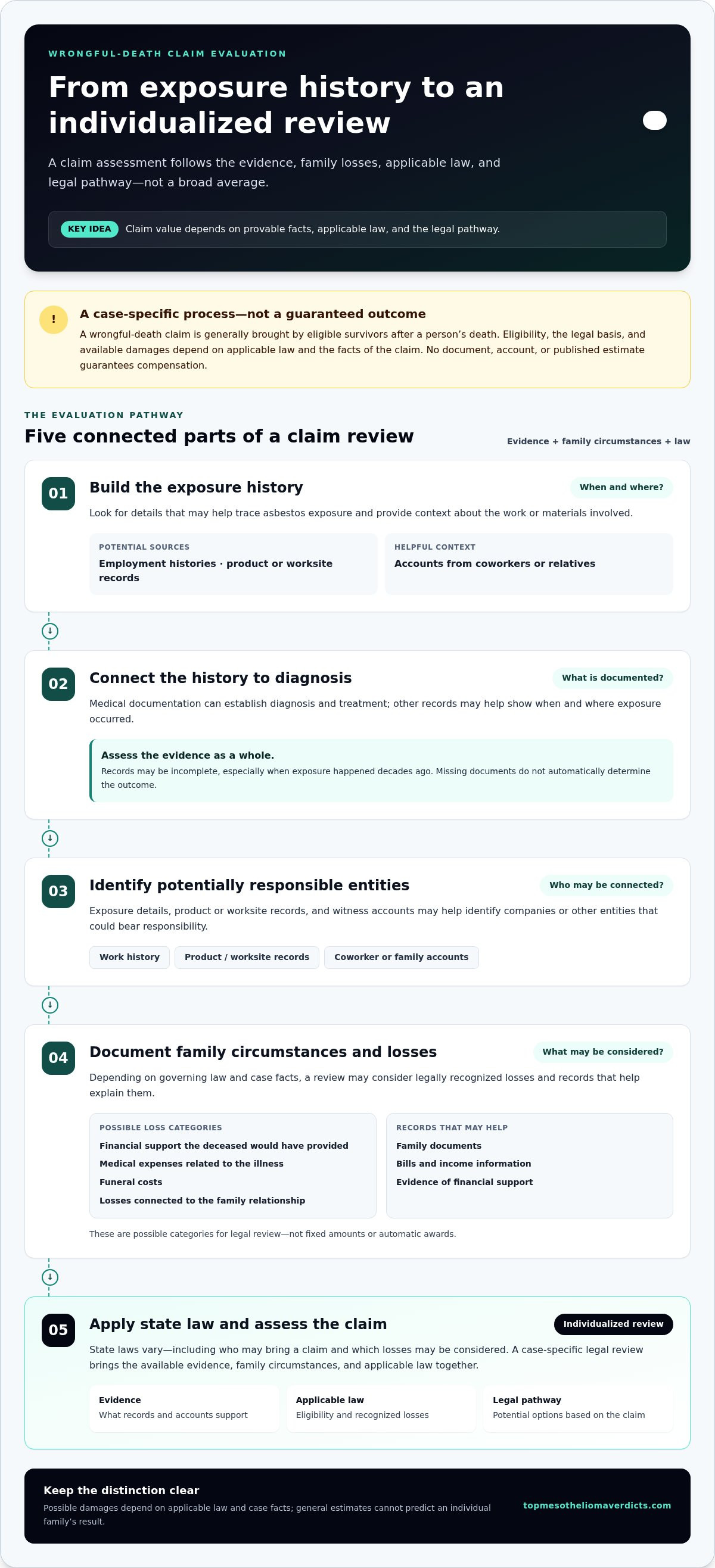
Every family’s history is different. An evaluation may examine how the person encountered asbestos, whether the available evidence connects that exposure to mesothelioma, which companies or other entities may be responsible, and what losses the family can document. The law that applies also matters. Claim value depends on provable facts, applicable law, and the legal pathway.
Exposure records, diagnosis, and responsible parties
Evidence can help build a timeline from exposure to diagnosis and identify entities that may bear responsibility. Useful sources may include employment histories, product or worksite records, medical records, and accounts from coworkers or relatives. Records may be incomplete, particularly when exposure occurred decades ago. Missing documents do not automatically determine the outcome; the available evidence must be assessed as a whole.
Details that seem ordinary on their own may add useful context. A job title, for example, may not show which materials a person handled. A coworker’s recollection or a product record might help clarify that history. Medical documentation can establish diagnosis and treatment, while other records may help show when and where exposure occurred. No single document or account guarantees compensation.
Family circumstances and legally recognized damages
Wrongful-death laws vary by state, including who may bring a claim and which losses may be considered. Depending on the governing law and case facts, damages may include financial support the deceased would have provided, medical expenses related to the illness, funeral costs, or losses connected to the family relationship. These are possible categories for legal review, not fixed amounts or automatic awards.
Family documents can help establish relationships and financial circumstances. Bills, income information, and evidence of support may help explain losses, though the relevance of each item depends on the claim and applicable law. An individual family’s circumstances should be reviewed on their own facts, not measured against a general formula.
Articles about settlements for people living with mesothelioma may focus on diagnosis stage and the person’s circumstances while pursuing a claim. A wrongful-death claim arises after the person has died, and eligibility and damages are governed by the applicable law. The Stage 4 settlement guide addresses settlement discussions involving diagnosis stage. It is not a substitute for evaluating a family’s wrongful-death claim.
Sorting through records while grieving can feel overwhelming. Start with what is readily available. An individualized review can help identify relevant evidence, potentially responsible parties, and possible legal options. Learn about mesothelioma claim review as one way to understand the legal process.
How Settlements Compare With Verdicts and Other Asbestos Compensation
Mesothelioma-related compensation may involve different legal pathways, and their outcomes are not interchangeable. A negotiated settlement, a trial verdict, and an asbestos trust fund payment each involve different decision-makers and procedures. This matters when interpreting an average wrongful death mesothelioma settlement: figures from one pathway do not automatically describe results from another.
| Pathway | Who determines the outcome? | Public visibility | Can outcomes vary? |
|---|---|---|---|
| Negotiated settlement | The parties agree to resolve a claim | Terms are often confidential | Yes. Terms depend on the case and negotiations |
| Trial verdict | A judge or jury decides after trial | Court decisions may be publicly accessible | Yes. Decisions depend on evidence, legal issues, and the case |
| Asbestos trust fund claim | An established asbestos bankruptcy trust reviews the claim under its procedures | Individual payment details may not appear in the same public records as court decisions | Yes. Trust requirements and claim evidence can differ |
Settlement versus trial verdict
A settlement is reached through negotiation. A verdict is a decision made after a case goes to trial. A verdict is not a negotiated settlement or a guaranteed payment. It may be challenged or appealed, which can affect the final outcome or timing. A trial does not necessarily produce a larger recovery or resolve a case faster. The result depends on the evidence, applicable law, and what happens after the decision.
The choice is not simply a question of which route might yield more. Both involve uncertainty, and a public verdict does not show what a different case would achieve. A legal review can clarify the available options and relevant considerations without promising a particular result.
Civil claims versus asbestos trust fund claims
Asbestos trust fund claims are submitted to trusts established through asbestos-related company bankruptcies. They are distinct from lawsuits against potentially responsible entities. A family may have questions about more than one pathway, but whether claims can proceed and how they should be coordinated depends on the facts and applicable law. Understanding those differences is important before combining figures or estimating total compensation.
Trust payments and lawsuit settlements or verdicts should not be added together to create a single “average” without understanding what the figures represent. They come from different processes, use different decision criteria, and may be reported differently. The asbestos trust fund payout guide discusses this separate compensation pathway. An individualized legal assessment can help families understand which routes may apply and how they relate to one another.
What Families Can Prepare Before Assessing a Potential Claim
You do not need a complete file to begin exploring possible next steps. Gather what is readily available at a pace that feels manageable. Records can help explain the person’s diagnosis, work and exposure history, family relationships, and financial losses. Missing paperwork should not prevent you from seeking individualized guidance.
Records that may help explain your family’s situation
A simple folder or list can help keep information organized. Start with what you have and add details later:
- Medical information: Available records showing the mesothelioma diagnosis, treatment, and related medical expenses.
- Death documentation: A copy of the death certificate, if available.
- Work history: Employers, job titles, approximate dates, worksites, and duties. Old résumés, union records, pay stubs, or coworker names may help fill in details.
- Possible exposure details: Products, materials, locations, or activities the person may have encountered at work or elsewhere. If the source is unknown, note what family members remember without guessing.
- Family and financial records: Basic documents showing family relationships and, if available, information about household support, income, funeral expenses, or other losses.
These are starting points, not requirements for an initial discussion. Exposure may have happened long before diagnosis, and families may not know which products or companies were involved. An investigation can assess records and recollections together. Protect private information: avoid sending medical, financial, or identity documents through unsecured email or other unprotected channels.
Questions to ask when reviewing possible compensation
A careful review should explain how your family’s circumstances relate to possible legal options. Consider asking:
- Which legal pathways may apply, and how do they differ for our family?
- What evidence could connect the asbestos exposure, diagnosis, and potentially responsible entities?
- Who may be eligible to bring a claim under the applicable law?
- If someone cites an average, which cases does it include, how was it calculated, and are those cases comparable to a wrongful-death claim?
These questions are more useful than treating an average wrongful death mesothelioma settlement as a forecast. A meaningful response should account for the evidence, applicable state law, and possible legal pathways, rather than suggest a fixed value.
Do not wait for every record to turn up. Deadlines differ by state and may depend on the circumstances, so prompt, jurisdiction-specific legal assessment can clarify timing. You can begin with the information you have and learn what may be useful next.
DIAGNOSED? CALL 1-800-885-MESO TODAY FOR A CONFIDENTIAL & FREE CONSULTATION
How Mesothelioma Counsel Can Help Families Evaluate a Claim
After a death from mesothelioma, families may have questions about what happened, which legal options could apply, and whether available records are enough to begin. Mesothelioma counsel can organize those questions into a practical review. Weitz & Luxenberg represents people affected by asbestos-related mesothelioma nationwide and handles mesothelioma litigation and asbestos trust fund claims.
A review may examine the person’s work and exposure history, medical records, and information about potentially relevant companies or products. Counsel can also consider which state’s law may apply, who may be eligible to bring a claim, and whether a lawsuit or trust fund claim warrants further evaluation. These issues are related, but each depends on the family’s specific facts.
What an individualized case review can clarify
An initial review can identify what is known, what evidence may still be needed, and which questions deserve timely attention. It may also clarify potential eligibility and applicable deadlines, which vary by state and case circumstances. Missing records do not necessarily prevent a conversation. Counsel can discuss what information may help and whether other sources could shed light on exposure or diagnosis.
A review does not promise that a claim can be brought or that a family will receive a particular financial result. It provides an opportunity to understand potential options and uncertainties before deciding how to proceed. Weitz & Luxenberg offers a free consultation and works on a contingency basis. The terms of representation can be explained during the discussion so families can make an informed decision.
Firm-wide verdict and settlement totals, when cited, describe recoveries across many matters and circumstances. They are not an average wrongful death mesothelioma settlement and cannot predict an individual family’s outcome. A claim-specific assessment is more useful because it considers the evidence, applicable law, and potential legal pathways together.
A clear next step for families seeking guidance
You do not need every answer or document in hand before seeking guidance. A conversation can begin with what your family knows, such as the diagnosis, the person’s work history, or possible asbestos exposure. Counsel can help identify what information to gather next and explain how the process may relate to your circumstances without presenting a headline average as a forecast.
Weitz & Luxenberg represents families nationwide in asbestos and mesothelioma matters. If you are ready to discuss your family’s situation, a confidential, free consultation can help you understand possible next steps.
DIAGNOSED? CALL 1-800-885-MESO TODAY FOR A CONFIDENTIAL & FREE CONSULTATION
Take the Next Step at Your Own Pace
You do not need every answer before seeking clarity. An initial conversation can help your family understand which information may matter, what questions remain, and whether a legal pathway deserves closer review. Take the process one step at a time, with room to consider your options.
The average wrongful death mesothelioma settlement cannot tell you what your family’s circumstances may support. A discussion grounded in your loved one’s history and the applicable law is a more practical way to understand possible next steps. Weitz & Luxenberg offers free consultations and contingency-based representation. The terms can be discussed during the consultation.
If you are ready to talk through your family’s situation, you can begin here:
DIAGNOSED? CALL 1-800-885-MESO TODAY FOR A CONFIDENTIAL & FREE CONSULTATION
You do not have to sort through every question alone. A measured first step can help your family move forward with greater clarity.
Frequently Asked Questions
What is the average wrongful death mesothelioma settlement?
No single verified figure reliably predicts what an individual family may receive. Published estimates may draw on different samples, time periods, claim types, and calculation methods, and many settlement terms remain confidential. A reported average may describe cases unlike your family’s. Treat any figure as general context, not an expected outcome, and assess exposure evidence, applicable law, and family circumstances individually.
Is a wrongful death mesothelioma settlement different from a personal injury settlement?
Yes. A wrongful-death claim is brought after a person dies, while a personal-injury claim is the injured person’s own claim during life. If the person had already started a claim, their death may raise separate questions about the case and estate under applicable state law. The consequences depend on the claim’s status and facts, so families should not assume both claims are available or cover identical losses.
Can a family file a mesothelioma wrongful death claim after a settlement or lawsuit began?
Possibly, but the answer depends on who brought the earlier claim, its procedural status, and the applicable law. A pending lawsuit, completed settlement, and verdict can raise different legal questions. Settlement documents, for example, may describe what the agreement resolved. Reviewing those records and the family’s circumstances with mesothelioma counsel can clarify potential options, without guaranteeing that a new or continuing claim is available.
How long does a wrongful death mesothelioma settlement take?
There is no universal timeline. Gathering exposure and medical evidence, identifying potentially responsible parties, procedural issues, negotiations, and whether litigation is needed may all affect the process. A claim with incomplete historical records may require a different review from one with clearer documentation. Filing deadlines are separate from the time it takes to resolve a claim and vary by state, so seek timely, case-specific guidance.
Are wrongful death mesothelioma settlements taxable?
Tax treatment can depend on what a payment compensates for and the family’s circumstances. The terms and allocation described in settlement documents may matter, so a general explanation should not be treated as a determination that a particular recovery is tax-free. Before relying on assumptions or making financial decisions, review the documents with a qualified tax professional and legal counsel. This tax question is separate from estimating a claim’s potential value.
Who can receive compensation in a mesothelioma wrongful death claim?
State law determines who may bring a wrongful-death action and which relatives or representatives may benefit. Eligibility rules vary, so a person’s relationship to the deceased may not, by itself, establish whether they can participate or recover damages. A review should consider the relevant state’s requirements, family documentation, and whether another claim was already filed. A nationwide list of eligible relatives cannot replace that assessment.
Do asbestos trust fund claims affect a wrongful death lawsuit?
Trust fund claims and civil lawsuits may relate to the same asbestos history, but they are distinct pathways. Whether either or both may apply, and how they interact, depends on the evidence, applicable law, and relevant procedures. Records submitted in one process may matter in another, so a coordinated review can help before decisions are made. Do not combine the outcomes into a single average or assume both pathways are available in every case.
Disclaimer
Published by Weitz & Luxenberg, P.C. National Headquarters: 700 Broadway, New York, NY 10003. Call 800-885-MESO. Attorney Advertising. Prior results do not guarantee a future outcome. Certain contentions in blog posts need to be confirmed by a licensed attorney.


