

Finding financial assistance for mesothelioma patients can feel like another challenge after a diagnosis. Treatment and related expenses may strain household finances, while insurance, government benefits, charitable aid, and legal compensation each follow different rules. A useful first step is to understand what each type of support may cover and who decides eligibility.
This guide explains the main support options and how they may fit together. You’ll learn which records to gather, what questions to ask, and how to keep applications organized without assuming you qualify for a particular program.
We cover insurance and public benefits, nonprofit support, and potential asbestos-related compensation through litigation or trust fund claims. These routes serve different purposes, and eligibility, deadlines, and outcomes depend on individual circumstances. A mesothelioma attorney can assess whether a legal claim may be relevant alongside other sources of support. Start by sorting the options, then take one step at a time.
Key Takeaways
- Financial assistance for mesothelioma patients may address medical bills, insurance gaps, travel, and household expenses.
- Compare support options by what they may cover, who administers them, and which eligibility rules apply.
- Don’t assume different forms of assistance automatically work together. Program rules and insurance terms can affect how they interact.
- Organized medical, insurance, employment, military service, and asbestos-exposure records can help families take focused next steps.
- Legal guidance may help explore asbestos litigation or trust fund claims, while benefits and insurance remain separate routes of support.
Financial Assistance for Mesothelioma Patients: What Costs and Support Should You Consider?
After a mesothelioma diagnosis, financial pressure can come from more than treatment bills. You may be balancing care decisions with insurance paperwork, changes in income, travel, and responsibilities at home. Start by listing the expenses you face, then consider which kinds of assistance might address them. No single program covers every need.
Mesothelioma care can involve different treatments and services over time. For general background on the disease, see the Mesothelioma Wikipedia article. Actual expenses and support options depend on your treatment plan, location, insurance policy, and circumstances.
Which expenses can create financial pressure after diagnosis?
Review both direct care costs and the practical effects of treatment. Some needs may be immediate; others may arise as appointments and care arrangements change.
- Medical expenses: Deductibles, copayments, prescriptions, and care or services a health plan doesn’t cover may leave out-of-pocket bills.
- Travel and lodging: Appointments or treatment may involve transportation, meals, or a place to stay, depending on where care is provided.
- Household costs: Time away from work, changes in income, or help with everyday tasks can affect a family budget.
- Caregiver impacts: A relative or other caregiver may need to adjust work or routine responsibilities to provide support.
These are possible needs, not guaranteed expenses. The amount and timing vary with the treatment plan, coverage, and location.
What does financial assistance mean in this guide?
Financial assistance for mesothelioma patients can refer to several distinct types of support, each with its own purpose and decision-maker. Separating them makes it easier to see what a resource may address and where to direct questions.
- Insurance coverage may pay for covered care under the terms of a health plan or policy. Coverage limits, cost sharing, and exclusions depend on the policy.
- Public benefits may provide health coverage or income support for people who meet the relevant program’s rules. Eligibility and application processes vary.
- Charitable aid may help with certain expenses, such as travel or copayments, depending on the organization’s programs and criteria.
- Asbestos-related legal compensation may be pursued through litigation or asbestos trust fund claims when the individual circumstances support a claim. These legal routes are separate from benefit administration and insurance.
Financial assistance may help cover care or living needs; legal compensation is a separate route that may provide recovery through an asbestos-related claim. Neither is automatic, and pursuing one type of support doesn’t establish eligibility for another. Administrators, policy terms, evidence requirements, and application steps differ, so assess each option on its own facts.
Which Financial Assistance Options May Be Available to Mesothelioma Patients?
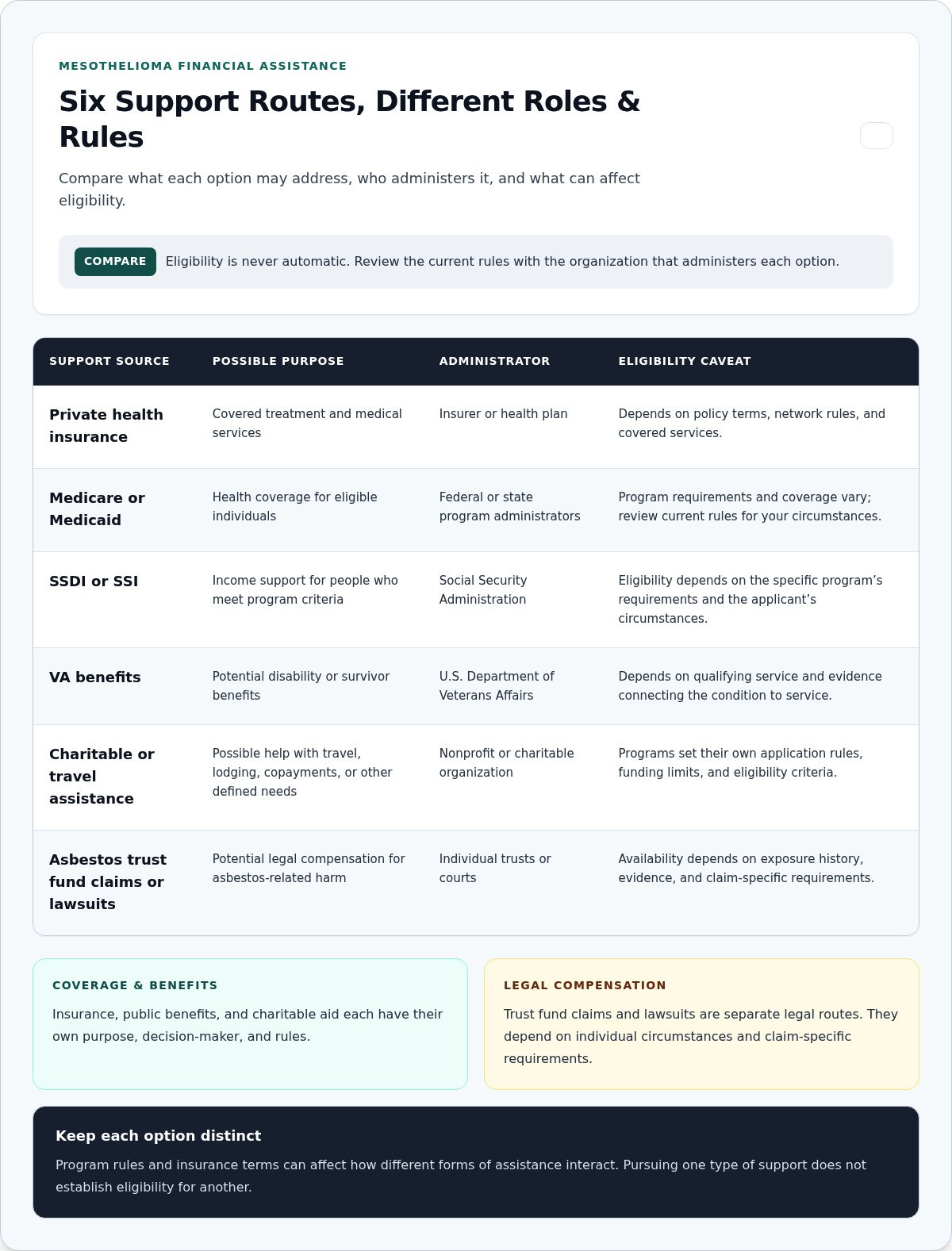
Different kinds of support serve different purposes. Health coverage may help pay for eligible medical care, an income benefit may provide support for people who meet program criteria, and a legal claim may seek compensation tied to asbestos exposure. The table below is a starting point for comparing financial assistance for mesothelioma patients by purpose and administrator. Eligibility is never automatic. Review current program rules with the organization that administers each option.
| Source | Possible purpose | Administrator | Eligibility caveat |
|---|---|---|---|
| Private health insurance | Covered treatment and medical services | Insurer or health plan | Depends on policy terms, network rules, and covered services. |
| Medicare or Medicaid | Health coverage for eligible individuals | Federal or state program administrators | Program requirements and coverage vary; review current rules for your circumstances. |
| Social Security Disability Insurance (SSDI) or Supplemental Security Income (SSI) | Income support for people who meet program criteria | Social Security Administration | Eligibility depends on the specific program’s requirements and the applicant’s circumstances. |
| VA benefits | Potential disability or survivor benefits | U.S. Department of Veterans Affairs | Depends on qualifying service and evidence connecting the condition to service. |
| Charitable or travel assistance | Possible help with travel, lodging, copayments, or other defined needs | Nonprofit or charitable organization | Programs set their own application rules, funding limits, and eligibility criteria. |
| Asbestos trust fund claims or lawsuits | Potential legal compensation for asbestos-related harm | Individual trusts or courts | Availability depends on exposure history, evidence, and claim-specific requirements. |
How do insurance, disability benefits, and veterans benefits differ?
Private insurance, Medicare, and Medicaid are health coverage routes, but each has its own rules about who qualifies and which care is covered. The National Cancer Institute (NCI) information on mesothelioma can help you understand treatment approaches; it doesn’t determine what a particular plan will pay. SSDI is a separate disability program, with eligibility assessed under its own criteria. VA benefits also have distinct requirements. Military service alone doesn’t establish eligibility; qualifying service and supporting evidence matter.
How do trust funds, lawsuits, and charitable aid differ?
Asbestos trust claims are submitted to individual trusts and assessed under their procedures and evidence requirements. A lawsuit is a separate legal claim. Whether it’s available and what its outcome may be depend on case-specific facts. Neither route guarantees compensation or a particular amount. Nonprofit grants and travel programs aren’t legal claims; each organization sets its own purpose, application process, and criteria. Keep these options distinct as you compare support.
If you’re considering whether asbestos-related legal compensation may be relevant, Weitz & Luxenberg handles asbestos litigation and trust fund claims. A free consultation gives you an opportunity to discuss your circumstances, and the firm works on a contingency basis. Learn more about asbestos-related legal options. Benefit and insurance questions follow separate processes.
Can Mesothelioma Patients Combine Financial Assistance Options?
More than one source of support may be relevant, but don’t assume different forms of assistance automatically combine or conflict. The effect can depend on program rules, insurance terms, reporting requirements, and your circumstances. Before accepting, declining, or changing benefits, ask the relevant program administrator or a qualified adviser how the rules apply. Keep a record of the guidance you receive.
For each source, identify who makes decisions and what you need to clarify. The Government Healthcare & Medical Assistance Programs page is a starting point for information about government health programs. The administering agency can explain how its current rules apply to you.
| Source | Administrator | What to ask |
|---|---|---|
| Private health insurance | Insurer or plan administrator | How are coverage, coordination with other coverage, and out-of-pocket costs handled? |
| Medicare or Medicaid | Relevant federal or state program office | What reporting duties or coordination rules apply to my situation? |
| SSDI or SSI | Social Security Administration | Could a change in income or other support affect eligibility, reporting, or payment? |
| VA benefits | U.S. Department of Veterans Affairs | What service and medical evidence is required, and what changes must be reported? |
| Charitable assistance | Individual nonprofit or charitable program | Can this aid be used alongside other support, and what documents or updates are required? |
| Trust claims or lawsuits | Individual asbestos trust or court process | What claim requirements, deadlines, and case-specific considerations may apply? |
What should patients check before pursuing more than one option?
For each program, note its eligibility rules, required documents, reporting duties, and application steps. Ask the administrator how other coverage, benefits, or payments may affect the program, and request instructions in writing when possible. Record the date, the person or office you spoke with, the answer, and any follow-up action. Don’t change, decline, or delay an existing benefit based on an assumption about how another source might interact with it.
How do asbestos trust claims and lawsuits fit into the picture?
Trust claims and lawsuits are legal routes, separate from insurance and public benefit administration. Whether a claim may be available depends on factors such as asbestos exposure history, diagnosis, supporting evidence, and applicable requirements. An attorney can review the circumstances and explain potential claims and case-specific considerations without guaranteeing eligibility or an outcome.
Weitz & Luxenberg handles asbestos litigation and trust fund claims. A free consultation can help you discuss whether legal guidance may be relevant, and the firm works on a contingency basis. For context on asbestos litigation and trust fund claims, review the firm’s information. Questions about other programs go to their respective administrators.
What Steps Can Families Take to Start Seeking Mesothelioma Financial Assistance?
Start with a manageable process, not a stack of applications. Listing your needs and organizing records can help you ask focused questions about financial assistance for mesothelioma patients. These documents support inquiries, but they don’t guarantee approval for benefits or recovery through a legal claim.
- List current needs. Note care-related bills, insurance questions, travel or lodging needs, household expenses, and changes in income or caregiving responsibilities. Mark which issues need attention first.
- Identify possible programs. Sort options by purpose, such as health coverage, income support, charitable help, or asbestos-related legal claims. Write down who administers each one.
- Gather relevant records. Collect diagnosis and treatment information, insurance details, and household expense records. For a possible legal claim, work, military service, product, and asbestos-exposure histories may also matter.
- Contact each administrator. Ask which current forms and supporting documents are needed, how to submit them, and whether there are reporting duties, review steps, or appeal procedures.
- Track every response. Record submission dates, calls, names or offices contacted, requested documents, deadlines, and next steps. Keep copies of applications and correspondence together.
What information may help when exploring assistance?
Build a file that’s useful without trying to gather everything at once. Include diagnosis and treatment records, insurance cards and policy information, and relevant household expense details. If you’re exploring asbestos-related claims, note employers, job duties, military service, products, and possible exposure locations as best you can. Store copies securely and share sensitive records only through appropriate channels.
How can families keep applications and follow-ups manageable?
Use one tracker, whether a notebook or a digital document, so requests and deadlines don’t get scattered. Ask administrators about current forms, review steps, and how to appeal a decision. A trusted caregiver can help organize records or follow up with the patient’s permission. Update the tracker after every contact.
Save or share this checklist:
- List immediate expenses and unanswered coverage questions.
- Gather diagnosis, treatment, insurance, and relevant household records.
- Note work, service, product, and exposure history if exploring a legal claim.
- Track administrators, contact dates, forms, deadlines, and follow-up actions.
- Keep copies secure and confirm each program’s requirements directly.
If you’re organizing records and want to discuss whether asbestos litigation or a trust fund claim may be relevant, Weitz & Luxenberg offers a free consultation and works on a contingency basis. Eligibility and outcomes depend on individual facts. DIAGNOSED? CALL 1-800-885-MESO TODAY FOR A CONFIDENTIAL & FREE CONSULTATION
How Can Legal Guidance Help Explore Mesothelioma Financial Assistance?
Legal guidance can help you understand whether asbestos-related litigation or a trust fund claim may be relevant to your circumstances. It’s one possible route within the broader search for financial assistance for mesothelioma patients, not a replacement for insurance, public benefits, or charitable aid. Weitz & Luxenberg represents people with mesothelioma and asbestos-related lung cancer in litigation and asbestos trust fund claims.
What can an asbestos law firm help assess?
An attorney can review diagnosis information, work and exposure history, and available records to discuss whether a legal claim may be appropriate. Employment history, military service, products encountered, and potential exposure circumstances may help clarify the facts. Based on the individual situation, a lawyer can explain potential litigation or trust fund claim routes and their requirements. This review doesn’t determine eligibility for Medicare, Medicaid, Social Security, VA benefits, or nonprofit assistance.
Records can make that conversation more focused. If available, gather:
- Diagnosis and treatment records
- Employment and job-duty history
- Military service information, if relevant
- Details about products or locations connected to possible asbestos exposure
- Names of people who may know about the work or exposure history
You don’t need every detail in hand before asking questions. Information may be incomplete, especially when exposure happened many years ago. A lawyer can discuss what is known and what additional records could matter. Any assessment depends on the facts, evidence, and applicable requirements; no claim or outcome is guaranteed.
What should patients understand before a legal consultation?
Weitz & Luxenberg offers free consultations and works on a contingency basis. A contingency arrangement generally means attorney fees are tied to a recovery rather than paid as hourly fees as the case proceeds. The specific agreement and terms matter, so discuss and understand them before deciding whether to move forward with representation. A consultation is an opportunity to ask questions, explain your circumstances, and learn whether a legal path may warrant further consideration.
Keep benefit questions with the relevant program administrators. A law firm can assess asbestos-related legal options, while public programs, insurers, and charitable organizations make decisions under their own rules. Understanding this distinction can help you pursue legal questions without mistaking them for applications for other forms of support.
If you’d like to discuss whether asbestos litigation or a trust fund claim may fit your situation, take the next step at your own pace. DIAGNOSED? CALL 1-800-885-MESO TODAY FOR A CONFIDENTIAL & FREE CONSULTATION
Take One Clear Step Toward Support
You don’t have to resolve every financial question at once. Choose one practical next step, such as clarifying a coverage issue with its administrator or deciding whether to explore an asbestos-related legal claim. Keeping these conversations separate can make it easier to understand what each route may address.
If you’re considering legal guidance, Weitz & Luxenberg represents people nationwide in mesothelioma and asbestos-related lung cancer matters. The firm offers a free consultation and works on a contingency basis. Discuss the case terms and understand them before representation; eligibility and outcomes depend on individual circumstances. A legal discussion is separate from applications for insurance, public benefits, or charitable support.
Taking a measured first step can help you move forward with greater clarity. For a confidential conversation about whether an asbestos-related claim may fit your situation, use the firm’s consultation option:
DIAGNOSED? CALL 1-800-885-MESO TODAY FOR A CONFIDENTIAL & FREE CONSULTATION
Support can begin with one question at a time. You deserve clear information as you decide what comes next.
Frequently Asked Questions
What financial assistance is available to mesothelioma patients?
Possible sources include insurance, eligible public or veterans benefits, charitable programs, and asbestos-related legal claims. Each has its own administrator, application process, and eligibility rules, so a general list can’t tell you what applies to your situation. Start by identifying the most pressing need, such as a pending medical bill or travel for care, then ask the relevant program or organization about its current requirements.
Can mesothelioma patients receive financial assistance if they have health insurance?
Yes. Insurance doesn’t necessarily cover every expense. Depending on the plan, deductibles, copayments, uncovered services, travel, or household needs may remain. Review your plan documents and ask the insurer about a specific treatment, provider, or service before relying on coverage. Keep notes about the questions asked and answers received. You can explore eligible benefits or legal options separately, since they follow different rules.
Are mesothelioma patients eligible for Social Security disability benefits?
Eligibility depends on current Social Security Administration requirements, your work and medical circumstances, and the documentation supporting your application. A diagnosis alone doesn’t guarantee approval. Before applying, review the agency’s current criteria and instructions, and gather records that explain your diagnosis and how your health affects your ability to work. Keep copies of everything submitted, along with notices or decisions, so you can refer to them if you need to follow up.
Can veterans with mesothelioma get financial assistance from the VA?
Veterans may explore VA health care or benefits when applicable, but eligibility depends on service history, supporting evidence, and current program rules. Military service by itself doesn’t establish qualification. Gather relevant service and medical records, then contact the VA for official requirements and application instructions. If you’re unsure which records could help explain your circumstances, ask the VA what documentation it needs for the specific benefit or care program you’re considering.
Can patients pursue asbestos trust claims and a lawsuit at the same time?
Possibly, but available claim routes and how they interact depend on exposure history, evidence, applicable requirements, and individual legal circumstances. Don’t assume both routes are available or that one sequence applies to every case. A mesothelioma attorney can review diagnosis and exposure information and explain case-specific options. For an overview of the legal process, see this mesothelioma litigation guide for families.
Does a mesothelioma lawyer charge upfront for a consultation?
Weitz & Luxenberg offers free consultations and works on a contingency basis. In general, a contingency fee is tied to a recovery rather than charged as an hourly fee as the case proceeds. The specific fee agreement and representation terms matter, so discuss and understand them before proceeding. This fee arrangement doesn’t guarantee a recovery or mean every possible case expense is eliminated.
How should families begin seeking financial assistance after a diagnosis?
Begin by writing down immediate needs, such as an upcoming bill or a coverage question, then identify the administrator for each relevant program. Organize medical and insurance records, and use one calendar or tracker for contact details, requested documents, and follow-up dates. Ask each program about its current rules and forms. Keep legal inquiries separate: an attorney can discuss asbestos-related claims, but can’t decide eligibility for other programs.
Disclaimer
Published by Weitz & Luxenberg, P.C. National Headquarters: 700 Broadway, New York, NY 10003. Call 800-885-MESO. Attorney Advertising. Prior results do not guarantee a future outcome. Certain contentions in blog posts need to be confirmed by a licensed attorney.


