

Did you know that while the legal system is often known for its delays, specific strategic filings can secure initial asbestos trust fund payments in as little as 90 days? You're likely dealing with the heavy physical and financial burden of a diagnosis, and it's completely normal to feel overwhelmed by complex jargon or the fear that a case will take years to resolve. Understanding the asbestos lung cancer lawsuit timeline is the first step toward reclaiming control over your family's future. We've spent forty years acting as a formidable ally for families, ensuring that the path to justice is as smooth and stress-free as possible.
In this 2026 guide, you'll learn exactly how to navigate the legal process to secure maximum compensation in the shortest possible timeframe. We'll walk you through each phase of a claim, explain how to handle multiple defendants simultaneously, and show you how to leverage the $30 billion currently available in asbestos trust funds. Our goal is to provide a clear roadmap to the financial security your family needs, backed by the confidence of having a national leader in your corner. We'll cover everything from evidence gathering to the final settlement, ensuring you're never left wondering about the next step.
Key Takeaways
- Understand that while litigation typically lasts 12 to 24 months, your asbestos lung cancer lawsuit timeline can be accelerated through expert evidence gathering.
- Learn how to access "quick-start" compensation from asbestos trust funds, which often begins arriving within 90 days of filing.
- Discover the five essential phases of a claim and how overlapping these stages can streamline the path to your family's financial security.
- Identify how a national firm manages complex factors, like multiple defendants or detailed medical histories, to prevent unnecessary delays in your case.
- Find out how a contingency fee model ensures you receive top-tier legal protection without any upfront costs or financial strain.
Understanding the Asbestos Lung Cancer Lawsuit Timeline: What to Expect in 2026
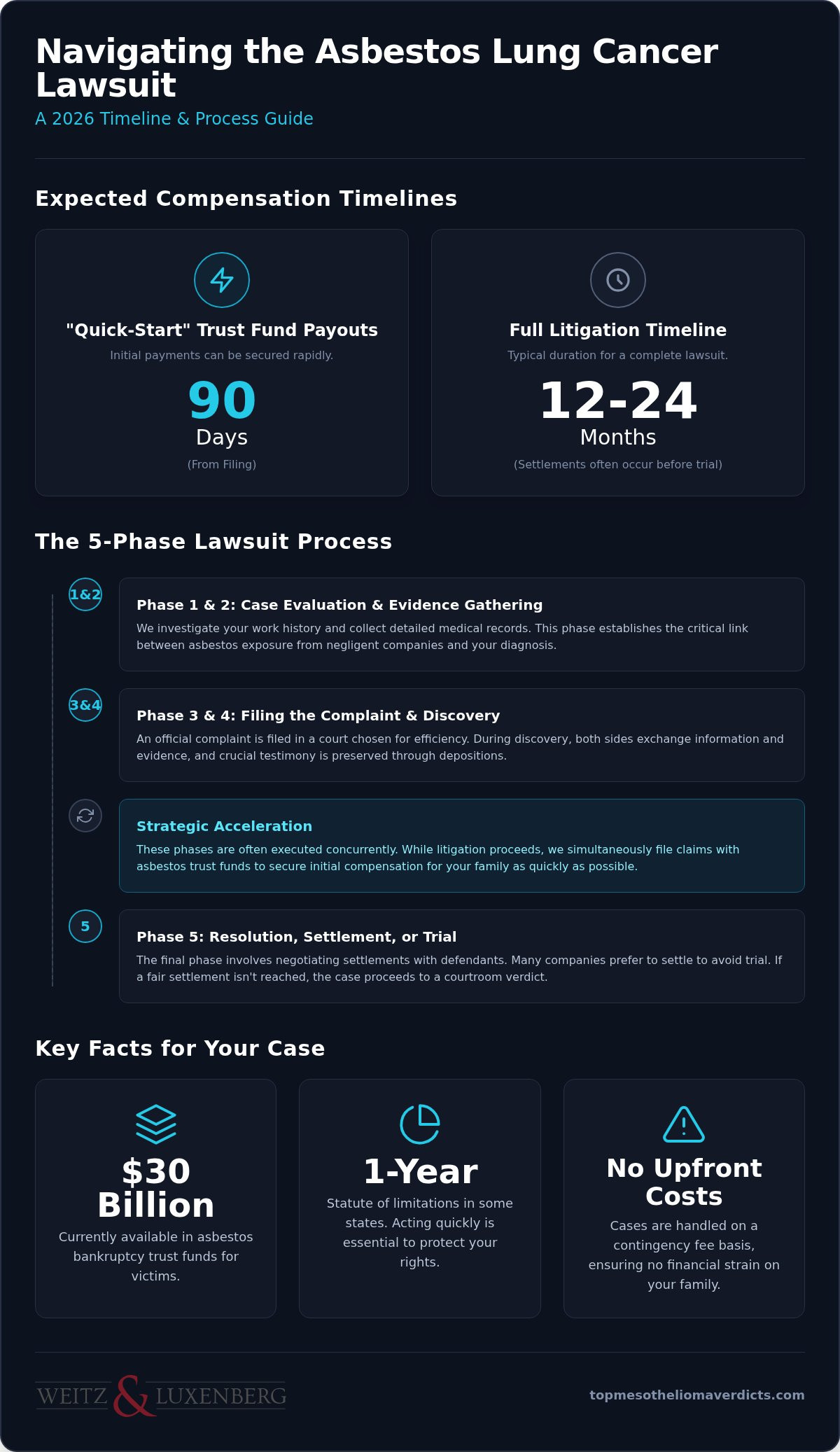
Receiving a diagnosis is a life-altering event, but the legal path to security doesn't have to be an additional burden. For most families, the asbestos lung cancer lawsuit timeline for litigation typically spans between 12 and 24 months. However, this doesn't mean you'll wait years for financial relief. Many of our clients begin receiving initial compensation from asbestos trust funds in as little as 90 days. Settlements often occur well before a trial ever begins; companies frequently prefer to resolve clear-cut cases of exposure through negotiations. As the #1 filer of asbestos cases in 2026, we utilize our massive resources to process claims efficiently, managing the complex evidence gathering so you can focus on your health while we handle the heavy lifting.
Initial Expectations vs. Legal Reality
Asbestos litigation differs significantly from standard personal injury cases due to the unique history of U.S. asbestos law. Unlike a simple accident claim where the timeline is linear, these cases often involve dozens of defendants and established bankruptcy trusts. These trusts were created specifically to ensure funds remain available for victims without the need for a full courtroom battle. It's helpful to distinguish between filing a claim, which starts the legal process, and going to trial, which is a rare final step that many cases never reach. A vital concept to grasp is the statute of limitations; this is the legal deadline that dictates how long you have to file a claim after receiving your diagnosis.
Why Time is of the Essence in Asbestos Litigation
State laws determine the specific window of opportunity for filing, making immediate action necessary for every family. In some jurisdictions, you may have only one year from your diagnosis to begin the process. Preserving testimony early through depositions is essential; it ensures your story is documented regardless of future health changes. Recent legal trends in 2026 show that concurrent filings, where we pursue both trust funds and active litigation simultaneously, are the most effective way to compress the overall timeline. This strategy ensures that while the court process moves forward, your family is already receiving the support they deserve. Acting quickly allows us to secure your place in the queue and protect your family's financial future before state deadlines expire.
The 5-Step Process: How Asbestos Lung Cancer Litigation Moves Forward
Understanding the sequence of a legal claim helps demystify the process during a difficult time. The standard asbestos lung cancer lawsuit timeline consists of five distinct phases that we often execute concurrently to reduce waiting times. Your primary responsibility is simply providing your medical and work history; our team handles the complex legal maneuvers and heavy research. Because we operate nationally, we can choose to file in jurisdictions with the most efficient court schedules, ensuring your case moves forward without unnecessary bureaucratic delays. This flexibility is a key advantage of working with an established national leader that understands the nuances of different state courts.
Phase 1 & 2: Case Evaluation and Evidence Gathering
The journey begins with an exhaustive case evaluation where we investigate decades of your professional history. Many victims were exposed at job sites they haven't thought about in years, such as shipyards, power plants, or commercial construction zones. We collect detailed medical records and pathology reports to establish a clear link between your diagnosis and the negligence of asbestos manufacturers. The National Cancer Institute provides extensive research on Asbestos Exposure and Cancer Risk, which serves as the medical bedrock for these claims. For those in specific industries, our Asbestos & Lung Cancer Claims: 2026 Construction Guide offers deeper insight into site-specific risks and common exposure scenarios.
Phase 3 & 4: Filing the Complaint and the Discovery Phase
Once we've built a robust foundation, we officially file the complaint in court. This triggers the Discovery phase, which involves a formal exchange of evidence with the named asbestos companies. This is where the defendants attempt to minimize their liability or question the source of exposure. While this sounds intimidating, we've refined this process over 40 years. We use our massive proprietary database of thousands of asbestos products and company records to pre-emptively counter their defense strategies. This internal resource significantly compresses the time spent waiting for corporate responses, as we already possess much of the documentation they would otherwise try to withhold or delay.
Phase 5: Reaching a Settlement or Trial Verdict
The final phase is resolution. Most asbestos litigation ends in a settlement rather than a trial. Companies often choose to settle when faced with our comprehensive evidence, as it provides a predictable outcome for all parties and avoids the public scrutiny of a courtroom. You can review typical outcomes in our Asbestos Lung Cancer Settlement Amounts: 2026 Compensation Guide. If a case does proceed to trial, it may extend the payout time, but it often results in higher verdicts for the family. If you're ready to see how these steps apply to your specific situation, you can request a confidential case review to start the process today.
Strategic Acceleration: How to Expedite Your Asbestos Payout Timeline
Families often worry that a legal case will move too slowly to provide real help when it is needed most. To solve this, we utilize a strategy known as concurrent filing. We don't just file a lawsuit; we also submit claims to all relevant asbestos trust funds at the same time. This approach acts as a quick-start for your compensation, providing vital financial relief while the larger litigation builds its case. With over 500 professionals on our team, we have the specialized resources to handle these multiple filings simultaneously. This prevents the bottlenecks that often plague smaller firms and ensures your asbestos lung cancer lawsuit timeline remains as short as possible.
The Power of Concurrent Trust Fund Claims
Trust fund payouts are frequently the fastest money a family receives. Since these funds were established by companies that have already undergone bankruptcy, the money is already set aside for victims. We meticulously scan your work history to identify which of the 60+ active trust funds apply to your specific exposure. Most families receive their first trust fund check within 3 to 6 months of filing. This process is firmly grounded in the established scientific link between Asbestos Exposure and Cancer Risk. By presenting irrefutable medical evidence early, we ensure your claims are processed with the urgency they deserve.
Securing an Expedited Trial Date
When health is a primary concern, we utilize legal mechanisms known as Trial Preference or a Motion to Fast-Track. These allow plaintiffs with advanced illness or those over a certain age to move to the front of the court's calendar. By petitioning the court to prioritize your case based on medical urgency, we can significantly shorten the asbestos lung cancer lawsuit timeline. An expedited trial date is also a powerful negotiation tool. When defendants realize they can't use delay tactics to outlast a patient's prognosis, they're much more likely to offer a fair settlement quickly. Our goal is always to secure your family's financial security while you're still here to see it, providing peace of mind during a difficult journey.
Factors That Can Delay or Lengthen Your Asbestos Case
While we strive for the most efficient resolution possible, several external variables can influence the asbestos lung cancer lawsuit timeline. One primary factor is the number of defendants named in your claim; it's common for a single work site to have utilized products from dozens of different manufacturers. Each company maintains its own legal team and right to a defense, which can lead to more legal maneuvering and scheduling conflicts. Additionally, state-specific court backlogs can vary significantly. We mitigate this by leveraging our national reach to select the most favorable venue available for your specific circumstances. We also navigate the "Bankruptcy Stay," a legal pause that occurs when a company enters insolvency, by pivoting immediately to trust fund claims to keep your compensation on track.
Managing Multiple Defendants and Complex Exposure
Asbestos lung cancer cases often involve 20 to 30 different companies because exposure rarely happened in a vacuum. Managing the Discovery timeline when multiple parties are involved requires a high level of coordination. To prevent this from becoming a bottleneck, we utilize "Master Complaints." These are standardized legal documents that streamline the filing process against common defendants, allowing us to move past the initial paperwork phase much faster than firms that treat every filing as a brand-new project. We also address complex medical histories, such as a history of smoking, with a proactive approach. We use specialized medical experts to demonstrate that asbestos exposure was a substantial contributing factor to the illness, regardless of other health variables.
Proving Exposure Without Direct Records
It's a common concern: what happens if your former employer is out of business or your records were lost decades ago? You don't need a perfect paper trail to secure justice. We frequently use co-worker testimony and site-specific blueprints as powerful evidence of exposure. Our 40-year archive of asbestos product data is one of the most comprehensive in the nation. It contains detailed information on which products were used at specific sites across the country, often saving months of research. This massive internal resource allows us to identify responsible parties even when direct records are missing, ensuring that corporate negligence doesn't go unanswered. If you want to understand how these factors might affect your specific case, you can get a free legal consultation to explore your options.
Choosing Weitz & Luxenberg: The Nation’s Leader in Asbestos Litigation
Weitz & Luxenberg stands as the #1 filer of asbestos injury cases in the United States for 2026. This position isn't just a statistic; it's a reflection of the trust thousands of families place in us every year. When you're managing a diagnosis, the last thing you need is the financial strain of legal fees. We operate on a contingency fee model, meaning we only get paid if you win. This alignment of interests ensures our 500+ legal professionals are fully committed to your recovery. Our $13 billion track record in verdicts and settlements provides the leverage needed to force asbestos manufacturers to settle fairly, often significantly shortening the asbestos lung cancer lawsuit timeline for our clients.
Our National Reach and Local Expertise
We represent clients in all 50 states, providing a massive scale of operations that remains deeply connected to individual needs. This national reach allows us to identify exposure patterns across the country, a task that smaller firms often struggle to manage. Because of our 40 years of specialized experience, other law firms frequently refer their most complex asbestos lung cancer cases to us. They know we have the resources to handle multiple defendants and the proprietary databases needed to prove exposure decades after it occurred. You don't have to worry about court backlogs alone; we use our centralized resources to find the most efficient path to justice for your family.
Getting Started: Your Free, No-Obligation Case Review
Taking the first step shouldn't feel like a high-stakes decision. We maintain a low-pressure environment for every family we serve, acting as a professional guide through an intimidating process. During your first call with our asbestos team, you can expect a conversation focused on your work history and medical journey rather than legal jargon. We're here to listen and provide clarity on how we can alleviate your burden. We handle the complex evidence gathering and litigation so you can focus entirely on your health and your loved ones. If you're ready to secure your family's future, secure your free case evaluation today with Weitz & Luxenberg and let us help you navigate the asbestos lung cancer lawsuit timeline with confidence and care.
Securing Your Family's Financial Future
Navigating the legal landscape after a diagnosis can feel overwhelming, but you don't have to face it alone. By understanding the asbestos lung cancer lawsuit timeline and utilizing strategic concurrent filings, you can secure the compensation your family deserves without unnecessary delays. We've spent 40 years advocating for victims of corporate negligence, and our status as the #1 asbestos case filer in 2026 ensures you have a powerful ally in your corner. With over $13 billion recovered for our clients, we possess the resources and the reputation to hold manufacturers accountable.
Our team is ready to handle the legal heavy lifting while you focus on your health and your loved ones. We provide a low-pressure environment where your needs are always the priority. It's time to reclaim your peace of mind and protect your legacy with a firm that understands the stakes. Start your free asbestos lung cancer case review today and let us guide you through every phase of this journey. You've worked hard your whole life; now, let us work hard for you.
Frequently Asked Questions
How long does it take to get a payout from an asbestos lung cancer lawsuit?
Most lawsuits reach a resolution within 12 to 18 months; however, you don't always have to wait that long for financial relief. The asbestos lung cancer lawsuit timeline can be accelerated through trust fund claims, which often begin paying out in as little as 90 days. We utilize concurrent filing strategies to ensure your family receives initial compensation while the larger litigation against solvent companies continues to move forward toward a settlement.
Can I still file a lawsuit if I was a smoker?
You can certainly file a claim if you have a history of smoking. Asbestos exposure and smoking have a synergistic effect, meaning they exponentially increase the risk of lung cancer when combined. Our legal team works with medical experts to prove that asbestos was a substantial contributing factor to your diagnosis. This allows us to hold negligent manufacturers accountable, even if other health factors or lifestyle choices were present during your lifetime.
What is the average settlement for asbestos-related lung cancer in 2026?
In 2026, the average settlement for asbestos-related lung cancer is approximately $700,000. It's important to remember that this figure varies based on your specific exposure history and the number of companies found liable. Total payouts from various asbestos trust funds typically range between $300,000 and $400,000. We focus on identifying every possible defendant to maximize your recovery, leveraging our 40 years of experience to secure the highest possible compensation for your family.
Will I have to go to court for my asbestos lung cancer claim?
The vast majority of our clients never have to step foot in a courtroom. Most asbestos claims are resolved through out-of-court settlements because manufacturers prefer to avoid the public scrutiny and high costs of a trial. While we prepare every case with the strength required for a trial verdict, your involvement is usually limited to providing a deposition. This can often be done from the comfort of your own home to minimize your stress.
How much does it cost to hire an asbestos lung cancer lawyer?
We operate on a contingency fee basis, meaning there are no upfront costs or out-of-pocket expenses for your family. We only receive a fee if we successfully secure compensation for you through a settlement or verdict. This model ensures that everyone has access to a national leader in litigation regardless of their current financial situation. It also removes the financial risk often associated with the asbestos lung cancer lawsuit timeline, allowing you to focus on your health.
What happens to the lawsuit if the patient passes away during the process?
If a patient passes away before the case concludes, the claim doesn't end; it transitions into a wrongful death lawsuit. Surviving family members or the estate can continue the legal process to secure the financial future of their loved ones. The statute of limitations for these claims varies by state, often ranging from one to three years. Our team provides gentle guidance during this difficult transition, ensuring your family's legal rights remain fully protected throughout the process.
How do I know if my lung cancer was caused by asbestos exposure?
Medical professionals identify asbestos-related lung cancer by looking for specific markers, such as pleural plaques or the presence of asbestos fibers in the lungs. We investigate your work history to find links to known asbestos-containing products at job sites like shipyards, refineries, or construction zones. Because these diseases have a long latency period, we often look back 20 to 50 years. Our proprietary database helps us connect your diagnosis to the specific companies responsible.
Can I file a claim against a company that is now bankrupt?
You can file claims against bankrupt companies through specialized asbestos trust funds. These trusts were created during bankruptcy proceedings to ensure that future victims would still have access to compensation. There is currently over $30 billion available across more than 60 active trust funds. We identify every trust that corresponds to your exposure history, often filing multiple claims simultaneously to ensure you receive the full amount of compensation provided for by the law.
*Published by Weitz & Luxenberg, P.C. National Headquarters: 700 Broadway, New York, NY 10003. Call 800-885-MESO. Attorney Advertising. Prior results do not guarantee a future outcome. *Certain contentions in blog posts need to be confirmed by a licensed attorney.
Disclaimer
Published by Weitz & Luxenberg, P.C. National Headquarters: 700 Broadway, New York, NY 10003. Call 800-885-MESO. Attorney Advertising. Prior results do not guarantee a future outcome. Certain contentions in blog posts need to be confirmed by a licensed attorney.


