

An asbestos MDL can bring lawsuits together for certain proceedings without turning them into one case. If you’re asking, “what is the asbestos multidistrict litigation (MDL), and what happens to my claim?” it’s understandable to wonder whether coordination means losing control over your individual case.
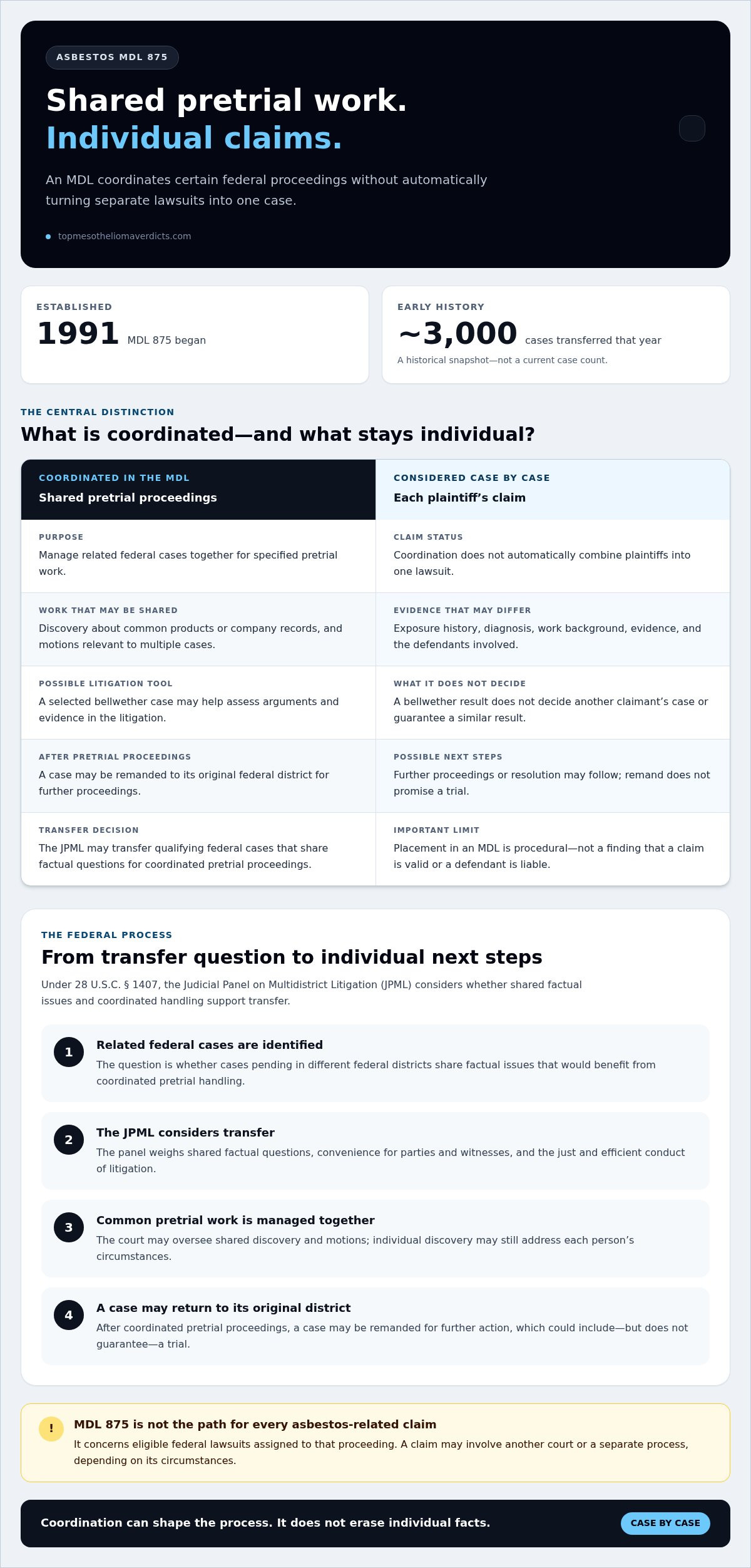
The key distinction is that an MDL groups certain federal cases for shared pretrial work, such as discovery and motions, while each plaintiff’s claim generally remains separate. The federal asbestos litigation known as MDL 875 was established in 1991. After pretrial proceedings, cases may be sent back to their original courts for further action, including trial.
This guide explains the purpose and basic structure of asbestos MDLs, and how they differ from class actions, state-court lawsuits, and asbestos trust claims. You’ll also learn what coordination may mean for an individual case and which questions to raise about its status, without assuming that every claim follows the same path or reaches a particular result.
Key Takeaways
- Understand what is the asbestos multidistrict litigation (MDL) and why related federal cases may be coordinated for pretrial proceedings.
- Learn how the Judicial Panel on Multidistrict Litigation and 28 U.S.C. § 1407 shape the transfer process.
- Compare MDLs with class actions and asbestos trust claims to see how their structures and forums differ.
- Identify how your exposure history, diagnosis, work history, defendants, evidence, and jurisdiction may affect an individual claim.
- Explore how Weitz & Luxenberg handles asbestos litigation and trust fund claims nationwide, with free consultations and contingency-based representation.
What Is the Asbestos Multidistrict Litigation (MDL)?
An MDL coordinates related federal cases for specified pretrial proceedings. If you’re asking “what is the asbestos multidistrict litigation (MDL),” the central point is that coordination doesn’t automatically combine plaintiffs into one lawsuit. A court may manage shared procedural work together, but each person’s claim remains individual, with its own evidence and circumstances.
Asbestos cases may involve overlapping questions, such as which products contained asbestos, how companies handled warnings, and what records or witnesses can help establish exposure. Coordinating some work can help a court address common issues consistently. It doesn’t mean every case has the same defendants, facts, or legal questions. A general overview of multidistrict litigation (MDL) explains the broader federal process.
Why asbestos cases may be coordinated
An asbestos-related illness may be diagnosed long after exposure. By then, a claimant may need to piece together work and product histories from older records, witnesses, or other available evidence. Similar issues across lawsuits can make coordinated pretrial management useful, even though the evidence still needs to be considered claim by claim.
The federal asbestos products-liability litigation known as MDL 875 was established in 1991. The court’s historical account describes about 3,000 cases transferred that year. That figure is a snapshot of the MDL’s early history, not a current count of pending cases or a measure of how many claims belong there today.
What MDL means for a person with an asbestos claim
For an individual, an MDL affects how certain court proceedings are organized. It doesn’t create a shared diagnosis or make plaintiffs’ injuries and damages identical. One person may have evidence about a particular job or product; another may have a different exposure history, diagnosis, or set of defendants. Those differences can matter to the proof and legal claims in each case.
Centralized management also doesn’t produce one automatic result for everyone. Shared pretrial decisions may affect the progress of cases, but they don’t determine that every claimant will settle, go to trial, or receive the same outcome. Cases may take different paths as their individual facts and procedural circumstances are addressed.
Not every asbestos-related claim qualifies for or belongs in MDL 875. The MDL concerns eligible federal lawsuits assigned to that proceeding. A claim may involve another court or a separate process, depending on its circumstances. To understand what coordination means for a particular case, identify the forum, the claims being pursued, and the evidence supporting them.
How Does an Asbestos MDL Work, From Transfer to Pretrial Proceedings?
For a federal asbestos lawsuit, placement in an MDL is a procedural decision, not a finding that the claim is valid or that a defendant is liable. The process starts with a question: do cases pending in different federal districts share factual issues that would benefit from coordinated pretrial handling? If so, federal law provides a way to manage some work together while preserving case-specific steps that may follow.
The role of the Judicial Panel on Multidistrict Litigation
The Judicial Panel on Multidistrict Litigation, often called the JPML, decides whether related federal cases should be transferred to one federal district for coordinated or consolidated pretrial proceedings. Under 28 U.S.C. § 1407, the panel may order transfer when cases share factual questions and coordination would serve the convenience of parties and witnesses and promote the just and efficient conduct of the litigation. Cornell Law School’s overview of the Multidistrict Litigation (MDL) Process explains this framework in accessible terms.
In plain English, § 1407 gives the panel authority to bring qualifying federal cases together for certain pretrial tasks. It doesn’t automatically transfer every asbestos lawsuit to MDL 875, and a transfer decision doesn’t resolve the merits of an individual claim. Whether a case is included depends on the proceedings and applicable court orders.
What happens during coordinated pretrial proceedings?
Once cases are centralized, the MDL court can oversee shared work. This may include discovery about common products or company records, as well as motions addressing issues relevant to multiple cases. Coordination can reduce duplicated work, but it doesn’t mean every plaintiff’s case receives identical treatment. Individual discovery may still be needed to examine a person’s exposure history, diagnosis, work background, and evidence against particular defendants.
The court may also set procedures for managing filings and identifying cases that need further attention. The details depend on the MDL’s orders and the circumstances of each lawsuit. In practical terms, what is the asbestos multidistrict litigation (MDL)? It’s a shared pretrial framework, not a single track that decides every claim in the same way.
Bellwether trials, remand, and possible resolution
A bellwether trial is a trial of a selected case that can help the parties and court assess arguments and evidence in the litigation. Its result may inform discussions about other cases, but it doesn’t decide another claimant’s case or guarantee a similar result. Each claim remains tied to its own facts and legal issues.
After coordinated pretrial proceedings, a case may be remanded, meaning returned to its original federal district for further proceedings. Remand doesn’t promise that the case will go to trial. Other procedural steps or a resolution may follow, depending on the case and court orders. An asbestos litigation attorney can explain how those procedures may apply to your circumstances, including through asbestos litigation guidance.
Asbestos MDL vs. Class Action vs. Trust Claim: What Is Different?
These terms describe different ways asbestos-related claims may be handled. An MDL is a court-management process for eligible federal lawsuits. A class action is brought on behalf of a defined group under specific legal requirements. An asbestos trust claim follows a separate process established by a bankruptcy trust. Knowing which process applies can help you understand the steps and rules that may affect a claim.
| Process | Structure | Forum |
|---|---|---|
| MDL | Related federal lawsuits are coordinated for certain pretrial proceedings. Each plaintiff’s lawsuit remains an individual case. | A designated federal district court manages the coordinated proceedings. A case may later return to its original federal district. |
| Class action | One or more representatives seek to pursue claims for a proposed group. A court must determine whether the case meets Rule 23 requirements for certification. | A state or federal court, depending on the case, considers certification and oversees the class action. |
| Asbestos trust claim | A claimant submits a claim under the procedures and criteria of a trust established in connection with an asbestos-related bankruptcy. | The claim is handled through the trust’s process, not as a lawsuit in an MDL court. |
MDL and class action are not interchangeable
In an MDL, coordination doesn’t replace individual lawsuits with a single representative claim. Each case retains its own plaintiff, evidence, and issues, even when some pretrial work is shared. By contrast, a class action must satisfy Rule 23’s requirements before a court can allow representative litigation on behalf of a group. Whether a proposed class meets those requirements is a separate legal question.
The Supreme Court’s 1997 decision in Amchem Products, Inc. v. Windsor affirmed the rejection of a proposed asbestos settlement class. The ruling addressed whether that proposed class met Rule 23 requirements. It’s an important historical example, not a blanket decision about whether every asbestos-related case can or cannot proceed as a class action. An MDL also doesn’t guarantee a settlement or collective recovery.
How an MDL differs from an asbestos trust claim
Trust claims follow procedures set by individual asbestos bankruptcy trusts, while MDLs involve lawsuits managed by a court. The processes may require different information and address different defendants or sources of compensation. A person’s exposure and claim facts may raise more than one distinct legal process, but whether any particular processes apply depends on the circumstances and governing rules.
If you’re asking “what is the asbestos multidistrict litigation (MDL)” in relation to a trust claim, the key distinction is the forum and process: an MDL is court litigation, while a trust claim is handled through a trust’s claims system. Trust payment percentages and procedures are specific to each trust, so they shouldn’t be assumed to work like a lawsuit or produce the same result.
What Should You Understand About Your Individual Claim in an Asbestos MDL?
MDL procedures may coordinate parts of a lawsuit, but your own claim depends on its facts. Exposure history, diagnosis, employment, potentially responsible companies, and available evidence can differ from one person to another. A case’s position in coordinated litigation doesn’t, by itself, show what evidence matters or what steps may come next.
If you’re trying to understand what is the asbestos multidistrict litigation (MDL) for your circumstances, focus on two things: the individual facts supporting the claim and the court procedures that apply to it. Deadlines and procedural requirements can depend on jurisdiction and case circumstances. General information can help you prepare, but it can’t establish a deadline or outcome for a particular case.
Why individual facts and records still matter
Records and recollections may help counsel assess a claim and understand its procedural posture. You don’t need to assemble a complete file before seeking legal guidance. Information that may be useful to discuss includes:
- Diagnosis information: Medical records or details about the diagnosis and treatment, if available.
- Work history: Employers, job roles, and approximate periods of employment that may help trace possible exposure.
- Exposure locations: Workplaces or other settings where asbestos exposure may have occurred.
- Product details: Names, descriptions, or records related to products that may have been present, if known.
- Existing case documents: Court notices or filings, if a lawsuit has already been started or transferred.
These are possible starting points, not a checklist of required documents. Memories, records, and available details vary. An attorney can help identify which information may be relevant to an individual asbestos claim.
Questions that can clarify an MDL case’s posture
Focused questions can help clarify what coordination means for a lawsuit. Consider asking counsel:
- Is the case pending in federal court, and has it been transferred to an MDL?
- Which proceedings or issues are being handled together?
- Which issues, evidence, or steps remain specific to this individual case?
- What deadlines or procedural requirements apply in the case’s current jurisdiction?
- What event or court order would change the case’s next procedural step?
The answers depend on the case record and applicable court orders. For a broader overview of how an asbestos-related lawsuit may proceed, consult the guide to mesothelioma litigation alongside this MDL explanation.
Experienced asbestos counsel can help interpret case documents, identify relevant facts, and explain how federal coordination relates to an individual claim. For a confidential, free consultation, call DIAGNOSED? CALL 1-800-885-MESO TODAY FOR A CONFIDENTIAL & FREE CONSULTATION.
How Weitz & Luxenberg Helps People Navigate Asbestos Litigation
Understanding how an MDL works is a starting point. Applying that process to a specific asbestos claim may involve questions about where a lawsuit is pending, whether it has been transferred, which court orders apply, and what issues remain individual. Weitz & Luxenberg represents people with mesothelioma and asbestos-related lung cancer nationwide, handling asbestos litigation and trust fund claims. The firm helps clients understand the legal processes relevant to their circumstances, without promising a particular path or result.
What legal guidance can add to an MDL explanation
If you’re still asking “what is the asbestos multidistrict litigation (MDL)” for your own case, counsel can review available information and explain how coordinated proceedings relate to your facts and procedural posture. That may include clarifying whether a case is in federal court, what work is being managed together, and which questions depend on the claimant’s diagnosis, exposure history, or evidence. Court rules govern the process, and no legal representation can guarantee an outcome.
MDL litigation and asbestos trust claims are distinct processes. Weitz & Luxenberg handles both asbestos litigation and trust fund claims, and can explain how those avenues differ and what information may be relevant to evaluating an individual matter. Whether a particular claim can proceed, and how, depends on its facts and applicable rules.
A private next step for questions about asbestos litigation
An initial consultation with Weitz & Luxenberg is free, and representation is contingency-based. A conversation can help you identify questions to consider, such as which court or process may be involved, what case documents are available, and how deadlines may depend on jurisdiction and circumstances. You don’t need to know procedural terminology in advance. The consultation is an opportunity to discuss your situation and possible next steps.
For people facing a serious asbestos-related diagnosis, clear information can make a complex process easier to understand. Weitz & Luxenberg’s nationwide asbestos practice includes litigation and trust fund claims. The firm can discuss how those services relate to the facts you share, while applicable court rules and individual circumstances determine how a case proceeds.
DIAGNOSED? CALL 1-800-885-MESO TODAY FOR A CONFIDENTIAL & FREE CONSULTATION
Take the Next Step With Clear Questions
If you’re still asking “what is the asbestos multidistrict litigation (MDL),” use that question as a starting point, not an assumption about where your claim stands. Write down what you know about your diagnosis and possible exposure, along with any court notices or case documents you’ve received. Then note what remains unclear, such as whether a lawsuit has been transferred or which deadlines may apply.
You don’t need to have every record or answer in hand before seeking guidance. A confidential conversation with Weitz & Luxenberg can help you discuss your circumstances and understand questions about asbestos litigation or trust claims. The firm offers free consultations and represents asbestos-related claimants nationwide. Representation is contingency-based, and the terms can be explained during a consultation.
DIAGNOSED? CALL 1-800-885-MESO TODAY FOR A CONFIDENTIAL & FREE CONSULTATION
Clear information can make the next step feel more manageable. Weitz & Luxenberg offers a free consultation to discuss your asbestos-related claim and possible next steps.
Frequently Asked Questions
Is asbestos MDL 875 still active in 2026?
As of October 2026, MDL 875 remains active in the U.S. District Court overseeing the proceeding, according to current status information. But “active” describes the centralized proceeding, not necessarily every lawsuit once assigned to it. Some cases may have been resolved or returned to their original courts. To understand a particular case’s status, review its docket and court orders rather than relying only on historical MDL materials.
How long does an asbestos MDL take?
There’s no fixed timeline for an asbestos MDL case. If you’re asking what is the asbestos multidistrict litigation (MDL) likely to mean for timing, the answer depends on more than the MDL calendar. The court’s schedule, the case’s procedural posture, evidence still being developed, and whether the dispute resolves or continues through further litigation may all affect duration. A timeline from another case isn’t a reliable estimate for yours.
What happens if an asbestos case is not selected as a bellwether trial?
A case that isn’t selected as a bellwether may continue through the procedures that apply to it. Selection isn’t a test of whether another claim has merit. The court’s orders and the case’s status will shape what happens next. For example, a case might still need case-specific discovery or rulings on its own issues. Not being selected doesn’t, by itself, establish a particular next step or predict an outcome.
Can a family pursue an asbestos claim after a loved one dies?
Possibly. Depending on the facts and applicable law, an estate or certain family members may have legal options after an asbestos-related death. The proper claimant, available claims, and deadlines can vary by jurisdiction and circumstances. Relevant questions may include whether a lawsuit was already filed and who has authority to act for the estate. Prompt, individualized legal guidance can help clarify those issues; MDL participation alone doesn’t answer them.
Does an asbestos MDL mean every claimant has to testify in court?
No. Being part of coordinated litigation doesn’t automatically require every claimant to testify in court. A person’s role may depend on what facts are disputed, what evidence is needed, and the procedures ordered in that case. Testimony could be considered as part of case-specific evidence, but whether a claimant is asked to testify can’t be determined from MDL participation alone. The case’s circumstances matter.
Can an asbestos MDL guarantee a settlement?
No. An MDL doesn’t guarantee a settlement, payment, or any particular result. Parties may resolve some disputes, while others continue through court proceedings. Even if a bellwether case or broader settlement discussions influence negotiations, that doesn’t automatically decide another person’s claim. Any proposed resolution and its terms require case-specific consideration, and the outcome depends on the individual facts and applicable law.
Disclaimer
Published by Weitz & Luxenberg, P.C. National Headquarters: 700 Broadway, New York, NY 10003. Call 800-885-MESO. Attorney Advertising. Prior results do not guarantee a future outcome. Certain contentions in blog posts need to be confirmed by a licensed attorney.


