

What if the compensation you deserve isn't tied to a stressful courtroom battle, but to a $30 billion system specifically designed to protect families like yours? Many people hesitate to seek help because of common asbestos claim myths that suggest the process is too late or too difficult. You're likely worried about rising medical bills and the legacy you'll leave for your family. It's easy to feel overwhelmed by complex legal terms and the fear of a long, public fight. We understand that this burden feels heavy. You don't have to carry it alone.
We're here to provide clarity and a steady hand. You'll discover how to access established trust funds and navigate litigation to secure your family's financial future with zero upfront costs. This guide clarifies the reality of compensation in 2026, providing a low-pressure path to accountability and the validation your suffering deserves. By understanding the current legal landscape, you can move forward with the confidence that an experienced protector is standing by your side to ensure your story is heard and your needs are met.
Key Takeaways
- Discover how a formal asbestos claim provides a structured path to financial recovery for life-altering diseases like mesothelioma and lung cancer.
- Learn why you can still seek accountability decades after exposure, as we debunk the most common asbestos claim myths regarding filing deadlines.
- Understand how to access the $30 billion reserved in asbestos trust funds, which often allows for compensation without the need for a jury trial.
- Find out how national databases of blueprints and coworker testimonies can establish your exposure history even if you no longer have old pay stubs.
- Explore the advantages of partnering with a national leader to navigate complex litigation and secure your family’s financial future without upfront costs.
Understanding Asbestos Claims: Why It’s More Than Just a Lawsuit
An asbestos claim is a formal legal request for financial recovery. It's designed to compensate you for the medical expenses, lost wages, and profound suffering caused by toxic exposure. These claims primarily address life-altering diagnoses such as mesothelioma and asbestos-related lung cancer. If you're looking for a comprehensive overview of asbestos and its historical industrial use, you'll see why the law holds manufacturers accountable for the health risks they knowingly created. A claim isn't just a piece of paperwork; it's a tool for justice.
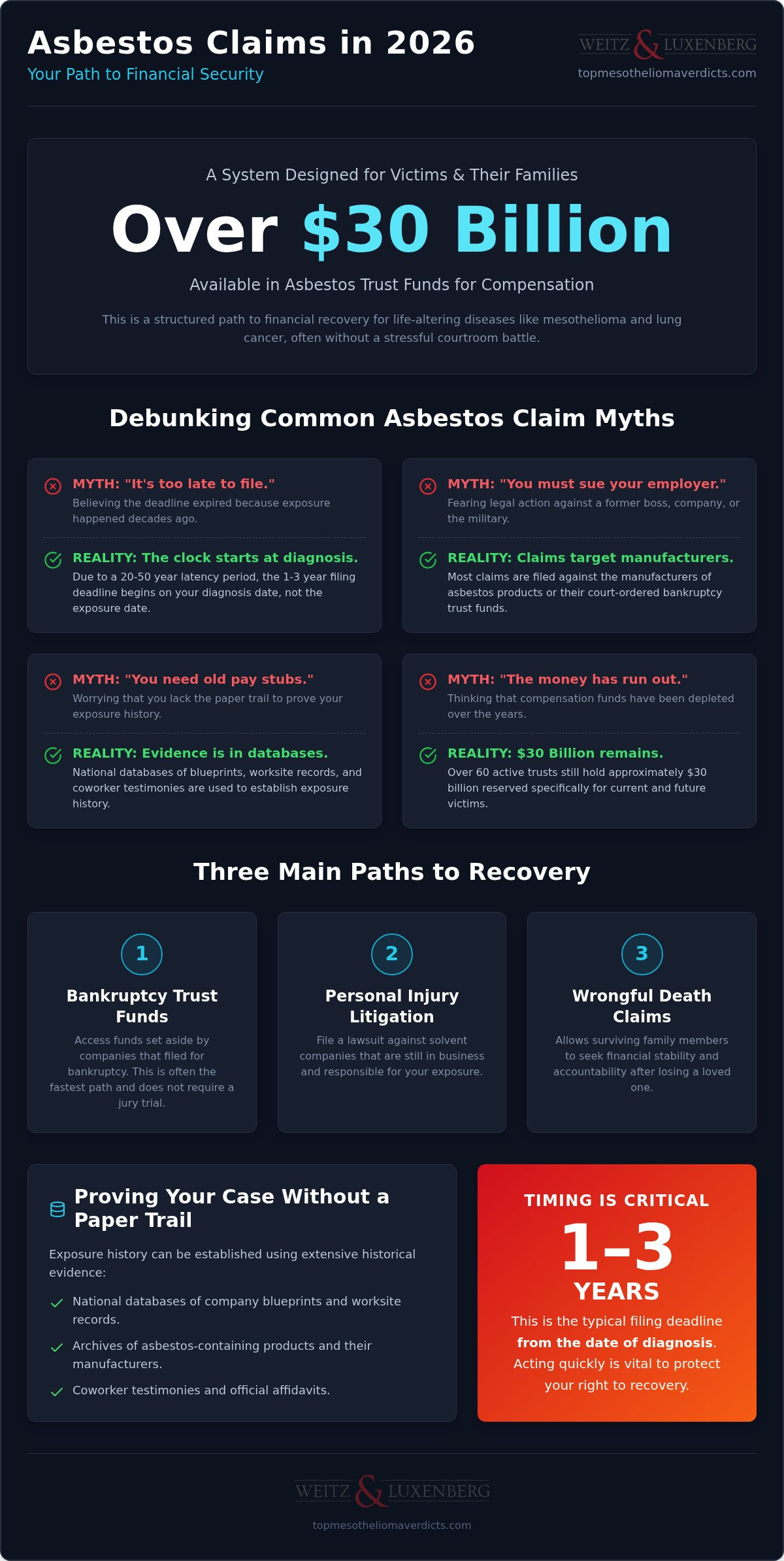
One of the most persistent asbestos claim myths is the belief that you must sue your former employer or the military to receive help. This misconception often prevents veterans and retirees from seeking the support they deserve. In reality, most claims are filed against the manufacturers of the asbestos-containing products or the dedicated trust funds they were court-ordered to establish. Your old boss or commanding officer is rarely the target of these actions. Instead, we focus on the corporations that prioritized profits over your safety.
The Three Main Paths to Recovery
Every family's journey is different, but recovery generally follows three specific legal avenues. Identifying the right path is essential for maximizing your results. These include:
- Bankruptcy Trust Fund Claims: These allow you to access money already set aside by companies that filed for bankruptcy protection. There are currently over 60 active trusts.
- Personal Injury Litigation: This involves filing a lawsuit against solvent companies that are still in business today.
- Wrongful Death Claims: These provide a way for surviving family members to seek financial stability and accountability after losing a loved one to an asbestos-related illness.
Why 2026 is a Critical Year for Filing
Timing is everything. As of 2026, the landscape of compensation is shifting. You should review the current asbestos trust fund payout percentages to understand how different trusts are managing their reserves. Some trusts, like NARCO, are currently paying at 100%, while others have adjusted their rates to ensure funds remain available for future victims. Staying informed helps you avoid falling for asbestos claim myths that suggest the money has run out. In fact, approximately $30 billion remains in these funds today.
Advancements in legal technology have also changed the process. National firms now utilize massive evidence databases that make filing faster and more efficient than in previous decades. Acting immediately after a diagnosis is vital because statutes of limitations are strict. In many states, you only have one to three years from the date of diagnosis to file. Waiting can mean losing your right to recovery. As the #1 filer of asbestos injury cases in 2026, we focus on moving your case forward with precision to ensure your family's future is secure.
The 40-Year Gap: Why You Can Still File a Claim in 2026
One of the most misunderstood aspects of asbestos exposure is the timeline between contact and illness. Asbestos-related diseases don't appear overnight. Instead, they operate on a long latency period, often taking 20 to 50 years to manifest after the initial exposure. This delay creates a significant gap that leads many to believe they've missed their chance for help. If you worked in a shipyard or a factory in the 1970s and were recently diagnosed, your right to seek recovery is very much alive in 2026. Understanding the relationship between Asbestos Exposure and Cancer Risk is the first step toward securing your family's future.
A common entry among asbestos claim myths is the idea that the statute of limitations ran out decades ago because the exposure happened so far in the past. This is simply not true. In the legal world, the "clock" for filing a claim typically starts at the time of your medical diagnosis, not when you were first exposed to the dust. Because we've been protecting families for 40 years, our firm maintains a massive archive of historical records dating back to the 1940s. We use these blueprints, invoices, and site logs to build a bridge between your work history and your current diagnosis, providing the evidence needed for a successful 2026 claim.
Understanding the Discovery Rule
The legal system recognizes that it's impossible to file a lawsuit for an injury you don't yet know exists. This is why courts apply the "discovery rule" to asbestos cases. A diagnosis in 2026 triggers a new window of opportunity to file, regardless of how many decades have passed since you left the job site. The discovery rule is the legal principle that pauses the statute of limitations until an asbestos-related illness is formally diagnosed. This protection ensures that victims aren't penalized for the slow-acting nature of these diseases.
Filing for Deceased Family Members
Many families mistakenly believe that if a loved one has already passed away, the opportunity for accountability is gone. This is another of the frequent asbestos claim myths that can prevent heirs from receiving much-needed financial support. Estates and surviving spouses can often pursue compensation for several years after a death to cover outstanding medical bills and lost household income. Taking the time to start reviewing your legal options can help validate your loved one's struggle while providing a stable financial foundation for the next generation. Our team handles these sensitive matters with the empathy and professional precision required to alleviate your burden during a difficult time.
Trust Funds vs. Litigation: Accessing the $30 Billion Reserved for Victims
Asbestos trust funds were born out of necessity. When major manufacturers faced overwhelming liability, courts ordered them to set aside billions to pay future victims. Today, approximately $30 billion remains in these accounts. One of the biggest asbestos claim myths is that you must prepare for a grueling courtroom battle to access this money. In reality, trust fund claims are handled through an administrative process. You don't have to step into a courtroom or testify before a jury to receive a payout from these funds. It's a system designed for your ease and protection.
It's a common mistake to view trust funds and lawsuits as mutually exclusive options. Many families believe they have to choose one path. However, there are significant benefits to filing both asbestos trust fund and lawsuit claims simultaneously. This dual approach ensures you're pursuing every possible source of accountability, maximizing the total recovery available to your family. We help you navigate both systems to ensure no stone is left unturned.
How Trust Funds Operate
These funds offer two main paths for review: expedited and individual. Expedited review provides a fixed payout amount based on your diagnosis, resulting in faster processing. Individual review allows for a more detailed look at your specific circumstances, which may lead to higher compensation. While often associated with mesothelioma, asbestos lung cancer trust fund options are also available for non-mesothelioma cases. These funds were established specifically for people in your exact situation, ensuring that bankrupt companies still fulfill their obligations to those they harmed.
When Litigation is the Better Path
While trust funds cover bankrupt entities, many companies responsible for asbestos exposure remain solvent today. To hold these active corporations accountable, litigation is necessary. Engaging in mesothelioma litigation can lead to substantial settlements or record-breaking verdicts, such as the $117 million verdict secured in 2025. Experienced trial lawyers analyze your specific work history to determine which combination of claims yields the highest value. This isn't about being aggressive; it's about ensuring those who caused your illness provide the financial security your family needs for medical bills and long-term care. We act as your guide, identifying which corporations are still solvent and determining the most effective route for your recovery.
Evidence and Eligibility: How to Prove Exposure Without a Paper Trail
Many people believe that without a stack of old pay stubs or original employment contracts, they can't prove their case. This is one of the most discouraging asbestos claim myths circulating today. You might have worked at a shipyard, power plant, or construction site fifty years ago, and it's perfectly natural not to have kept every piece of paperwork from that time. We don't expect you to be an archivist. Our role is to act as your investigator and protector, using our extensive resources to reconstruct your history and prove your eligibility.
National firms maintain massive, proprietary databases that individual claimants simply don't have access to. These archives include historical blueprints, corporate invoices, and thousands of co-worker testimonies from job sites across all 50 states. We use these tools to identify exactly which asbestos-containing products were present when you were on the clock. To build a solid foundation for your recovery, we gather several types of evidence:
- Social Security Records: These provide a verified timeline of your employment history.
- Union Logs: Many trade unions kept detailed records of member assignments and site conditions.
- Product Identification Experts: Professionals who can recognize specific brands of insulation, gaskets, or floor tiles used during certain eras.
Gathering this evidence is a complex, expensive task. However, we operate on a contingency-based model with a "No Upfront Cost" guarantee. We pay for all the research, expert consultations, and evidence gathering required to prove your eligibility. You only pay if we secure a recovery for you. This approach removes the financial stress, allowing you to focus on your health while we handle the heavy lifting. If you're ready to see how we can document your history, you can start by learning more about the claims process today.
Secondary Exposure Claims
Exposure wasn't always limited to the person on the payroll. Among the common asbestos claim myths is the idea that you must have worked with the material directly to have a valid claim. Actually, many spouses and children developed illnesses due to "take-home" exposure. This occurred when a worker unknowingly brought toxic dust home on their hair, skin, or work clothes. Families of workers are often eligible for the same trust funds and compensation as the workers themselves, provided the medical link is established.
The Role of Occupational Experts
We work with industrial hygienists who specialize in reconstructing work sites from decades ago. These experts can pinpoint the exact locations where asbestos was used and identify the manufacturers responsible. To solidify the connection, we also utilize medical nexus letters. These documents are provided by specialists who link your 2026 diagnosis directly to the asbestos products identified at your former job site. Expert testimony can bridge the gap between a 1970s job site and a 2026 medical diagnosis. This professional reconstruction ensures that your claim is backed by scientific and historical authority.
Navigating the Legal Process: How a National Firm Maximizes Your Recovery
Choosing the right legal partner is the most critical decision you'll make after a diagnosis. While some regional firms offer help, asbestos litigation requires a massive scale of operations. The companies responsible for your exposure are often headquartered in states far from where you live or worked. A firm with national reach can file your case in the jurisdiction that offers the most favorable laws for your specific situation. As the #1 filer of asbestos injury cases in 2026, Weitz & Luxenberg possesses the geographical reach and established reputation to challenge even the largest corporate defendants.
One of the common asbestos claim myths is that a large firm won't provide personal attention. On the contrary, our scale allows us to assign dedicated specialists to your case while leveraging the "Power of Referral." Other attorneys frequently send their toughest cases to us because of our 40-year history of success. We act as a professional guide, leading you through a complex process with a steady hand and a clear sense of purpose.
The journey from diagnosis to recovery follows a purposeful rhythm. It begins with a comprehensive case review to understand your unique story. From there, our team handles the granular details of investigation and filing. We move at a brisk pace to ensure your family receives support as quickly as possible, typically progressing from the initial filing to the first payout without you ever having to manage the legal heavy lifting.
The Contingency Fee Model Explained
You should never have to choose between medical care and legal representation. We operate strictly on a contingency fee basis. This means we only get paid if we win your case. There are no hourly fees and no out-of-pocket costs for you to worry about. Our initial consultations and case reviews are 100% free and entirely low-pressure. This model levels the playing field, allowing a single family to stand with equal strength against billion-dollar corporations that have spent decades avoiding accountability. It's a risk-free path to the validation your suffering deserves.
Why Experience is the Deciding Factor
With over 40 years of stability and more than $13 billion secured in verdicts and settlements, our track record speaks for itself. This includes a record $117 million verdict achieved in 2025. Our team of 500+ professionals nationwide ensures that no detail is missed, from the smallest invoice to the most complex medical testimony. We provide a balanced experience that feels both efficient and comprehensive, moving from high-level benefits to granular details without losing your trust. To begin your path toward financial security, schedule your free asbestos case review today.
Take Control of Your Recovery and Your Legacy
Decades of silence from the companies responsible for your exposure don't diminish your right to justice today. By dismantling the most common asbestos claim myths, it's clear that the path to financial recovery is structured, accessible, and designed to protect your family from medical debt. Whether you're accessing the $30 billion in dedicated trust funds or pursuing litigation against solvent corporations, the key is acting while legal windows remain open. Your diagnosis in 2026 is the starting point for a new chapter of accountability.
Our team stands as a seasoned protector for families across all 50 states. With 40 years of national leadership and over $13 billion secured for our clients, we have the formidable resources required to hold billion-dollar manufacturers accountable. As the #1 filer of asbestos injury cases in 2026, we're prepared to turn your history of hard work into a legacy of security. You've carried this burden long enough. Let a powerful ally take it from here and provide the peace of mind you deserve.
Get a Free Case Evaluation from the Nation’s #1 Asbestos Firm and take the first step toward the accountability and financial validation your family deserves.
Frequently Asked Questions
What is the average payout for an asbestos claim in 2026?
The average total compensation from multiple asbestos trust fund claims typically ranges between $300,000 and $400,000. Individual payouts vary based on the specific trust's payment percentage and your diagnosis. Litigation results can be significantly higher, as shown by our record $117 million verdict in 2025. We work to identify every possible source of recovery, including both trusts and solvent companies, to maximize the financial security provided to your family.
Can I file an asbestos claim if I was a smoker?
Yes, you can still file a claim if you have a history of smoking. Tobacco use does not disqualify you from seeking compensation for asbestos lung cancer or mesothelioma. While corporations often try to use smoking to avoid accountability, our medical experts provide evidence showing that asbestos exposure was a substantial contributing factor to your illness. We have successfully secured recoveries for many clients who were smokers by focusing on the toxic impact of asbestos fibers.
How long does it take to receive money from an asbestos trust fund?
Most trust fund claims begin paying out within 90 days to one year after the initial filing. The exact timeline depends on whether you choose an expedited review for a faster, fixed payment or an individual review for a potentially higher amount. As the #1 filer of asbestos injury cases in 2026, we use our established relationships and extensive databases to move your claim through the system as efficiently as possible to provide immediate support.
Do I need to travel to a law office to file my claim?
No, you don't need to travel to any office to begin your recovery process. We utilize secure digital tools and phone consultations to handle everything from the comfort of your home. If a face-to-face meeting is required, our team of 500+ professionals has the national reach to come directly to you. This low-pressure approach ensures you can focus on your health and family while we manage the complex legal work across all 50 states.
What happens if the company that exposed me is out of business?
You can still receive compensation even if the company is no longer in business. Most bankrupt asbestos manufacturers were court-ordered to establish trust funds to pay future victims, and approximately $30 billion remains in these accounts today. We use our historical archives to identify which bankrupt entities are responsible for your exposure. This is one of the most common asbestos claim myths, but the reality is that these funds were created for your protection.
Are veterans eligible for asbestos claims in addition to VA benefits?
Veterans are absolutely eligible to file legal claims while continuing to receive their VA benefits. Filing a claim against the manufacturers of asbestos products does not impact your VA disability rating or healthcare eligibility. These are two separate systems of financial recovery. We help veterans access both trust fund compensation and litigation awards to ensure they receive the full support they earned. Our firm has 40 years of experience protecting those who served our country.
What is the difference between a mesothelioma claim and an asbestos lung cancer claim?
The primary difference involves the medical diagnosis and the specific criteria set by trust funds. Mesothelioma claims are for cancer of the lung lining or abdomen caused exclusively by asbestos. Asbestos lung cancer claims involve cancer within the lung tissue itself. While both qualify for recovery, the evidence required to link lung cancer to asbestos is often more complex. We utilize industrial hygienists and medical experts to build a strong case for either diagnosis to ensure accountability.
Is there a deadline to file an asbestos claim after a diagnosis?
Yes, every state has a strict statute of limitations that dictates how long you have to file a claim. These deadlines generally range from one to six years from the date of your formal diagnosis. Missing this window can permanently bar you from seeking recovery. Because certain asbestos claim myths suggest it's too late to file for exposure that happened decades ago, many people wait too long. It's vital to speak with a professional immediately to protect your rights.


