

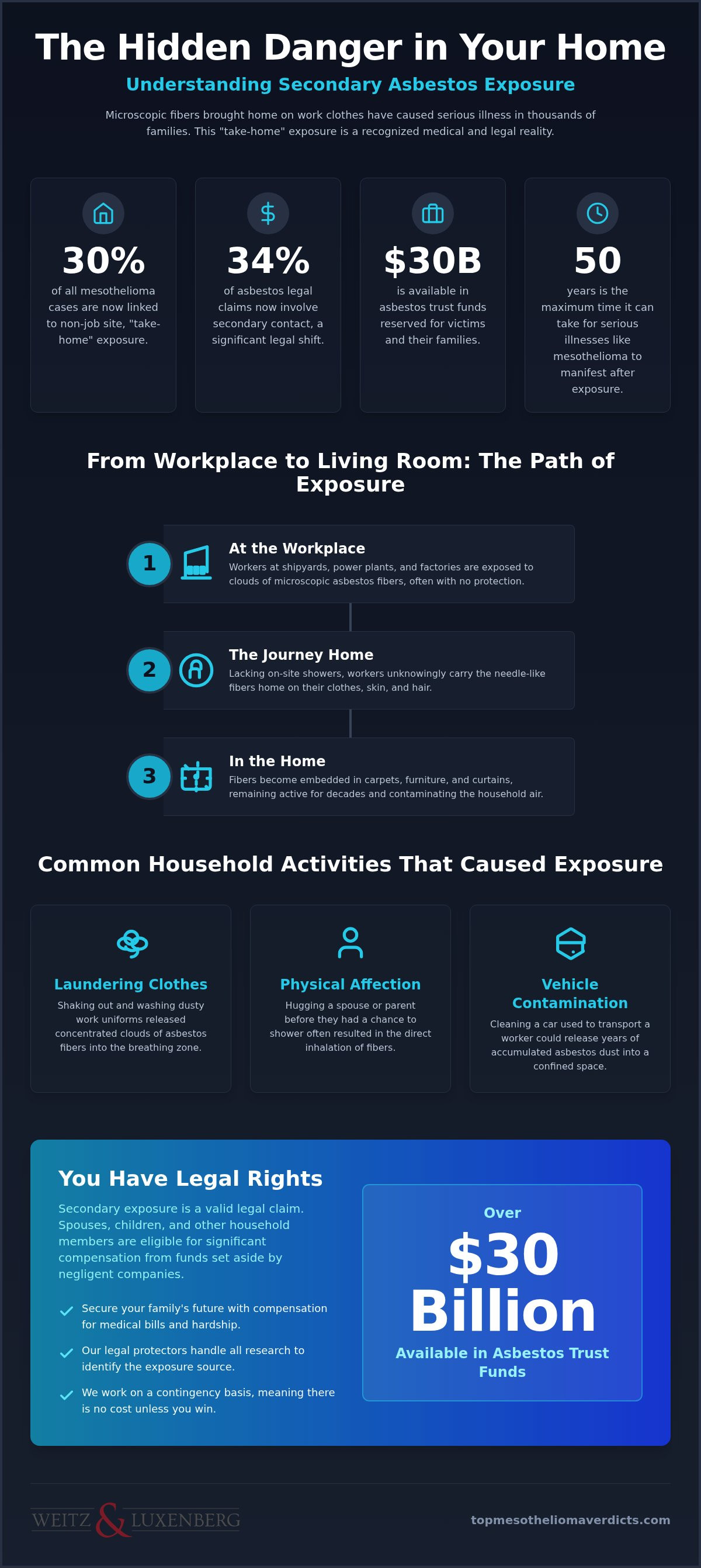
Did you know that approximately 30% of mesothelioma cases in the United States are now linked to exposure that never occurred on a job site? For many families, the danger didn't come from a factory floor, but from the simple act of doing laundry for a spouse or parent. Asbestos exposure from family member's clothes, often called "take-home" exposure, is a recognized medical and legal reality that affects thousands of people every year. Recent data from 2025 shows that over 34% of all asbestos legal claims now involve this secondary contact, highlighting a significant shift in how these illnesses are diagnosed and litigated in 2026.
It's understandable to feel confused or even guilty when a diagnosis arrives despite never working with toxic materials yourself. You deserve to know that this wasn't your fault and that you have the same legal rights to compensation as any industrial worker. This guide will show you how secondary exposure happens, the health risks involved, and how to access the $30 billion currently held in asbestos trust funds. We'll explain how a seasoned legal protector can handle the difficult research to identify the exposure source, allowing you to focus on your health while we work on a contingency basis to secure your family's future.
Key Takeaways
- Understand how microscopic fibers on work gear lead to asbestos exposure from family member's clothes, even if you've never worked in an industrial setting.
- Recognize the connection between household contact and serious illnesses like mesothelioma, which can take up to 50 years to manifest.
- Discover how to secure your family's future by accessing over $30 billion in asbestos trust funds reserved for victims of corporate negligence.
- Learn why secondary exposure is a valid legal claim that allows spouses and children to seek significant compensation for medical expenses.
- Find out how to partner with a national leader who conducts all necessary exposure research on a contingency basis, ensuring no cost unless you win.
What is Secondary Asbestos Exposure and How Does it Occur?
Secondary asbestos exposure, frequently referred to as "take-home" or "domestic" exposure, occurs when a worker unknowingly carries toxic dust into their living space. While the worker may have been the one physically handling the material, their family members often paid the price. It's a quiet tragedy. In 2026, medical data continues to show that approximately 30% of mesothelioma cases in the United States are attributed to this form of contact. For many, asbestos exposure from family member's clothes began with a simple hug or a load of laundry.
The primary danger lies in the physical properties of the mineral. Asbestos fibers are microscopic. They have no scent and are completely invisible to the naked eye. Because they are jagged and needle-like, they easily attach to common work fabrics such as denim and flannel. They also cling to skin and hair. This means a worker could leave a shipyard or construction site looking relatively clean while actually transporting millions of lethal fibers into their home. Understanding the Health impact of asbestos is vital for anyone who lived in a household where industrial work clothes were present.
The Science of Take-Home Asbestos Dust
When these fibers enter a home, they don't simply disappear. They are incredibly durable and can remain active for decades. Take-home exposure is the unintentional transfer of asbestos fibers from a job site to a residence. Once inside, these microscopic particles become embedded in carpets, furniture upholstery, and even the curtains. Every time someone sits on a sofa or walks across a rug, those fibers can be kicked back into the air. Shaking out work clothes before washing them is particularly hazardous. This action creates a concentrated cloud of dust that is easily inhaled by anyone in the room.
Common Household Activities that Trigger Exposure
The risk often stems from routine acts of care and affection. For decades, companies failed to warn employees about the dangers they were bringing home. This lack of transparency turned everyday moments into high-risk events for spouses and children.
- Laundering work uniforms: Handling and washing dusty clothes without specialized ventilation or protective gear is the most common source of asbestos exposure from family member's clothes.
- Physical affection: Hugging a spouse or parent before they had a chance to shower or change out of their work gear often resulted in the direct inhalation of fibers.
- Maintaining the family vehicle: Cleaning or vacuuming a car used to transport a worker to an industrial site can release years of accumulated asbestos dust into a confined space.
These activities were performed without any knowledge of the danger. Our firm recognizes that the guilt often felt by the primary worker is misplaced. The responsibility lies solely with the companies that prioritized profits over the safety of families.
How Asbestos Fibers Traveled from the Workplace to Your Home
For decades, industrial sites like shipyards, power plants, and refineries operated in what many workers described as "snowstorms" of white dust. These unventilated environments were often saturated with microscopic minerals. Before the 1970s, it was rare for employers to provide on-site showers or lockers for uniform changes. Consequently, workers had no choice but to head home in the same gear they wore all day. They unknowingly became carriers of a silent toxin, bringing it into their private living spaces. This "drift" of fibers didn't just stay on the clothing. It settled into carpets, furniture, and even the fur of family pets, putting everyone in the household at risk. According to the National Cancer Institute, this type of Asbestos Exposure and Cancer Risk is a primary reason why family members develop mesothelioma later in life.
The Role of Laundry in Family Exposure
The laundry room was often the most dangerous place in the home. Historically, wives and daughters handled the bulk of the domestic work, making them the most at-risk demographic for asbestos exposure from family member's clothes. The common practice of "shaking out" dusty overalls before washing them released a concentrated cloud of fibers directly into the breathing zone. Standard washing machines were rarely effective at removing these minerals. Asbestos fibers are hooked and barbed; they cling tenaciously to fabrics like denim and flannel. They often survived multiple wash cycles, contaminating the next load of laundry and ensuring the cycle of exposure continued day after day.
Contamination of Shared Spaces and Vehicles
The daily commute often turned the family car into a reservoir for toxic dust. As a worker sat in the driver's seat, fibers were pressed into the upholstery, only to be released again when a child or spouse used the vehicle. Inside the house, these fibers could enter the central ventilation system or settle into attic insulation, where they remained undisturbed for decades. In legal terms, this often falls under "premises liability," where companies are held responsible for the "take-home" toxins that escape their property. If you're concerned about how these fibers impacted your family, you can explore previous legal outcomes to see how others have secured justice and held these companies accountable.
In 2026, we understand that these fibers don't lose their potency over time. A jacket sitting in a closet for thirty years can be just as dangerous today as it was the day it left the factory. Our firm treats these cases with the gravity they deserve, recognizing that your home should have been a sanctuary, not a source of illness.
Health Consequences for Spouses and Children of Asbestos Workers
While the primary worker may show no symptoms for decades, the health consequences for family members who lived in the same household can be devastating. Asbestos exposure from family member's clothes often leads to several specific, life-altering conditions. These illnesses are not limited to those who stood on a factory floor; they frequently affect the people who handled the laundry or embraced a worker at the end of a shift. The most severe of these is mesothelioma, a rare and aggressive cancer that is caused almost exclusively by inhaling or ingesting asbestos fibers.
In addition to mesothelioma, families must be vigilant regarding other respiratory issues. Asbestos-related lung cancer is a significant risk, and it is frequently misdiagnosed in non-smokers who don't realize they had household exposure. Other conditions include:
- Asbestosis: A chronic, non-cancerous disease characterized by the scarring of lung tissue, which severely limits breathing capacity and worsens over time.
- Pleural plaques: These are areas of thickened tissue on the lining of the lungs. While often asymptomatic, they serve as a definitive indicator of significant past exposure.
- Pleural thickening: This occurs when extensive scarring coats the lung lining, often causing chest pain and shortness of breath.
The Latency Period: Why Symptoms Appear Decades Later
Asbestos is a patient toxin. Once the microscopic fibers are inhaled from a spouse's or parent's clothing, they lodge deep within the lungs or abdomen. They remain there for years, causing silent inflammation and cellular damage. Symptoms often take 20 to 50 years to manifest after the initial exposure. This explains why adult children who played near their father’s work clothes in the 1970s are being diagnosed in 2026. The average latency period for mesothelioma is roughly 40 years, meaning the impact of household exposure often remains hidden for a lifetime before becoming an urgent medical crisis.
Why Secondary Exposure is Frequently Misdiagnosed
Medical professionals often fail to connect a patient's illness to asbestos if that patient never worked in a high-risk industry. During a standard medical intake, a doctor might ask about your own work history but may not ask about your spouse’s or father’s career. This oversight leads to missed or delayed diagnoses. If you have a family history of industrial work, it is vital to seek a specialist who understands the nuances of secondary exposure. For those facing a new diagnosis, our Mesothelioma Litigation: 2026 Guide for Families provides essential diagnostic next steps. We act as a seasoned protector for our clients, ensuring that every medical detail is documented to support your claim while we work on a contingency basis to secure the resources you need for treatment.
Identifying the Source: Industries Linked to Secondary Exposure
Proving the origin of an illness decades after the fact is a complex task. To secure justice, we must trace the microscopic fibers back to the specific job sites and manufacturers responsible for the initial hazard. Certain industrial environments were notorious for producing the heavy dust that led to asbestos exposure from family member's clothes. Shipyards and Navy Yards remain some of the most concentrated sources of these claims. Workers in these facilities often labored in cramped, poorly ventilated hulls where asbestos insulation was cut and sprayed daily, saturating their uniforms in a lethal powder.
High-heat environments also posed a severe risk. Power plants and refineries required massive amounts of insulation to protect pipes, boilers, and turbines. Construction and demolition sites were equally dangerous, as workers handled asbestos-containing tiles, roofing materials, and joint compounds that crumbled easily. Even the local garage wasn't safe. Automotive mechanics frequently brought home dust from grinding brake pads and clutches, unknowingly exposing their spouses and children to toxins during the evening commute.
High-Risk Occupations for Take-Home Toxins
Specific trades carried a much higher burden of "take-home" dust than others. Pipefitters, boilermakers, and insulators worked directly with friable materials that released fibers at the slightest touch. However, "bystander" exposure was also common. Electricians and carpenters often worked in the same unventilated zones where insulation was being installed or removed. Steel mill workers and factory laborers were similarly surrounded by raw asbestos fibers used in machinery and protective gear. If your loved one worked in any of these roles, their daily uniform likely served as a primary transport for these minerals.
Proving Exposure Without Direct Occupational History
One of the biggest challenges for families in 2026 is reconstructing a work history from forty or fifty years ago. You don't need to have the answers today. Our legal investigators specialize in identifying the source by analyzing site records and securing co-worker testimony from the same era. We look for specific products notorious for "dusting" clothes, such as asbestos-containing cements, block insulation, and spray-on fireproofing. By establishing which companies supplied these products to a specific job site, we can build a powerful case for compensation. If you are unsure where the exposure began, you can view our record of success to see how we have identified sources for families nationwide.
Our firm acts as a seasoned protector for your family. We handle the heavy lifting of historical research so you can focus on your medical care. Because we work on a contingency basis, you never pay a fee unless we successfully recover funds for you. We know that identifying the source is the first step toward holding these negligent corporations accountable for the harm they caused in your home.
Legal Options and Compensation for Secondary Asbestos Victims
If you or a loved one has been diagnosed with an asbestos-related illness, the law provides clear pathways for justice. Even if you never stepped foot in a factory, asbestos exposure from family member's clothes is a recognized basis for significant financial recovery. You have the right to file a personal injury lawsuit against the manufacturers who knew their products were dangerous but failed to warn workers. For those who have already lost a family member, wrongful death claims allow you to hold these companies accountable for the loss of companionship and financial support. Managing these claims requires a national law firm that understands how different state laws treat take-home exposure, ensuring your case is filed in the most advantageous jurisdiction.
Lawsuits vs. Trust Fund Claims: Which is Right for You?
Choosing the right legal path depends on your family's immediate needs and long-term goals. Asbestos Trust Funds currently hold over $30 billion set aside specifically for victims, including those whose illness resulted from asbestos exposure from family member's clothes. These trust fund claims often provide faster compensation without the need for a full trial. In contrast, formal litigation can lead to much larger outcomes. Weitz & Luxenberg recently secured a record $117 million verdict for a client, demonstrating the power of taking a case to trial when necessary. Many families choose to pursue both avenues simultaneously. This approach maximizes the available resources to cover medical bills and provide for your family's future.
Why Weitz & Luxenberg is the Preferred Choice for Families
With 40 years of experience and over $13 billion secured in verdicts and settlements, we act as a seasoned protector for families across the country. Our firm was ranked as the #1 filer of asbestos injury cases in the United States for the first half of 2026. We understand that a diagnosis is overwhelming, which is why we operate on a contingency-based model. You won't pay any out-of-pocket costs; we only receive a fee if we successfully secure compensation for you. We handle the complex research and litigation so you can focus on what matters most: your health and your family. If you're ready to explore your options, contact Weitz & Luxenberg for a free case evaluation today.
Secure Your Family's Future and Legal Rights
Families shouldn't have to carry the heavy burden of corporate negligence alone. Whether you were exposed while handling laundry or simply living in a home contaminated by industrial dust, your diagnosis is the result of companies failing to protect their workers and their households. You now know that asbestos exposure from family member's clothes is a recognized medical reality with established legal pathways for compensation. We've demonstrated that over $30 billion remains in trust funds for victims, and our investigators can reconstruct work histories to identify the source of your illness even decades later.
As the ranked #1 asbestos firm in 2026, we've secured over $13 billion in verdicts and settlements for those we represent. We act as your seasoned protector, handling every legal hurdle on a contingency basis, which means there are no fees unless we win your case. You deserve a powerful ally to fight for the resources you need for medical treatment and family security. Take the first step toward justice by speaking with a professional who understands your journey.
Get a Free Case Review from America’s Leading Asbestos Law Firm
Frequently Asked Questions
Can I sue for asbestos exposure if I never worked with it directly?
Yes, you can absolutely pursue compensation even if you never worked with the material yourself. Courts recognize that companies have a legal duty to prevent toxins from leaving their property on workers' uniforms. Secondary asbestos exposure from family member's clothes is a valid basis for a legal claim in 2026. This allows spouses and children to file lawsuits or trust fund claims against the manufacturers responsible for the initial hazard.
How do I prove my mesothelioma came from my father’s work clothes?
Proving the source involves reconstructing your family member's work history from decades ago. We use employment records, social security statements, and testimony from former co-workers to establish that asbestos was present at the job site. National firms maintain extensive databases of asbestos-containing products used in specific shipyards and factories. This evidence links the dust on your father's clothes to the specific manufacturers who failed to warn him of the danger.
Is there a time limit for filing a secondary asbestos exposure claim?
Yes, every state has a statute of limitations that dictates how long you have to file a claim. Typically, this window is two to three years from the date of your diagnosis or the date a loved one passed away. Because these laws vary significantly by state, it's critical to consult with a national firm immediately. Acting quickly ensures you don't lose your right to access the $30 billion currently available in trust funds.
What industries are most commonly linked to take-home asbestos exposure?
The most common sources include industries that used heavy insulation or high-friction materials. Shipyards, power plants, and oil refineries are frequent culprits due to the massive volume of asbestos required for heat protection. Construction sites and automotive garages also contributed significantly to asbestos exposure from family member's clothes. Fibers from brake pads, pipe insulation, and joint compounds were easily trapped in work gear and carried into residential spaces.
How much is a secondary asbestos exposure settlement worth in 2026?
While every case is unique, the average mesothelioma settlement in 2026 is over $1 million. For cases that proceed to a trial verdict, the average award ranges between $5 million and $11 million. These figures help cover specialized medical care, lost wages, and the profound emotional impact on the family. We focus on maximizing your recovery by pursuing both traditional lawsuits and claims against established asbestos trust funds simultaneously.
Can I file a claim if the family member who was exposed at work has passed away?
Yes, you can file a wrongful death claim if your family member has already passed away from an asbestos-related disease. Spouses, children, and other legal heirs are entitled to seek compensation for medical expenses, funeral costs, and the loss of financial support. These claims hold negligent companies accountable for the long-term damage caused by their products. Our firm handles the complex legal filings so families can find closure and financial stability.
What are the first symptoms of mesothelioma for a family member?
Early symptoms are often subtle and can be mistaken for more common respiratory issues. Many patients report a persistent cough, shortness of breath, or a dull pain in the chest or abdomen. Unexplained weight loss and fatigue are also frequent indicators. Because of the long latency period, these symptoms may not appear until 20 to 50 years after the exposure occurred. If you have a family history of industrial work, see a specialist.
Do I need a lawyer to file an asbestos trust fund claim for secondary exposure?
While you aren't legally required to have a lawyer, navigating the complex requirements of dozens of different trust funds is incredibly difficult alone. Each fund has its own criteria for evidence and exposure history. A seasoned attorney ensures your claim is filed correctly to maximize the payout. We work on a contingency basis, meaning we only get paid if you receive compensation, providing you with elite representation at no upfront cost.
*Published by Weitz & Luxenberg, P.C. National Headquarters: 700 Broadway, New York, NY 10003. Call 800-885-MESO. Attorney Advertising. Prior results do not guarantee a future outcome. *Certain contentions in blog posts need to be confirmed by a licensed attorney.
Disclaimer
Published by Weitz & Luxenberg, P.C. National Headquarters: 700 Broadway, New York, NY 10003. Call 800-885-MESO. Attorney Advertising. Prior results do not guarantee a future outcome. Certain contentions in blog posts need to be confirmed by a licensed attorney.


