

What if the clock on your legal rights didn't start ticking when you were exposed to asbestos forty years ago, but only when you received your diagnosis? Many people assume their window for justice closed decades ago, but the mesothelioma statute of limitations is far more flexible than it appears. You've likely spent your recent days focused on medical treatments and family, feeling a sense of urgency but unsure where to start. It's completely natural to feel anxious about missing a deadline while you're navigating the complexities of a new diagnosis.
Our firm has secured over $13 billion for families exactly like yours, and we know that timing is everything. This 2026 guide provides the clarity you need to understand your filing deadlines and secure the financial support required for your medical bills. You'll learn how state laws vary across the country, how to handle claims against bankrupt companies, and how we identify the best jurisdiction to protect your rights. We'll show you exactly how much time is left to take action and how a national ally can handle the heavy lifting for you.
Key Takeaways
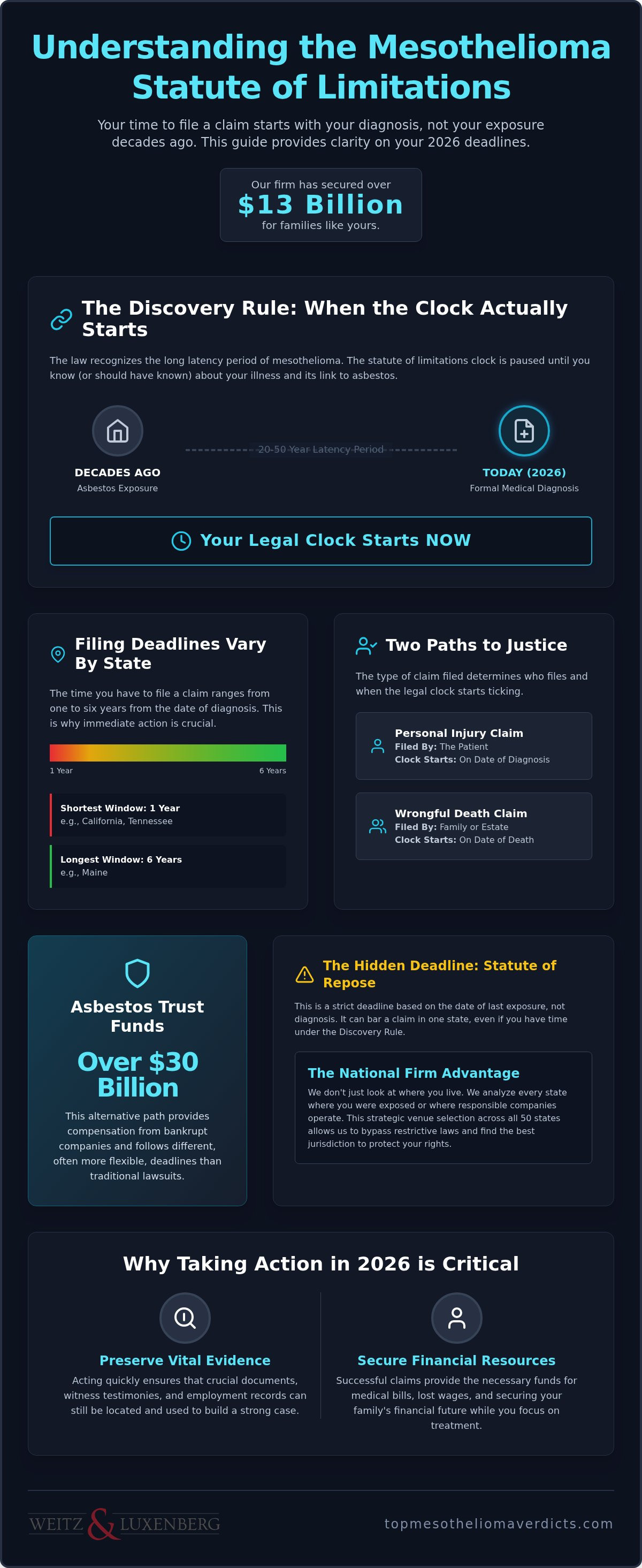
- Learn how the mesothelioma statute of limitations varies by state, typically providing a window of one to six years from the date of diagnosis to file a claim.
- Discover how the Discovery Rule protects victims of decades-old asbestos exposure by ensuring the legal clock only begins once an illness is formally identified.
- Understand why you aren't limited to filing in your home state and how strategic venue selection across all 50 states can maximize your potential recovery.
- Explore alternative paths to compensation through asbestos trust funds, which hold over $30 billion for victims and follow different deadlines than traditional lawsuits.
- Find out why taking action in 2026 is critical for preserving vital evidence and securing the financial resources necessary for your medical care.
What Is a Mesothelioma Statute of Limitations?
A statute of limitations is essentially a countdown clock. It represents the maximum time allowed by law to initiate legal proceedings after an injury occurs. In the context of asbestos exposure, these laws ensure that litigation moves forward while evidence is still attainable and witnesses can still provide reliable testimony. Without these deadlines, companies would face the threat of lawsuits indefinitely, which the legal system views as a barrier to fair trials.
Mesothelioma cases are unique because the injury doesn't happen instantly. While a typical personal injury case might involve a car accident where the damage is immediate, asbestos-related diseases have a latency period of 20 to 50 years. Because of this, the mesothelioma statute of limitations doesn't follow the same rigid rules as a standard slip-and-fall case. Special legal principles have been established to protect your right to seek justice even decades after your initial exposure.
Personal Injury vs. Wrongful Death Deadlines
The type of claim you file dictates when your clock begins. Personal injury claims are filed by the patient. In most states, the deadline for these claims is triggered by the moment of a formal medical diagnosis. You generally have between one and six years to take action, depending on the state where the claim is filed. For example, California and Tennessee have strict one-year limits, while Maine allows for a much longer six-year window.
Wrongful death claims are different. These are filed by the family or estate after a loved one has passed away. In these cases, the clock starts on the date of death, regardless of when the original diagnosis occurred. Families often find themselves balancing grief with these legal requirements, making it vital to understand the specific window available in their jurisdiction. This level of legal precision is also essential in other high-stakes areas; for instance, The Dedric Brown Law Firm focuses on the complexities of birth injury and traumatic brain injury litigation where similar statutory nuances apply.
While the statute of limitations is tied to a diagnosis, a statute of repose is a "hard" deadline based on an event, such as the date an asbestos-containing product was sold or the date of your last exposure. This law can act as a total bar to a claim, even if the statute of limitations hasn't started yet. If a state has a 10-year statute of repose and you were exposed 30 years ago, you might be prevented from filing in that specific state.
This is why a national firm's perspective is critical. We don't just look at where you live; we look at every state where you were exposed or where the responsible companies are based. Our ability to identify the best jurisdiction across all 50 states allows us to navigate these restrictive repose laws. We've used this strategic approach to secure over $13 billion for our clients, ensuring that a "hidden" deadline in one state doesn't stop you from receiving the compensation you deserve in another.
The Discovery Rule: When the Clock Actually Starts
The legal system recognizes that mesothelioma presents a unique medical challenge. Unlike a sudden injury where the cause is immediate, the damage from Asbestos Exposure and Cancer Risk remains hidden for decades. This is why the Discovery Rule is a cornerstone of asbestos litigation. It essentially pauses the mesothelioma statute of limitations until you actually know, or reasonably should have known, that you are ill and that the illness is related to asbestos. If you were exposed at a job site in the 1970s but weren't diagnosed until 2026, your legal window starts now, not fifty years ago.
What counts as "discovery" can vary, but it generally requires more than just feeling unwell. Courts typically look for a definitive link between your symptoms and your asbestos history. This might be a doctor's note, a chest X-ray showing pleural thickening, or an official pathology report. Because the stakes are high, the law doesn't expect you to be a medical expert; it only expects you to act once a professional has provided a clear diagnosis.
How a Diagnosis Triggers the Legal Clock
A formal diagnosis is usually the definitive trigger for your claim. While persistent coughing or fatigue might send you to the doctor, the legal "clock" typically starts with a biopsy report confirming the presence of mesothelioma cells. It's critical to share your full work history with your medical team immediately. The discovery rule ensures that the legal clock only begins to run once a patient reasonably knows their illness was caused by asbestos exposure, accounting for the decades-long dormancy of the disease. Clear communication with your physician helps establish a transparent medical record, which is vital for your future legal strategy.
What Happens if You Were Misdiagnosed?
Misdiagnosis is a frequent and frustrating hurdle for many families. It's common for patients to be initially told they have pneumonia, pleurisy, or standard lung cancer. If you were misdiagnosed in 2024 but didn't receive a mesothelioma confirmation until 2026, your mesothelioma statute of limitations may not have started until that later, accurate diagnosis. We use seasoned legal strategies to argue that the "discovery" of the injury only happened once the true nature of the disease was revealed.
Securing expert medical testimony is often necessary to confirm the true date of onset and to explain why the earlier diagnosis was incorrect. This ensures that a doctor's initial mistake doesn't strip you of your right to seek justice. If you're concerned about how a delayed diagnosis impacts your rights, reviewing previous successful case outcomes can provide perspective on how these complex rules are applied in real-world scenarios. We handle the heavy lifting of proving these timelines so you can focus entirely on your health.
Strategic Venue Selection: The National Firm Advantage
The state listed on your driver's license doesn't dictate your legal options. One of the most common misconceptions is that you must file your claim where you currently live. In reality, a mesothelioma statute of limitations can vary wildly from one border to the next. If the deadline has already passed in your home state, you might still have a valid path to compensation in another jurisdiction. Strategic venue selection, sometimes called forum shopping, is a vital tool we use to ensure your case isn't dismissed on a technicality.
Choosing the right venue involves analyzing three primary factors: where your asbestos exposure occurred, where the responsible companies are headquartered, and the specific laws of those states. A national firm acts as a seasoned protector, handling the complex multi-state logistics so you don't have to. We manage all travel and filings across state lines, allowing you to focus entirely on your medical care while we secure your future.
Filing Across State Lines
Most asbestos victims were exposed in multiple locations throughout their careers. You might have worked at a shipyard in Virginia, served on a military base in California, and retired in Florida. Each of these locations offers a potential venue for your claim. Some states are recognized as being more plaintiff-friendly, offering longer statutes of limitations or faster trial dates to accommodate the urgent nature of a mesothelioma diagnosis.
- Multi-state coordination: We coordinate cases across all 50 states simultaneously to find the most advantageous court.
- Military exposure: Veterans often have the flexibility to file in states where they were stationed or where the equipment manufacturers are based.
- Industrial sites: Exposure at power plants or construction sites often links back to companies with a significant presence in favorable legal jurisdictions.
The Power of a Nationwide Database
Our firm's success is built on a massive scale of operations and a history of significant achievements. We maintain a comprehensive nationwide database of historical employment records and asbestos-containing products. This allows us to link your specific exposure to manufacturers headquartered in states with favorable laws. By identifying these connections, we can often file in jurisdictions known for higher settlements and record-breaking verdicts, such as the $117 million verdict we achieved in 2025.
Ranked as the #1 filer of asbestos cases in the U.S. for the first half of 2026, we've recovered over $13 billion for our clients. This national reach means we aren't limited by local constraints. We use our established success to navigate the mesothelioma statute of limitations in every state, ensuring that the heavy lifting of the legal process is handled with polish and precision. Your location shouldn't be a barrier to justice; it should be a strategic advantage.
Alternative Paths: Trust Funds and Bankrupt Companies
There are approximately 60 active asbestos trust funds with an estimated $30 billion in assets as of 2026. These funds were established specifically to compensate victims when the responsible companies filed for bankruptcy. Crucially, these trusts operate on their own timelines. Even if you believe you've missed the mesothelioma statute of limitations in your state's court system, you may still be eligible to file a claim with a trust fund. We specialize in identifying these alternative paths to ensure no potential source of compensation is overlooked.
Trust funds serve as a vital safety net for families who might otherwise feel they've run out of time. Because these funds exist outside the traditional court system, they aren't bound by the same rigid legislative deadlines. Our team handles the heavy lifting of auditing your work history to match your exposure with the specific trusts that owe you support. This dual approach, pursuing both active litigation and trust fund claims, is how we've secured over $13 billion for our clients.
Navigating Trust Fund Deadlines
Trust funds often provide the most efficient route for securing financial support to cover immediate medical bills. Unlike the court system, which can involve lengthy discovery and trial phases, trust funds are designed for accessibility. Many trusts allow for claims even years after a diagnosis if specific criteria are met. In 2026, we utilize "Expedited Review" for many clients, which offers a fixed payment amount based on established values for a faster payout. Alternatively, "Individual Review" allows for a more detailed look at your specific case, which can result in higher compensation but takes longer to process.
Claims Against Bankrupt Manufacturers
A company filing for bankruptcy doesn't end your right to compensation. The 524(g) bankruptcy code was created to ensure that companies could reorganize while setting aside substantial assets for current and future mesothelioma victims. This legal structure protects your interests even if the manufacturer has been out of business for years. Read our Mesothelioma Litigation: 2026 Guide for Families for more on trust funds and how we navigate these specific claims.
The 524(g) provision ensures that the mesothelioma statute of limitations for a trust fund is often more flexible than for a standard lawsuit. This is especially helpful if your diagnosis came long after the company's bankruptcy was finalized. If you're ready to see how these funds can support your family, review our recent trust fund settlements to understand the potential value of your claim. We act as your seasoned protector, leading you through this complex process with a steady hand and a commitment to transparency.
Why Time Is of the Essence: Taking Action in 2026
Receiving a mesothelioma diagnosis is a life-altering event that often leaves families in a state of shock. During this difficult time, the last thing you should have to worry about is a ticking legal clock. Our firm acts as a seasoned protector, stepping in to handle the immense legal burden so you can focus entirely on your health and your loved ones. While the mesothelioma statute of limitations provides a window for action, moving forward sooner rather than later is the most effective way to secure your family's future.
As the #1 filer of asbestos cases in the U.S. for the first half of 2026, we've refined a process that prioritizes both speed and precision. We've recovered over $13 billion for victims of asbestos exposure, and that success is built on taking swift, decisive action. Starting your claim early doesn't just meet a deadline; it allows us to gather the most comprehensive evidence possible while it is still readily available.
The Risks of Delaying Your Claim
Time impacts more than just a legal filing date. As years pass, witnesses' memories can fade and the specific details of a job site from forty years ago may become harder to verify. Companies frequently change ownership, merge, or dissolve, which can complicate the process of identifying the correct legal entity to hold accountable. By initiating your case now, you ensure that vital testimony and documentation are preserved.
Our team of 500 professionals is dedicated to accelerating every aspect of the documentation process. We understand that financial protection is a primary concern for families navigating medical costs. Acting quickly helps us secure settlements faster, providing the resources needed for specialized treatments and long-term care. We work tirelessly to ensure your rights are protected regardless of the medical outcome, providing a stable foundation for your family's future.
Your Path to Justice Starts Here
Taking the first step toward a claim is often the most intimidating part of the process. We've designed our first consultation to be entirely low-pressure, offering expert guidance without any obligation. You'll speak with a professional who understands the nuances of the mesothelioma statute of limitations and can explain how it applies to your unique work history. We'll listen to your story and provide a clear, honest assessment of your options across all 50 states.
Our commitment to you is absolute: we operate on a contingency fee basis. This means there are no upfront costs and no fees unless we successfully secure a verdict or settlement for you. We're prepared to initiate a comprehensive national search for your exposure history today, using our extensive databases to link your illness to the responsible parties. You don't have to carry this weight alone; let our experience and national reach work for you.
Secure Your Future and Your Legacy
Your journey toward justice shouldn't be a solitary one. We've explored how the discovery rule protects you and why the mesothelioma statute of limitations is often more flexible than it first appears. Whether through strategic venue selection across all 50 states or by accessing the $30 billion held in asbestos trust funds, there are multiple paths to secure your family's financial stability. You don't have to navigate these complex state laws alone.
As the #1 ranked asbestos law firm filer in 2026, we've recovered over $13 billion for victims and their families. Our role is to serve as your seasoned protector, handling every legal detail with precision while you focus on your health. You have the right to hold responsible parties accountable, and we have the national reach to make it happen. Don't let uncertainty about deadlines prevent you from seeking the support you deserve.
Take the first step toward peace of mind and Request Your Free Mesothelioma Case Evaluation Now. We're here to lead you through this process with transparency, empathy, and a commitment to your success. Your story matters, and we're ready to help you write the next chapter.
Frequently Asked Questions
How long do I have to file a mesothelioma claim after my diagnosis in 2026?
You generally have between one and six years from the date of your formal diagnosis to file a claim. In many states, the window is limited to two or three years. Because these laws vary significantly across the country, it's vital to consult with a national firm that understands which state offers the most favorable timeline for your specific situation. Acting immediately ensures your rights are protected before the mesothelioma statute of limitations expires.
Can I still file a lawsuit if the asbestos exposure happened 40 years ago?
Yes, you can still file because the legal clock doesn't start until you are diagnosed with the disease. Mesothelioma has a long latency period, often taking 20 to 50 years to develop after initial exposure. The law recognizes this delay through the Discovery Rule, which pauses the deadline until the illness is identified. Your exposure in the 1970s or 1980s doesn't prevent you from seeking justice and compensation in 2026.
What happens if I miss the statute of limitations deadline in my state?
Missing the deadline in your current state doesn't necessarily mean your legal options are gone. You may be eligible to file in another state where you were exposed or where the responsible company is headquartered. Additionally, asbestos trust funds have their own unique deadlines that often extend beyond state court limits. We specialize in identifying these alternative jurisdictions to ensure you don't lose your right to financial support for medical bills.
Is the deadline different for an asbestos trust fund claim than a lawsuit?
Yes, trust fund deadlines are governed by the specific trust's bylaws rather than state laws. While a court case might have a strict two-year limit, a trust fund may allow for a longer filing period or offer extensions under certain circumstances. There are currently about 60 active trusts with $30 billion in assets. We coordinate these claims alongside litigation to maximize your recovery while navigating the distinct timelines of each entity.
If my loved one died from mesothelioma, how long do I have to file a wrongful death claim?
Families typically have one to three years from the date of their loved one's passing to initiate a wrongful death claim. This deadline is separate from the personal injury clock that would have applied during the patient's lifetime. Because these windows are short, it's important to act quickly to preserve evidence and secure your family's financial future. We handle the logistical burden during this difficult time so you can focus on your family.
Can I file a claim in a state where I no longer live but was exposed to asbestos?
You are absolutely permitted to file in a state where your exposure occurred, even if you haven't lived there in decades. In fact, filing in a different state is often a strategic advantage if that jurisdiction has more favorable laws or a longer mesothelioma statute of limitations. Our national reach allows us to evaluate all 50 states to determine the best venue for your case, regardless of where you currently reside.
Does a mesothelioma misdiagnosis change the statute of limitations clock?
A misdiagnosis can potentially delay the start of your legal clock. The statute of limitations usually begins when a patient is reasonably aware they have an asbestos-related illness. If you were initially told you had pneumonia or standard lung cancer, your discovery of mesothelioma only happens once you receive an accurate pathology report. We use expert medical testimony to argue that your deadline should reflect the date of the correct diagnosis rather than the initial error.
Will filing a lawsuit require me to travel or appear in court?
It is very rare for mesothelioma patients or their families to need to travel or appear in a courtroom. As a national firm, we handle the heavy lifting, including all travel, depositions, and multi-state filings. Most cases are settled out of court without the need for a trial. Our goal is to make the process as low-pressure as possible, ensuring you receive expert guidance and support without adding stress to your daily life.
*Published by Weitz & Luxenberg, P.C. National Headquarters: 700 Broadway, New York, NY 10003. Call 800-885-MESO. Attorney Advertising. Prior results do not guarantee a future outcome. *Certain contentions in blog posts need to be confirmed by a licensed attorney.
Disclaimer
Published by Weitz & Luxenberg, P.C. National Headquarters: 700 Broadway, New York, NY 10003. Call 800-885-MESO. Attorney Advertising. Prior results do not guarantee a future outcome. Certain contentions in blog posts need to be confirmed by a licensed attorney.


