

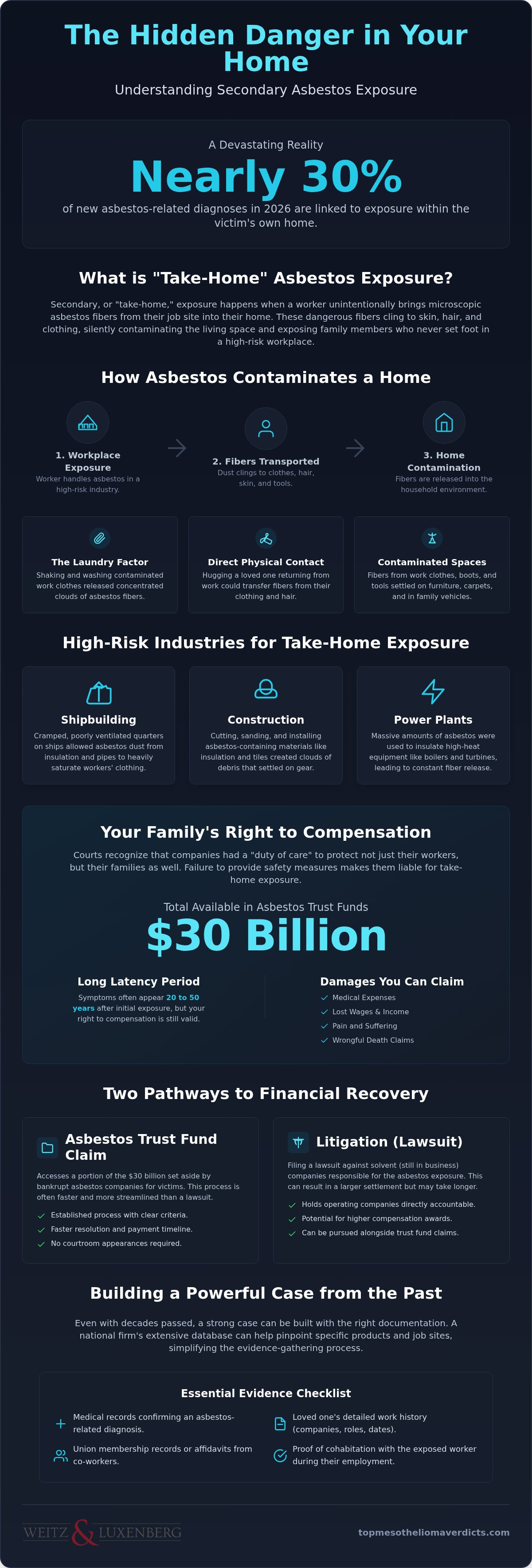
Did you know that nearly 30% of new asbestos-related diagnoses in 2026 are linked to exposure that happened right in the victim's own home? It's a devastating reality for families facing mesothelioma or lung cancer decades after a husband, father, or other loved one worked in a shipyard or factory. You might feel a deep sense of confusion about how you got sick, especially if you never stepped foot on a job site yourself. It’s natural to feel anxious about proving a case that dates back 40 years, but your family may be eligible for significant secondary asbestos exposure compensation. Your illness is a direct result of a company's failure to protect its workers and their households.
We understand the heavy financial burden of medical bills and the uncertainty of the future. This guide is designed to help you secure the financial recovery your family deserves while providing a clear path forward. You'll discover how to navigate the legal process to access a portion of the $30 billion currently available in asbestos trust funds. We'll preview the essential evidence needed to link your diagnosis to a loved one's career and show you how a national leader can handle the heavy lifting for you. Financial security is within reach, and you don't have to face this complex process alone.
Key Takeaways
- Learn how the legal system validates claims for families exposed to asbestos indirectly through a loved one's workplace.
- Identify the household activities and high-risk industries that most commonly led to dangerous "take-home" asbestos exposure.
- Explore the distinct differences between filing an asbestos trust fund claim and pursuing litigation to maximize your secondary asbestos exposure compensation.
- Uncover the specific types of documentation, such as union history and work records, needed to build a powerful case from decades ago.
- Find out how a national firm's extensive database can pinpoint the source of your exposure and simplify the path to financial recovery.
What is Secondary Asbestos Exposure and Is It Legally Valid?
Secondary asbestos exposure, often called "take-home" exposure, occurs when a person is exposed to microscopic fibers brought into the home by someone else. You didn't have to work in a shipyard or a power plant to be at risk. Instead, the danger arrived on a loved one’s work boots, skin, or hair. This indirect contact is just as dangerous as direct handling. To understand the root cause of these illnesses, one must first ask: What is Asbestos? It is a naturally occurring mineral once prized for its heat resistance, but its fibers are easily trapped in the folds of clothing and transported far from the original job site.
You might wonder if you have a valid claim if you never worked with the material yourself. The answer is a definitive yes. Modern courts across the country recognize that employers had a "duty of care" to the families of their employees. This means companies were legally responsible for preventing the spread of toxic dust beyond the factory gates. When they failed to provide on-site showers or industrial laundry services, they effectively brought the hazard into your living room. Families shouldn't have to pay the price for a corporation's negligence.
The primary victims of this oversight are often the spouses who shook out dusty work clothes before washing them and the children who rushed to hug their parents at the end of a shift. The challenge with these cases is the "latency period." Symptoms of mesothelioma or lung cancer typically don't appear until 20 to 50 years after the initial exposure. This long delay can make it difficult to connect the dots, but your right to secondary asbestos exposure compensation remains valid regardless of how much time has passed since the dust entered your home.
Common Terms: Take-Home vs. Paraoccupational Exposure
In legal and medical circles, you'll hear several names for this phenomenon. "Take-home," "indirect," and "domestic" exposure all describe the same situation and qualify for the same legal protections. Paraoccupational exposure is the scientific term for fibers transported from a workplace to a home. While "bystander exposure" usually refers to people who worked near asbestos on a job site without handling it directly, it is often related to these filings. Understanding these terms is the first step toward securing secondary asbestos exposure compensation.
The Rights of Family Members Under National Asbestos Law
If you're suffering from an asbestos-related illness due to household exposure, you're entitled to the same categories of damages as a primary worker. This includes compensation for medical expenses, lost wages, and pain and suffering. For those who have already lost a family member to these diseases, wrongful death claims provide a way to hold companies accountable and secure your family's future. A national firm has the resources to file your claim in the most favorable jurisdiction, ensuring your case is handled with the weight of a national leader behind it. While navigating these health and legal crises, families may also require guidance on broader matters such as inheritance or estate planning; for those seeking specialized expertise in Israel, משרד עורכי דין מורן גוהר offers dedicated legal representation in family and inheritance law.
How 'Take-Home' Asbestos Exposure Occurred in the Home
Asbestos fibers are microscopic, jagged, and incredibly persistent. They don't simply stay at the job site; they cling to almost any surface they touch. Workers in high-risk environments often carried these "hitchhikers" home on their skin, in their hair, and within the deep folds of their work uniforms. Because these fibers are invisible to the naked eye, families had no way of knowing their living spaces were being contaminated daily. This silent transfer is why many families are now seeking secondary asbestos exposure compensation decades after the initial contact occurred.
The risk wasn't the same for every household. Certain industrial sectors fueled the majority of take-home exposure cases due to the sheer volume of raw asbestos used. High-risk industries included:
- Shipbuilding: Cramped, poorly ventilated quarters on ships made it easy for dust to saturate clothing.
- Construction: Cutting, sanding, and installing insulation created clouds of debris that settled on gear.
- Power Plants: High-heat equipment required massive amounts of asbestos-containing thermal insulation.
The most common point of exposure in the home was the "laundry factor." Spouses often shook out dusty work clothes before placing them in the wash, unknowingly releasing millions of fibers into the air. This created a concentrated cloud of toxic dust in small, poorly ventilated laundry rooms. Additionally, the family car became a secondary hazard. Asbestos dust shed from work clothes during the commute, settling into car seats and carpets where it remained for years. Scientific research on asbestos exposure and cancer risk confirms that even these indirect levels of contact can lead to life-altering diagnoses.
The Role of Household Activities in Fiber Inhalation
Routine chores often turned dangerous. When a worker brought tools home to clean in the garage or basement, fibers were released into the living space. These fibers are resilient and don't just disappear; they become "re-entrained." This means they get kicked back into the air every time you vacuum or dust. Children were particularly vulnerable because they played on floors where this heavy dust eventually settled. If your family is facing these consequences, looking at past legal results for families can provide clarity on what's possible.
Identifying the Source: High-Risk Occupations for the Primary Worker
To build a successful claim, we look at the specific trades of the primary worker. Pipefitters, insulators, boilermakers, and brake mechanics were frequently surrounded by asbestos-containing materials. You don't need to remember the specific brand of insulation or brake lining used forty years ago. An experienced legal team uses national databases to identify the products present at specific job sites. This is vital for multi-generational homes or families who shared laundry facilities, where "invisible" exposure was a constant threat. Securing secondary asbestos exposure compensation depends on linking these specific work histories to your current health status with precision.
Compensation Options: Asbestos Trust Fund Claims vs. Litigation
Families often worry that because they didn't work directly with toxic materials, their legal options are limited. This is a common misconception. You have two primary paths to secure secondary asbestos exposure compensation, and in many cases, you can pursue both simultaneously. Currently, there is an estimated $30 billion held in active asbestos trust funds. These funds were established by companies that filed for bankruptcy to ensure future victims, including family members, would have access to financial support. Choosing the right path depends on which companies were responsible for the dust that entered your home.
The main difference between a trust fund claim and a lawsuit is the status of the company. Trust funds are for bankrupt entities, while lawsuits target solvent companies that are still in business today. Payout timelines also vary. Trust fund claims are typically processed faster, providing families with much-needed funds in a shorter window. Lawsuits take longer but often result in significantly higher verdicts or settlements. To understand the widespread use of these materials in past decades, you can Learn About Asbestos and its history through official EPA resources.
Accessing Asbestos Trust Funds as a Family Member
Asbestos trust funds were specifically designed to compensate victims who were exposed decades ago. This includes spouses and children. When we file a claim on your behalf, you'll choose between an expedited review or an individual review. An expedited review follows a set schedule for faster payment. An individual review allows us to present the specific details of your diagnosis for a potentially larger award. A significant benefit for families is that these trust claims often don't require a trial or even a formal deposition, making the process much less stressful.
Pursuing a Lawsuit for Secondary Exposure
If the company responsible for your exposure is still active, we pursue Mesothelioma Litigation to hold them accountable. This process involves a phase called "discovery." During this time, our legal team investigates which specific products the primary worker handled. We use our national database to link those products to your household. Record-breaking results, such as Weitz & Luxenberg's $117 million verdict in 2025, set a powerful precedent. These massive victories give us incredible leverage during settlement negotiations. We use every available tool to ensure you receive the full secondary asbestos exposure compensation your family deserves.
The Evidence Needed to Win a Secondary Exposure Case
Proving a connection to a workplace from decades ago might feel impossible. You shouldn't let the passage of time discourage you from seeking secondary asbestos exposure compensation. While you may not have a sample of the physical dust from 1975, the legal system relies on a combination of records, expert testimony, and family history to build a successful case. We specialize in reconstructing these timelines to show exactly how toxic fibers traveled from the job site to your home. Our team works with industrial hygienists and pathologists who can testify about the specific mechanics of fiber transport and how it led to your illness.
A significant part of our strategy involves gathering "social history" evidence. This includes testimony from you and your family members about daily routines. We look for specific memories of laundry habits, such as who shook out the work clothes or how often the primary worker hugged their children before showering. These personal details, combined with the primary worker's employment history, create a powerful narrative that links the company's negligence to your current health struggle. If you're ready to see how our experience can work for you, review our past case results to understand the scale of recovery possible for families.
Documenting the Link Between Work and Illness
To begin, we look for any paper trail that places the primary worker at a specific site during the years of exposure. Even small details can be significant in a legal filing. Helpful documents include:
- Pay stubs or W-2 forms from the relevant years.
- Union membership cards, dispatch logs, or pension records.
- Photographs of the worker in their work clothes or at the job site.
- Medical records of the secondary victim confirming a mesothelioma or lung cancer diagnosis.
Co-worker testimony is another vital tool. Often, we can locate former colleagues who remember the specific brands of insulation, gaskets, or packing materials used, even if your loved one doesn't remember the names. This testimony helps establish exactly which asbestos-containing products were present.
Overcoming Defense Arguments in Secondary Claims
Corporate attorneys often argue they couldn't have foreseen the risk to family members. This "lack of knowledge" defense is a common tactic to avoid responsibility. We counter this by presenting internal company documents and industry studies proving that the dangers of take-home dust were documented as early as the 1930s. Companies had a responsibility to warn their employees and provide safety measures like on-site showers; they simply chose not to. We also address arguments regarding "alternative causes." In cases of mesothelioma, asbestos is the only known cause, making these defense distractions easy to dismantle with a focused legal strategy.
Why a National Firm is Essential for Secondary Exposure Claims
Securing secondary asbestos exposure compensation requires more than just medical records; it demands a forensic reconstruction of a life lived decades ago. A local law firm may lack the resources to identify a specific asbestos-containing valve or gasket used on a naval ship in 1970. Weitz & Luxenberg maintains a massive national database that tracks thousands of job sites and asbestos products across all 50 states. This data is the key to proving your case. We've spent over 40 years building this archive, allowing us to connect your illness to a specific source with unwavering precision.
Choosing a national leader means your family doesn't carry the financial risk of litigation. We operate on a contingency-based model, which means you pay nothing unless we win your case. Our firm has recovered more than $13 billion in verdicts and settlements for asbestos victims and was ranked the #1 filer of asbestos cases in 2026 by the KCIC research group. This history of success isn't just a statistic. It represents our ability to handle the heavy lifting, from filing complex paperwork to negotiating with massive corporate entities, so you can focus entirely on your health and your family.
Investigative Resources of an Industry Leader
Our team includes more than 500 professionals who work tirelessly to trace the specific fibers that caused your illness. This depth of talent is why other law firms often trust Weitz & Luxenberg with their most significant cases, recognizing our "referral-grade" expertise. Because we operate nationally, we have the unique ability to file your claim in the most favorable jurisdiction. This strategy is vital for maximizing the potential secondary asbestos exposure compensation available to your family, as laws regarding take-home exposure can vary significantly from one state to another.
Starting Your Case with a Free National Evaluation
We believe that families facing a new diagnosis deserve clarity without added pressure. During your initial consultation, you'll experience an empathetic approach focused on your needs and your story. You don't need to worry about travel or logistics; our firm travels to you, meeting you in the comfort of your own home to discuss your options. This low-pressure process ensures you have the information you need to make the best decision for your family's future. Justice shouldn't be an added stressor during a difficult time.
DIAGNOSED? CALL 1-800-885-MESO TODAY FOR A CONFIDENTIAL & FREE CONSULTATION
Take the Next Step Toward Justice and Security
Facing a diagnosis of mesothelioma or lung cancer is overwhelming, but you don't have to carry the burden of corporate negligence alone. You've seen that secondary exposure is a legally recognized pathway to recovery, and the evidence needed to prove your case is within reach. Whether through accessing the $30 billion in trust funds or pursuing active litigation, your right to secondary asbestos exposure compensation is protected by decades of legal precedent. Companies had a duty to keep their workers' families safe, and we're here to hold them accountable for their failure.
Choosing a partner with the weight of a national leader makes all the difference. Weitz & Luxenberg brings 40 years of national advocacy and the distinction of being the ranked #1 asbestos firm in 2026 to your side. With over $13 billion recovered for asbestos victims, we have the proven strength to secure the financial future your family deserves. You can start this process today without any upfront costs or added stress. Secure Your Family's Future with a Free Case Evaluation. Your journey toward justice begins with a single, supportive conversation.
Frequently Asked Questions
Can children of asbestos workers file for compensation?
Yes, adult children who grew up in households where asbestos was present are eligible for secondary asbestos exposure compensation. Many children were exposed while hugging their parents or playing on floors where toxic dust settled. If you have been diagnosed with an asbestos-related illness, your legal rights are identical to those of the worker. Our firm uses employment records to establish the link between your childhood home and the materials used at your parent's job site.
What if the worker who brought home the asbestos is already deceased?
You can absolutely pursue a claim even if the primary worker is no longer alive. The legal process focuses on the source of the exposure and your medical diagnosis. We utilize extensive databases to track down employment history, union records, and coworker testimony from decades ago. This allows us to build a strong case for your family without requiring the primary worker to be present to testify about their daily routines or the products they handled.
How much is a secondary asbestos exposure settlement worth?
While every case is unique, the average payout for an asbestos claim in 2026 is over $1 million when combining settlements and trust funds. Individual trust fund payouts typically average between $300,000 and $400,000. These figures can be much higher in litigation, as seen with our firm's record $117 million verdict in 2025. Factors like the severity of your illness and the number of responsible companies will ultimately determine the total value of your recovery.
Is there a time limit for filing a secondary exposure claim?
Every state has a statute of limitations that dictates how long you have to file a claim. This window usually ranges from one to six years from the date of your diagnosis. For example, California and Alabama have a two-year limit, while New York provides three years. Because the "discovery rule" applies, the clock starts when you learn of your illness, not when the exposure occurred decades ago. Consult a lawyer early to meet these deadlines.
Do I have to go to court to get compensation for secondary exposure?
No, you do not always have to go to court to receive secondary asbestos exposure compensation. Many families secure significant funds through asbestos trust fund claims, which often don't require a trial or a deposition. Even in litigation against solvent companies, the vast majority of cases reach a settlement agreement before a trial ever begins. Our goal is to handle the complex legal work so you can focus on your medical treatment and your family. If your family is also managing other legal challenges during this difficult time, you can explore Legal representation and litigation services for immigration, criminal, and family law to find dedicated support for your diverse needs.
Can I file a claim if I have lung cancer but never smoked?
Yes, non-smokers diagnosed with lung cancer can and do file successful asbestos claims. While smoking is a common risk factor, asbestos exposure is a scientifically proven cause of lung cancer that exists independently of tobacco use. If your medical records indicate asbestos-related changes in your lungs and we can link your exposure to a family member's workplace, you have a valid legal right to seek damages from the companies that manufactured those toxic materials.
What is the difference between a mesothelioma lawsuit and a trust fund claim?
A mesothelioma lawsuit is filed against a solvent company that is still in business, whereas a trust fund claim is filed against a bankrupt company. Solvent companies often pay through settlements or jury verdicts, while trust funds use a "payment percentage" system to ensure money remains for future claimants. There are currently over 60 active trust funds with an estimated $30 billion available. Many families find they are eligible to pursue both avenues to maximize their total recovery.
How long does it take to receive a payout for secondary exposure?
The timeline for receiving a payout depends on the type of claim you file. Asbestos trust fund claims are generally the fastest option, especially if you choose an "expedited review" process. These can often result in payments within a few months. Litigation against active companies takes longer because it involves a discovery phase and negotiations, but it often leads to larger financial recoveries. We work to move every case forward as efficiently as possible for your family.
*Published by Weitz & Luxenberg, P.C. National Headquarters: 700 Broadway, New York, NY 10003. Call 800-885-MESO. Attorney Advertising. Prior results do not guarantee a future outcome. *Certain contentions in blog posts need to be confirmed by a licensed attorney.
Disclaimer
Published by Weitz & Luxenberg, P.C. National Headquarters: 700 Broadway, New York, NY 10003. Call 800-885-MESO. Attorney Advertising. Prior results do not guarantee a future outcome. Certain contentions in blog posts need to be confirmed by a licensed attorney.


