

A mesothelioma diagnosis is a life-altering event that demands more than just medical attention. It requires a strategic, multi-front defense of your physical health and your family's future. Knowing what to do after a mesothelioma diagnosis is the difference between feeling overwhelmed by a complex system and taking command of your recovery and legal rights. You're likely facing a storm of questions about where to find the best care, how to manage medical costs, and where this exposure even began decades ago. You deserve clarity. It's an immense burden, but you don't have to carry it alone.
This 2026 guide provides a clear, actionable roadmap to secure the top-tier medical specialists you need and the financial stability your family deserves. We'll walk you through the critical steps of identifying asbestos exposure sources and accessing the $30 billion currently held in asbestos trust funds without the stress of upfront legal costs. From understanding the latest NCCN clinical guidelines to managing the legal timeline, we're here to help you move forward with confidence. You deserve a seasoned protector to handle the heavy lifting while you focus on your health.
Key Takeaways
- Learn why confirming your specific mesothelioma cell type at an NCI-designated cancer center is the first step toward a personalized 2026 treatment plan.
- Discover how to conduct an asbestos exposure audit to pinpoint high-risk job sites from decades ago, which serves as the essential evidence for your claim.
- Understand exactly what to do after a mesothelioma diagnosis to access more than $30 billion in asbestos trust funds, often without ever stepping foot in a courtroom.
- Explore how to expedite financial support through VA benefits and Social Security Compassionate Allowances to protect your family's immediate stability.
- Find out how a national leader with over 40 years of experience handles the heavy lifting of litigation on a contingency basis, ensuring no upfront costs for your family.
Immediate Medical Priorities Following Your Diagnosis
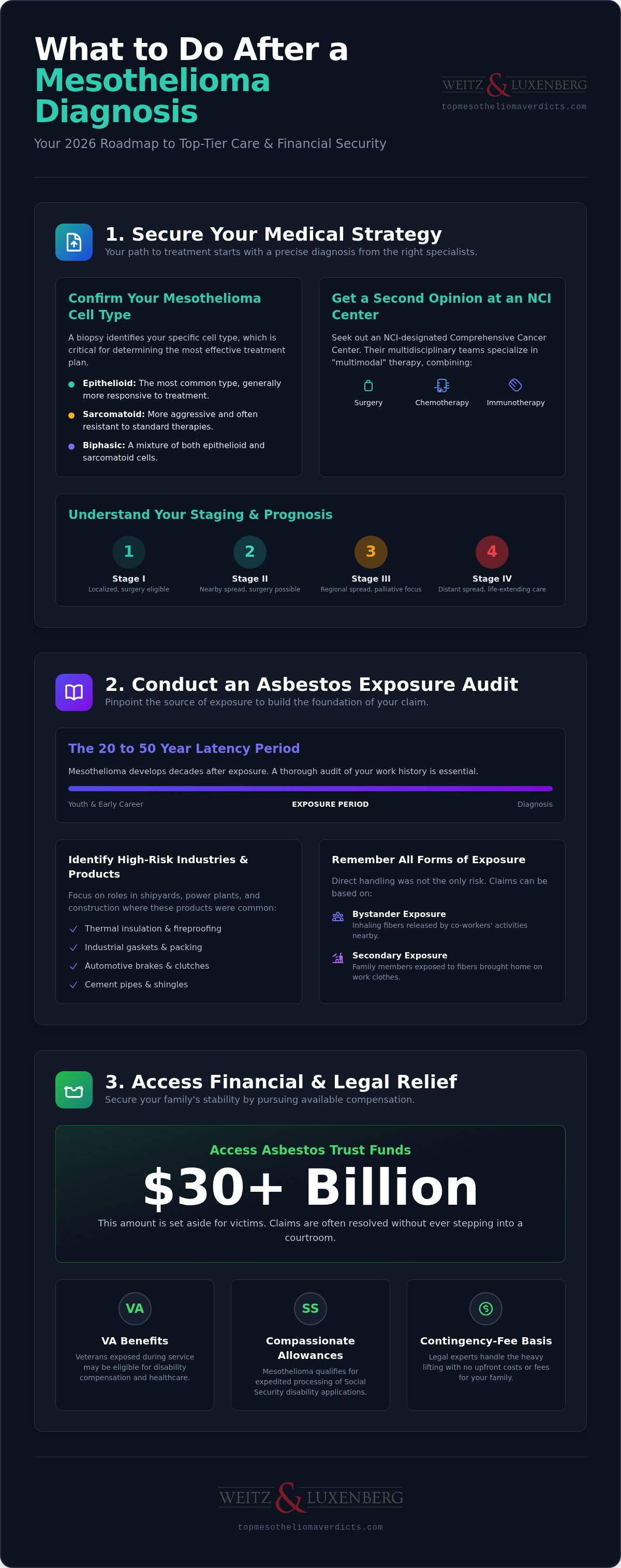
Determining exactly what to do after a mesothelioma diagnosis begins with securing a precise medical profile. Your treatment path depends entirely on your cell type, which is identified through a biopsy. Epithelioid cells are the most common and generally respond better to treatment, while sarcomatoid cells are more aggressive and resistant to standard therapies. Biphasic mesothelioma contains a mix of both. For a foundational look at the disease's pathology, Understanding Mesothelioma can help clarify why these cell types behave so differently.
You shouldn't rely solely on a general oncologist. Mesothelioma is rare, and most local doctors see only a handful of cases in their entire careers. It's vital to seek a second opinion from an NCI-designated Comprehensive Cancer Center. These institutions house multidisciplinary teams that specialize in "multimodal" therapy, a strategy that combines surgery, chemotherapy, and advanced immunotherapy. According to the NCCN Clinical Practice Guidelines version 3.2026, immunotherapy combinations like nivolumab and ipilimumab are now the preferred first-line approach for non-epithelioid cases.
Clinical trials are another essential pillar of your care. In 2026, emerging therapies involving gene therapy and personalized vaccines are showing promise in extending survival rates. Knowing what to do after a mesothelioma diagnosis means looking beyond standard care to find these emerging opportunities. Your medical team should actively screen you for trials that match your specific biomarkers and staging.
Finding a Mesothelioma Specialist
General oncologists often lack the high-volume experience required to distinguish between subtle cellular variations. Use the National Cancer Institute (NCI) database to locate specialists who focus exclusively on thoracic or abdominal cancers. During your first consultation, you're the one in charge. Don't hesitate to ask direct questions to gauge their expertise:
- How many mesothelioma patients do you treat every year?
- Do you have a dedicated multidisciplinary team for asbestos-related cancers?
- What specific 2026 clinical trials are currently open for my cell type?
Understanding Your Staging and Prognosis
Pleural mesothelioma affects the lining of the lungs, while peritoneal mesothelioma originates in the lining of the abdominal cavity. Your stage, ranging from 1 to 4, determines your eligibility for aggressive surgical options. Stage 1 and 2 diagnoses often allow for tumor-removing surgeries, whereas Stage 3 and 4 focus more on palliative care and life-extending immunotherapy.
Your prognosis isn't just a number; it's a starting point for a strategy. While cell type and staging significantly impact life expectancy, the rapid advancement of 2026 medical protocols means more patients are outliving traditional timelines. A specialist can help you interpret these stages through the lens of the latest medical breakthroughs rather than outdated statistics.
Organizing Your History: The Asbestos Exposure Audit
Because mesothelioma has a latency period of 20 to 50 years, your most recent employment is rarely the source of the problem. A vital step in what to do after a mesothelioma diagnosis is looking back at every job you held since your youth. This "exposure audit" is the foundation of any future financial recovery. You'll need to reconstruct a timeline that includes every job site, the specific years you worked there, and the exact tasks you performed daily.
It isn't enough to simply name a company. You must identify specific asbestos-containing products you handled or worked near. This includes everything from thermal insulation and fireproofing spray to industrial gaskets, packing materials, and automotive brakes. Even if you weren't the one using the product, "bystander exposure" from a co-worker ten feet away was often enough to cause harm. We also look for "secondary exposure" cases. This happened when workers brought fibers home on their hair or clothing, inadvertently exposing family members who handled the laundry.
Documenting Your Occupational Journey
Memories fade, so you need objective proof. Start by requesting your complete work history from the Social Security Administration. Union dispatch records, old pay stubs, and even holiday photos from the job site can serve as powerful evidence. High-risk industries such as shipyards, power plants, steel mills, and commercial construction sites are well-documented for their heavy asbestos use. If you can, reach out to former co-workers. Their testimony can confirm that asbestos was present on a job site even if the company's own records have "disappeared" over the last four decades.
Medical Record Management
While you and your family research Mesothelioma Treatment Options, you must also become a meticulous archivist. Request physical copies of your pathology reports and imaging discs, including CT and PET scans, from every facility you visit. don't rely on digital portals alone; they can be difficult to share between different specialists or legal experts.
Start a daily journal to track your symptoms, treatment side effects, and the impact the illness has on your quality of life. This record is invaluable for both your medical team and for proving the extent of your damages later. Appointing a trusted family member as your "Health Advocate" can relieve you of the paperwork burden, allowing you to focus on your care. Properly organizing this history is a key part of what to do after a mesothelioma diagnosis to ensure you are prepared for the road ahead. Finding a partner who understands how to turn these memories into a strong case is essential, and you can learn more by viewing significant asbestos case results.
Understanding Your Legal Options and Financial Relief
While you prioritize the medical steps outlined in the National Cancer Institute's Mesothelioma Guide, you must also protect your family's financial future. A critical part of knowing what to do after a mesothelioma diagnosis is understanding that the legal system provides specific pathways for compensation. You don't necessarily have to set foot in a courtroom to receive help. Many families secure significant funding through administrative claims that never involve a judge or a jury.
The clock is already ticking on these opportunities. Most states follow the "discovery rule," which means your legal deadline starts the day you receive your diagnosis, not the decades ago when you were exposed. These statutes of limitations are strict and vary by state, typically ranging from one to three years as of June 2026. Delaying this step can permanently bar you from accessing the funds you deserve. A national law firm acts as a formidable ally, identifying every potential source of recovery from the manufacturers of asbestos products to the job sites where you worked.
Asbestos Trust Funds: Immediate Financial Support
Over $30 billion has been set aside in asbestos trust funds. These were created by companies that filed for bankruptcy to ensure they could still pay future victims. Filing a trust fund claim is an administrative process rather than a traditional lawsuit. In 2026, these funds remain a primary source of relief, often providing payouts much faster than litigation. This allows you to cover the high costs of specialized cancer care without waiting years for a resolution.
Mesothelioma Litigation: Seeking Full Justice
When the companies responsible for your exposure are still solvent and in business, a lawsuit may be necessary to hold them fully accountable. Your legal team handles the heavy lifting of the "discovery" process, where they gather the evidence needed to prove your case without taxing your energy. This is where the "no-stress" model is vital. Professional firms operate on a contingency basis, meaning there are no upfront costs or hourly fees. You only pay if the firm wins a settlement or verdict for you, ensuring your family's current stability is never at risk while you pursue justice. Knowing what to do after a mesothelioma diagnosis includes choosing a partner who manages these complexities so you can focus on your health.
Administrative and Family Protection Steps
Beyond the legal battle for compensation, ensuring your family's estate is in order is a vital step; Massingill Attorneys & Counselors at Law provides the probate and business law expertise to help you build a secure foundation.
Managing the administrative burden is a crucial part of what to do after a mesothelioma diagnosis. While medical care is your first priority, securing your household's financial stability requires immediate action. The Social Security Administration classifies mesothelioma as a "Compassionate Allowance" condition. This designation expedites the approval of Social Security Disability Insurance (SSDI) benefits, often reducing the wait time from months to just weeks. In 2026, the maximum monthly SSDI benefit has reached $4,152, providing a vital safety net for families facing sudden loss of income. Ensuring your home remains a safe and healthy environment is another practical priority; Mosquito Assassin Pest Control LLC offers comprehensive pest management solutions to help families protect their property and focus on recovery.
Beyond immediate disability payments, you must look at long-term legal protections. Establishing a durable Power of Attorney allows a trusted family member to manage your medical and financial decisions if you become unable to do so. It's also the right time to update your estate plans; you can read more about how Flex Legal, PLLC helps families navigate these essential legal preparations. Ensuring that your spouse and children are protected through "Wrongful Death" provisions in your legal strategy is an act of foresight that provides peace of mind. These steps aren't about admitting defeat; they're about building a fortress around your family's future. For New York residents who may also be navigating the aftermath of an accident or other personal injury, Yakov Mushiyev & Associates, P.C. offers the specialized legal support needed to protect your rights and recovery. Veterans are disproportionately affected by asbestos diseases due to the heavy use of the mineral in Navy shipyards and military installations throughout the 20th century. Under the PACT Act, mesothelioma is now a presumptive condition for veterans exposed to toxic substances. This means the VA assumes your illness is service-connected, significantly simplifying the claims process. For a single veteran with a 100% disability rating, the 2026 monthly compensation is $3,938.58. If you're married, that rate increases to $4,158.17. For veterans who prefer working with a dedicated advocacy firm to navigate the VA's specific requirements, Military Veteran Solutions, LLC provides expert guidance to ensure all entitled benefits are secured. Many veterans also qualify for the VA Aid and Attendance benefit, which can provide up to $2,874 per month for a married veteran to help cover the costs of in-home care. It's vital to remember that filing for VA benefits is an entirely separate process from taking legal action. You can receive your full VA monthly compensation while simultaneously pursuing mesothelioma litigation against the private corporations that supplied asbestos to the military. We handle the complexities of these filings so you can focus on your health and your family.
Financial Planning for the Long Term
As part of this long-term protection, ensuring that your estate and trusts are properly managed is essential. The Law Offices of Robert P. Bergman offers specialized support in trust administration and probate to help families navigate these complex legal requirements during a difficult time.
The out-of-pocket costs of cancer care, including travel to NCI-designated centers and specialized home health aides, can accumulate rapidly. A comprehensive financial strategy involves more than just paying the next bill. It requires structuring legal settlements to provide a lifetime of support. By knowing what to do after a mesothelioma diagnosis, you can ensure that your legal recovery is integrated into your broader financial plan. Our team of professionals acts as your guide, leading you through this complex process with a steady hand and a commitment to transparency. To see how we've helped other families secure their futures, you can review our record of asbestos settlements and verdicts.
How Weitz & Luxenberg Guides Families Through the Process
Once you have addressed the medical and administrative priorities, the most critical part of what to do after a mesothelioma diagnosis is choosing a legal partner who understands the magnitude of your situation. Weitz & Luxenberg is a national leader in asbestos litigation with over 40 years of experience. We act as a formidable ally, taking the weight of the legal process off your shoulders so you can focus entirely on your health. With a team of 500+ professionals, we handle every granular detail, from investigating 50-year-old work sites to filing complex claims in the most advantageous jurisdictions.
Our firm's reach extends across all 50 states, which is a significant advantage for families. Because asbestos exposure often happened decades ago in a different state than where you live now, we have the resources to file your case where the law is most favorable to you. This national scale, combined with our deep local connections, has allowed us to secure over $13 billion in total verdicts and settlements for our clients. This includes a landmark $117 million verdict in 2025, which stands as the largest single-plaintiff asbestos verdict in New York history.
Our Low-Pressure, High-Result Approach
We believe that seeking justice shouldn't add to your stress. Our initial "Free Case Review" is a low-pressure conversation where we listen to your story and explain your options with total transparency. To make the process as easy as possible, our attorneys often visit clients at home or in the hospital. You don't need to worry about travel or logistics. We operate on a contingency basis, ensuring there are no upfront costs for your family. You only pay if we win, which aligns our success directly with yours.
A History of Record-Breaking Verdicts
In early 2026, Weitz & Luxenberg was ranked as the #1 filer of asbestos cases. This volume isn't just a number; it represents a massive scale of operations that allows us to out-prepare any corporate defendant. We have the internal databases, expert witnesses, and historical records needed to prove exposure when other firms might struggle. We lead you through this complex process with a steady hand and a clear sense of purpose. If you are ready to take the next step in what to do after a mesothelioma diagnosis, contact Weitz & Luxenberg for a free, no-obligation consultation today.
Protect Your Health and Your Family’s Legacy
You now have a clear roadmap for the medical and financial challenges ahead. Securing a second opinion from an NCI-designated specialist and auditing your employment history are the first essential pillars of your defense. By accessing administrative benefits like SSDI and VA compensation, you can find immediate stability while a dedicated legal team pursues long-term justice. Knowing what to do after a mesothelioma diagnosis is a heavy burden, but you don't have to carry it alone.
Our firm brings over 40 years of legal advocacy and a proven history of recovering more than $13 billion for asbestos victims. We handle the complexities of litigation and trust fund claims on a contingency basis; there are no fees unless we win your case. Let us be your formidable ally so you can focus entirely on your recovery and your loved ones. We are ready to lead you through this process with a steady hand and total transparency.
Secure Your Family's Future with a Free Mesothelioma Case Review
You have the strength to face this journey, and with the right experts by your side, you can move forward with unwavering confidence.
Frequently Asked Questions
How long do I have to file a claim after a mesothelioma diagnosis?
State laws, known as statutes of limitations, dictate your timeline. Most states as of 2026 require you to file within two to three years of your diagnosis. This is the "discovery rule," which means the clock starts when you learn of your illness, not when you were exposed. Because these deadlines are final, deciding what to do after a mesothelioma diagnosis should involve a quick legal review to protect your family's future rights.
Can I still get compensation if the company that exposed me is out of business?
Yes, you can still seek compensation even if the company that exposed you no longer exists. Many bankrupt corporations were legally required to establish asbestos trust funds to pay future victims. There is currently more than $30 billion allocated across these various trusts. These funds exist specifically to provide financial relief to patients and families without the need for the original company to be operational or solvent today.
Do I have to go to court to get a mesothelioma settlement?
Most mesothelioma cases are resolved without the patient ever having to step foot in a courtroom. Legal teams often secure settlements through out-of-court negotiations or by filing administrative claims with asbestos trust funds. These processes are designed to be low-stress for the family. While a trial is always a possibility if a fair settlement isn't reached, it's a relatively rare occurrence in modern asbestos litigation.
What is the average payout for a mesothelioma trust fund claim?
Payout amounts vary significantly based on the specific trust's payment percentage and the severity of the illness. While over $30 billion is available in total, each trust has its own set of criteria for distribution. Factors like your work history, the specific products you handled, and your medical staging all influence the final value. A professional firm uses its deep database of historical records to maximize the value of these administrative claims.
Will filing a lawsuit affect my VA benefits?
Filing a legal claim or lawsuit won't negatively impact your VA disability benefits or monthly compensation. VA benefits are a government entitlement earned through your service, while legal claims are filed against the private corporations that manufactured the asbestos products. You can receive your full 2026 VA monthly rate of $3,938.58 or more while simultaneously pursuing a settlement from the companies responsible for your toxic exposure.
What happens to a mesothelioma claim if the patient passes away during the process?
If a patient passes away before their case is resolved, the legal action typically continues as a wrongful death claim. The patient's estate or surviving family members, such as a spouse or children, take over the proceedings. This ensures the family still receives the financial support intended to cover medical debts and provide future stability. It's a vital step in what to do after a mesothelioma diagnosis to ensure your legal documents are in order; the Northeast Legal Team provides the specialized estate planning services necessary to protect your family's future.
Hiring a specialized asbestos lawyer involves no upfront or out-of-pocket costs for your family. Professional firms operate on a contingency fee basis, which means they only receive a percentage of the final settlement or verdict if they win your case. If the firm doesn't secure compensation for you, you owe nothing. This model allows families to access top-tier legal protection without risking their current financial stability during a difficult time.
Can family members file a claim for secondary asbestos exposure?
Family members can and do file successful claims for secondary asbestos exposure. This occurs when a worker unknowingly brought asbestos fibers home on their hair, skin, or work clothes, exposing others in the household. Spouses who laundered these clothes or children who hugged their parents after work are often eligible for compensation. These "take-home" exposure cases are handled with the same level of care and professional rigor as direct occupational claims.
*Published by Weitz & Luxenberg, P.C. National Headquarters: 700 Broadway, New York, NY 10003. Call 800-885-MESO. Attorney Advertising. Prior results do not guarantee a future outcome. *Certain contentions in blog posts need to be confirmed by a licensed attorney.
Disclaimer
Published by Weitz & Luxenberg, P.C. National Headquarters: 700 Broadway, New York, NY 10003. Call 800-885-MESO. Attorney Advertising. Prior results do not guarantee a future outcome. Certain contentions in blog posts need to be confirmed by a licensed attorney.


